

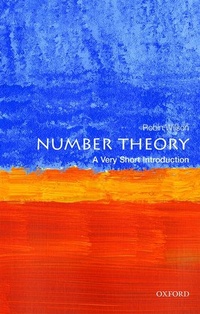
Number Theory
A Very Short Introduction
Published on 28. May 2020
Book
Paperback/Softback
176 pages
978-0-19-879809-5 (ISBN)
Description
Number theory is the branch of mathematics that is primarily concerned with the counting numbers. Of particular importance are the prime numbers, the 'building blocks' of our number system. The subject is an old one, dating back over two millennia to the ancient Greeks, and for many years has been studied for its intrinsic beauty and elegance, not least because several of its challenges are so easy to state that everyone can understand them, and yet no-one has ever been able to resolve them.
But number theory has also recently become of great practical importance - in the area of cryptography, where the security of your credit card, and indeed of the nation's defence, depends on a result concerning prime numbers that dates back to the 18th century. Recent years have witnessed other spectacular developments, such as Andrew Wiles's proof of 'Fermat's last theorem' (unproved for over 250 years) and some exciting work on prime numbers. In this Very Short Introduction Robin Wilson introduces the main areas of classical number theory, both ancient and modern. Drawing on the work of many of the greatest mathematicians of the past, such as Euclid, Fermat, Euler, and Gauss, he situates some of the most interesting and creative problems in the area in their historical context.
ABOUT THE SERIES:
The Very Short Introductions series from Oxford University Press contains hundreds of titles in almost every subject area. These pocket-sized books are the perfect way to get ahead in a new subject quickly. Our expert authors combine facts, analysis, perspective, new ideas, and enthusiasm to make interesting and challenging topics highly readable.
But number theory has also recently become of great practical importance - in the area of cryptography, where the security of your credit card, and indeed of the nation's defence, depends on a result concerning prime numbers that dates back to the 18th century. Recent years have witnessed other spectacular developments, such as Andrew Wiles's proof of 'Fermat's last theorem' (unproved for over 250 years) and some exciting work on prime numbers. In this Very Short Introduction Robin Wilson introduces the main areas of classical number theory, both ancient and modern. Drawing on the work of many of the greatest mathematicians of the past, such as Euclid, Fermat, Euler, and Gauss, he situates some of the most interesting and creative problems in the area in their historical context.
ABOUT THE SERIES:
The Very Short Introductions series from Oxford University Press contains hundreds of titles in almost every subject area. These pocket-sized books are the perfect way to get ahead in a new subject quickly. Our expert authors combine facts, analysis, perspective, new ideas, and enthusiasm to make interesting and challenging topics highly readable.
More details
Series
Language
English
Place of publication
Oxford
United Kingdom
Target group
Adult education
Product notice
Paperback (trade)
Illustrations
35 black and white illustrations
Dimensions
Height: 174 mm
Width: 114 mm
Thickness: 12 mm
Weight
128 gr
ISBN-13
978-0-19-879809-5 (9780198798095)
Copyright in bibliographic data and cover images is held by Nielsen Book Services Limited or by the publishers or by their respective licensors: all rights reserved.
Schweitzer Classification
Other editions
Additional editions
E-Book
05/2020
1st Edition
OUP eBook
€9.49
Available for download
E-Book
05/2020
1st Edition
OUP eBook
€9.49
Available for download
Person
Robin Wilson received his Ph.D degree from the University of Pennsylvania for a thesis on number theory. He is an Emeritus Professor of Pure Mathematics at the Open University, Emeritus Professor of Geometry at Gresham College, London, and a former Fellow of Keble College, Oxford University. He is also a Visiting Professor at the LSE. A former President of the British Society for the History of Mathematics, he has written and edited over 40 books on the subject, including Lewis Carroll in Numberland (Penguin, 2008), Four Colours Suffice (Princeton University Press, 2009), Combinatorics: A Very Short Introduction (OUP, 2016), and Euler's Pioneering Equation (OUP, 2018). He has been awarded the Mathematical Association of America's Lester Ford award and Polya prize for his 'outstanding expository writing', and the Stanton Medal for outreach activities in combinatorics by the Institute of Combinatorics and its Applications. He has Erdos Number 1.
Content
List of illustrations
List of tables
1: What is number theory?
2: Divisibility
3: Primes I
4: Congruences I
5: Diophantine equations
6: Congruences II
7: Primes II
8: The Riemann hypothesis
Appendix
Further reading
Index
List of tables
1: What is number theory?
2: Divisibility
3: Primes I
4: Congruences I
5: Diophantine equations
6: Congruences II
7: Primes II
8: The Riemann hypothesis
Appendix
Further reading
Index