

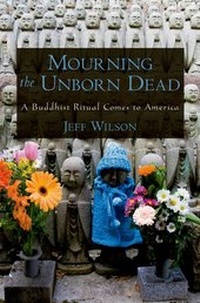
Mourning the Unborn Dead
A Buddhist Ritual Comes to America
Published on 9. April 2009
Book
Hardback
272 pages
978-0-19-537193-2 (ISBN)
Description
Many Western visitors to Japan have been struck by the numerous cemeteries for aborted fetuses, which are characterized by throngs of images of the Bodhisattva Jizo, usually dressed in red baby aprons or other baby garments, and each dedicated to an individual fetus. Abortion is common in Japan and as a consequence one of the frequently performed rituals in Japanese Buddhism is mizuko-kuyo, a ceremony for aborted and miscarried fetuses. Over the past forty years, mizuko-kuyo has gradually come to America, where it has been appropriated by non-Buddhists as well as Buddhist practitioners.
In this book, Jeff Wilson examines how and why Americans of different backgrounds have brought knowledge and performance of this Japanese ceremony to the United States. Drawing on his own extensive fieldwork in Japan and the U.S., as well as the literature in both Japanese and English, Wilson shows that the meaning and purpose of the ritual have changed greatly in the American context. In Japan, mizuko-kuyo is performed to placate the potentially dangerous spirit of the angry fetus. In America, however, it has come to be seen as a way for the mother to mourn and receive solace for her loss. Many American women who learn about mizuko-kuyo are struck by the lack of such a ceremony and see it as filling a very important need. Ceremonies are now performed even for losses that took place many years ago. Wilson's well-written study not only contributes to the growing literature on American Buddhism, but sheds light on a range of significant issues in Buddhist studies, interreligious contact, women's studies, and even bioethics.
In this book, Jeff Wilson examines how and why Americans of different backgrounds have brought knowledge and performance of this Japanese ceremony to the United States. Drawing on his own extensive fieldwork in Japan and the U.S., as well as the literature in both Japanese and English, Wilson shows that the meaning and purpose of the ritual have changed greatly in the American context. In Japan, mizuko-kuyo is performed to placate the potentially dangerous spirit of the angry fetus. In America, however, it has come to be seen as a way for the mother to mourn and receive solace for her loss. Many American women who learn about mizuko-kuyo are struck by the lack of such a ceremony and see it as filling a very important need. Ceremonies are now performed even for losses that took place many years ago. Wilson's well-written study not only contributes to the growing literature on American Buddhism, but sheds light on a range of significant issues in Buddhist studies, interreligious contact, women's studies, and even bioethics.
Reviews / Votes
A fascinating portrait of contemporary American Zen viewed through an unlikely lens: the Americanization of the mizuko kuyo ritual, which is a funeral of sorts for aborted and miscarried fetuses. * Buddhadharma *More details
Language
English
Place of publication
New York
United States
Illustrations
24 halftones
Dimensions
Height: 155 mm
Width: 236 mm
Thickness: 25 mm
Weight
524 gr
ISBN-13
978-0-19-537193-2 (9780195371932)
Copyright in bibliographic data and cover images is held by Nielsen Book Services Limited or by the publishers or by their respective licensors: all rights reserved.
Schweitzer Classification
Other editions
Additional editions
E-Book
01/2009
1st Edition
OUP eBook
€24.99
Available for download
E-Book
01/2009
1st Edition
OUP eBook
€31.49
Available for download
Person
Jeff Wilson is Professor of Religious Studies, Renison College, University of Waterloo. He is also the founding chair of the Buddhism in the West program unit at the American Academy of Religion and a consulting editor for Tricycle: The Buddhist Review, the largest English-language Buddhist magazine.