

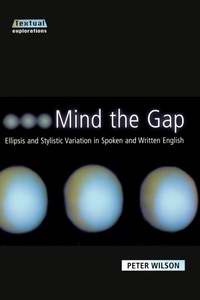
Mind The Gap
Ellipsis and Stylistic Variation in Spoken and Written English
1st Edition
Published on 16. May 2000
Book
Paperback/Softback
252 pages
978-0-582-35679-5 (ISBN)
Description
We rarely speak or even write in the complete sentences that are often held to be the ideal form of linguistic communication. Language is, in fact, full of gaps, because speakers and writers operate in contexts which allow bits of language to be understood rather than expressed. This book systematically analyses this inherent gappiness of language, known as ellipsis, and provides an account of the different contexts, both linguistic and situational, which affect its use. Peter Wilson draws on a wide variety of examples of spoken and written English, and both literary and non-literary to present a comprehensive classification of elliptical language that ranges from the conversational fragment and the advertisement to the dialogue of Shakespeare and imagist poetry. Mind the Gap shows how ellipsis is a feature of major structural and stylistic importance to our understanding of spoken and written language, and will be of interest to undergraduate students of linguistics, literature, communication and the interrelations between them..
More details
Series
Language
English
Place of publication
London
United Kingdom
Publishing group
Taylor & Francis Ltd
Target group
Professional and scholarly
Dimensions
Height: 234 mm
Width: 156 mm
Thickness: 14 mm
Weight
389 gr
ISBN-13
978-0-582-35679-5 (9780582356795)
Copyright in bibliographic data and cover images is held by Nielsen Book Services Limited or by the publishers or by their respective licensors: all rights reserved.
Schweitzer Classification
Other editions
Additional editions
Book
01/2017
1st Edition
Routledge
€206.40
Shipment within 10-20 days
E-Book
06/2014
1st Edition
Routledge
€78.99
Available for download
E-Book
06/2014
1st Edition
Routledge
€78.99
Available for download
Person
Wilson, Peter
Content
Introduction
PART I: THE FORMS OF ELLIPSIS
1. What is ellipsis?
2. What isn't ellipsis
3. The linguistic context
4. The situational context
5. Telegraphic Ellipsis
6. Coordination Reduction
7. The rough guide to gaps
PART II: THE STYLISTIC EFFECTS OF ELLIPSIS
8. Style and stylistics
9. Speech styles and ellipsis
10. Sports Commentary
11. Dramatizing Dialogue
12. The conative turn
13. Narrative voices, narrative gaps
14. Ellipsis and compression in poetry
15. Conclusion
Bibliography
PART I: THE FORMS OF ELLIPSIS
1. What is ellipsis?
2. What isn't ellipsis
3. The linguistic context
4. The situational context
5. Telegraphic Ellipsis
6. Coordination Reduction
7. The rough guide to gaps
PART II: THE STYLISTIC EFFECTS OF ELLIPSIS
8. Style and stylistics
9. Speech styles and ellipsis
10. Sports Commentary
11. Dramatizing Dialogue
12. The conative turn
13. Narrative voices, narrative gaps
14. Ellipsis and compression in poetry
15. Conclusion
Bibliography