

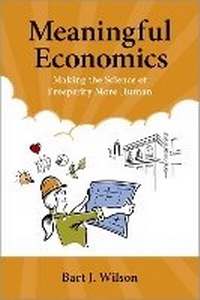
Meaningful Economics
Making the Science of Prosperity More Human
Published on 23. April 2025
Book
Paperback/Softback
262 pages
978-0-19-775815-1 (ISBN)
Description
Economics has a problem--the discipline cannot distinguish the causes of human action from the consequences of human action. Economists deal with matters of fact, not with feelings and morals. They model representations of optimal agents, not flesh-and-blood human beings in ordinary life. By assuming that incentives and self-interest are sufficient to explain economic activity, economic science proceeds as if the human mind does not matter. But the origins of our actions--ideas--do indeed matter. They make us human.
In Meaningful Economics, Bart J. Wilson challenges economics to directly engage human beings as we really are, not as economists ideally assume. Wilson argues that economic science is as much about purposes and human values as it is about incentives. Moreover, he shows how the outcomes of our decisions (costs and benefits) and the origins of our decisions (motives and goals) can be understood in an integrated way.
Over the course of the book, Wilson develops a framework that connects the origins of human action to the outcomes of human action, explaining human conduct with causes and effects. He then shows how three basic principles of economics--trade, specialization, and property--require meaning, values, and purpose. With a fresh perspective and a novel theoretical framework that bridges economics and ethics, Meaningful Economics explains the roots of human conduct and its economic effects by grounding a science of economics in the moral sentiments that prompt human beings to act.
In Meaningful Economics, Bart J. Wilson challenges economics to directly engage human beings as we really are, not as economists ideally assume. Wilson argues that economic science is as much about purposes and human values as it is about incentives. Moreover, he shows how the outcomes of our decisions (costs and benefits) and the origins of our decisions (motives and goals) can be understood in an integrated way.
Over the course of the book, Wilson develops a framework that connects the origins of human action to the outcomes of human action, explaining human conduct with causes and effects. He then shows how three basic principles of economics--trade, specialization, and property--require meaning, values, and purpose. With a fresh perspective and a novel theoretical framework that bridges economics and ethics, Meaningful Economics explains the roots of human conduct and its economic effects by grounding a science of economics in the moral sentiments that prompt human beings to act.
More details
Language
English
Place of publication
New York
United States
Target group
Professional and scholarly
Product notice
Paperback (trade)
Unsewn / adhesive bound
Dimensions
Height: 230 mm
Width: 158 mm
Thickness: 22 mm
Weight
298 gr
ISBN-13
978-0-19-775815-1 (9780197758151)
Copyright in bibliographic data and cover images is held by Nielsen Book Services Limited or by the publishers or by their respective licensors: all rights reserved.
Schweitzer Classification
Other editions
Additional editions

Book
12/2024
Oxford University Press Inc
€79.36
Shipment within 15-20 days
E-Book
12/2024
OUP eBook
€24.99
Available for download
E-Book
12/2024
OUP eBook
€24.99
Available for download
Person
Bart J. Wilson is Professor of Economics and Law and Donald P. Kennedy Endowed Chair in Economics and Law at Chapman University. He is the author of The Property Species: Mine, Yours, and the Human and co-author (with Vernon Smith) of Humanomics: Moral Sentiments and Wealth of Nations for the Twenty-First Century. He has also published widely in economics and general science journals, including the American Economic Review, Proceedings of the National Academy of Sciences, Scientific Reports, and Nature Human Behaviour.
Content
Acknowledgements
Exordium
Prologue
Part I. Economics Has a Problem
1. Scarcity Isn't Fundamental; The Human Mind Is
2. Economics Needs Moral Sentiments
3. And to Distinguish Cause and Effect in Meaningful Human Action
4. With Universal Patterns of Human History
5. And With Human Customs and Practices
Part II. A Framework for Studying the Origins and Outcomes of Human Conduct
6. Human Conduct Is a Challenge to Study
7. Because There Are Four Ways to Explain Why We Do What We Do
8. The Mind Creates Human Customs
Part III. Why Do Human Beings . . .
9. Why Do Human Beings Have the Custom of Property?
10. Why Do Human Beings Truck, Barter, and Exchange One Thing for Another?
11. Why Do Human Beings Divide Their Labor?
Part IV. The Mind Is the Answer to Old and New Questions
12. Property Rights Aren't Primary; Ideas Are
13. Preferences Do Not Explain Norms; Ideas Do
14. Materials Alone Can't Enrich Us; Ideas Plus Materials Can
Author's Note
References
Exordium
Prologue
Part I. Economics Has a Problem
1. Scarcity Isn't Fundamental; The Human Mind Is
2. Economics Needs Moral Sentiments
3. And to Distinguish Cause and Effect in Meaningful Human Action
4. With Universal Patterns of Human History
5. And With Human Customs and Practices
Part II. A Framework for Studying the Origins and Outcomes of Human Conduct
6. Human Conduct Is a Challenge to Study
7. Because There Are Four Ways to Explain Why We Do What We Do
8. The Mind Creates Human Customs
Part III. Why Do Human Beings . . .
9. Why Do Human Beings Have the Custom of Property?
10. Why Do Human Beings Truck, Barter, and Exchange One Thing for Another?
11. Why Do Human Beings Divide Their Labor?
Part IV. The Mind Is the Answer to Old and New Questions
12. Property Rights Aren't Primary; Ideas Are
13. Preferences Do Not Explain Norms; Ideas Do
14. Materials Alone Can't Enrich Us; Ideas Plus Materials Can
Author's Note
References