

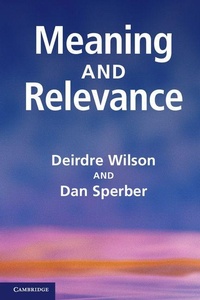
Meaning and Relevance
Published on 22. March 2012
Book
Paperback/Softback
395 pages
978-0-521-74748-6 (ISBN)
Description
When people speak, their words never fully encode what they mean, and the context is always compatible with a variety of interpretations. How can comprehension ever be achieved? Wilson and Sperber argue that comprehension is a process of inference guided by precise expectations of relevance. What are the relations between the linguistically encoded meanings studied in semantics and the thoughts that humans are capable of entertaining and conveying? How should we analyse literal meaning, approximations, metaphors and ironies? Is the ability to understand speakers' meanings rooted in a more general human ability to understand other minds? How do these abilities interact in evolution and in cognitive development? Meaning and Relevance sets out to answer these and other questions, enriching and updating relevance theory and exploring its implications for linguistics, philosophy, cognitive science and literary studies.
Reviews / Votes
'... significantly expands upon [the authors'] groundbreaking 1986/1995 book Relevance: Communication and Cognition, and nicely situates relevance theory within contemporary developments in cognitive science ... a masterful scholarly achievement that correctly places mind and relevance as the essential site for the scientific study of meaning and cognition.' Raymond W. Gibbs, Jr, University of California, Santa Cruz 'Wilson and Sperber are not merely the promoters of an influential framework in linguistic pragmatics, which this book beautifully illustrates; their pioneering work has implications for a wide range of disciplines, from evolutionary psychology to literary theory, and is of special interest to philosophers of language and mind.' Francois Recanati, Institut Jean Nicod, CNRS, Paris 'Twenty-five years ago, Sperber and Wilson published Relevance, Communication and Cognition: this was a major breakthrough in pragmatics. Philosophers and cognitive scientists intrigued by the subtle mapping between concepts and words should delve right away into their new Meaning and Relevance.' Pierre Jacob, Institut Jean Nicod, CNRS, ParisMore details
Language
English
Place of publication
Cambridge
United Kingdom
Target group
Professional and scholarly
Product notice
Paperback (trade)
Illustrations
11 Tables, black and white; 5 Line drawings, unspecified
Dimensions
Height: 229 mm
Width: 152 mm
Thickness: 22 mm
Weight
575 gr
ISBN-13
978-0-521-74748-6 (9780521747486)
Copyright in bibliographic data and cover images is held by Nielsen Book Services Limited or by the publishers or by their respective licensors: all rights reserved.
Schweitzer Classification
Other editions
Additional editions
Deirdre Wilson | Dan Sperber
Meaning and Relevance
E-Book
04/2012
Cambridge University Press
€38.49
Available for download
Deirdre Wilson | Dan Sperber
Meaning and Relevance
Book
03/2012
Cambridge University Press
€116.10
Shipment within 15-20 days
Persons
Deirdre Wilson is Emeritus Professor of Linguistics at University College London and Research Professor at the Centre for the Study of Mind in Nature at the University of Oslo. Dan Sperber is Emeritus Directeur de Recherche at the Institut Jean Nicod, CNRS, Paris and part-time university professor in the departments of philosophy and cognitive science at the Central European University, Budapest.
Content
Introduction: 1. Pragmatics; Part I. Relevance and Meaning: 2. The mapping between the mental and the public lexicon; 3. Truthfulness and relevance; 4. Rhetoric and relevance; 5. A deflationary account of metaphors; 6. Explaining irony; Part II. Explicit and Implicit Communication: 7. Linguistic form and relevance; 8. Pragmatics and time; 9. Recent approaches to bridging: truth, coherence, relevance; 10. Mood and the analysis of non-declarative sentences; 11. Metarepresentation in linguistic communication; Part III. Cross-disciplinary Themes: 12. Pragmatics, modularity and mindreading; 13. Testing the cognitive and communicative principles of relevance; 14. The why and how of experimental pragmatics; 15. A pragmatic perspective on the evolution of language.