

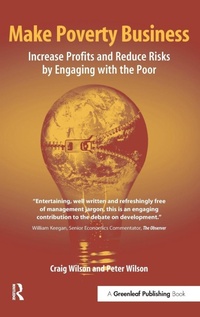
Make Poverty Business
Increase Profits and Reduce Risks by Engaging with the Poor
1st Edition
Published on 1. November 2006
Book
Hardback
192 pages
978-1-874719-96-0 (ISBN)
Description
Poor people in developing countries could make excellent suppliers, employees and customers but are often ignored by major businesses. This omission leads to increased risk, higher costs and lower sales. Meanwhile, businesses are asked by governments and poverty activists to do more for economic development, but their exhortations are rarely based on a proper business case. Make Poverty Business bridges the gap by constructing a rigorous profit-making argument for multinational corporations to do more business with the poor. It takes economic development out of the corporate social responsibility ghetto and places it firmly in the core business interests of the corporation, and argues that to see the poor only as potential consumers at the bottom of the pyramid (BOP) misses half of the story.
Make Poverty Business examines the successes, failures and missed opportunities of a wide range of global companies including Wal-Mart, BP, Unilever, Shell and HSBC when dealing with the poor and with development advocates in the media, NGOs, governments and international organisations. It includes a discussion on how to use a poverty perspective to provoke profitable innovation - not only to create new products and services but also to find new sources of competitive advantage in the supply chain and to develop more sustainable, lower-cost business models in developing countries.
Make Poverty Business will be essential reading for international business managers seeking to increase profits and decrease risks in developing countries, development advocates who seek to harness the profit motive to achieve reductions in poverty, and academics looking for practical strategies on how business can implement BOP initiatives in developing countries.
Make Poverty Business examines the successes, failures and missed opportunities of a wide range of global companies including Wal-Mart, BP, Unilever, Shell and HSBC when dealing with the poor and with development advocates in the media, NGOs, governments and international organisations. It includes a discussion on how to use a poverty perspective to provoke profitable innovation - not only to create new products and services but also to find new sources of competitive advantage in the supply chain and to develop more sustainable, lower-cost business models in developing countries.
Make Poverty Business will be essential reading for international business managers seeking to increase profits and decrease risks in developing countries, development advocates who seek to harness the profit motive to achieve reductions in poverty, and academics looking for practical strategies on how business can implement BOP initiatives in developing countries.
Reviews / Votes
This slim volume takes Prahalad's bottom of the pyramid philosophy and makes it actionable for the business manager who lives in blissful ignorance of international development jargon. A great airplane read, it also avoids the 'well, duh' statements that infect so many management books. I highly recommend it. http://psdblog.worldbank.org/psdblog/2007/01/three_new_books.html World Bank and IFC Private Sector Development Blog, 5 January 2007, Based on economic theory and good business practice, this easy-to-read account outlines the incentives for multinational leaders to do business with poor people in developing countries. In doing so, it revives the debate regarding the definition of corporate social responsibility, with the co-authors claiming multinational companies' engagement in lesser developed countries cannot be classed as CSR. Follow-up questions and further reading suggestions will stimulate wider discussion on whether to support their case for making poverty business, long after you put this book down. Corporate Citizenship Briefing, January 2007 Rarely can the saying "You can't judge a book by its cover" have been as true as in this case: the cover is dreadful! Which makes it all the more extraordinary when you dip in to find that the Wilsons - no relation, they explain - have produced a book packed with insight on one of the defining issues of the 21st century: the eradication of poverty. Their style is disarming and charming. "When thinking about poverty," they say, "we've tried to think like carbon-based life forms rather than economists." Whereas the typical business blockbuster these days offers to reveal an impending revolution, the Wilsons reassure us that there is "no new paradigm here, no redefinition of the corporation, no need for a business revolution". Their ambition sounds deceptively simple: "We hope that a manager who reads this book and then starts talking to a wider range of people and reading from a wider range of sources will start to make better decisions." They offer sympathetic, helpful assessments of what it is like to be an expatriate manager or a government bureaucrat in a non-industrialised country. One of their friends "has just been promoted in a major multinational and been told that he'll be sacked unless he meets his annual targets. It's hard", they say, "for him to focus on corporate reputation or long-term profitability or, for goodness' sake, poverty reduction when his mortgage and his kids' schooling depend on how much profit his small bit of the company makes over the next twelve months." Alternatively, try putting yourself in the shoes of government officials in non-industrialised countries. "They are often incredibly poor," the Wilsons explain, "operating in a severely dysfunctional bureaucracy, and with very low levels of autonomy." In case all of this sounds like apologies for the folk who stall the eradication of poverty, it isn't. It's an attempt to provide the reality check needed to ensure that future efforts do not dribble away, as so many have before. The authors stress that poverty is dangerous because of its role as "a crucible for terrorism and instability", and that it masks some of the greatest potential market opportunities of the new century. But they warn against new forms of irrational exuberance. For those who would argue that C. K. Prahalad scooped them with his Fortune at the Bottom of the Pyramid, the Wilsons note, "You'd be well advised to read his book first before starting on ours because he does the motivation, the ambition and the shining city on the hill. We're more interested in replacing a few light bulbs down here in the valley." If you're an anti-globaliser, the book's worth reading just for its discussion of how China's development has helped pull millions out of poverty. No need to agree on every point; indeed, a key reward is having your assumptions poked. -- John Elkington Resurgence 243 (July/August 2007)More details
Language
English
Place of publication
Saltaire
United Kingdom
Publishing group
Taylor & Francis Ltd
Target group
Postgraduate and Professional Practice & Development
Dimensions
Height: 240 mm
Width: 161 mm
Thickness: 15 mm
Weight
461 gr
ISBN-13
978-1-874719-96-0 (9781874719960)
Copyright in bibliographic data and cover images is held by Nielsen Book Services Limited or by the publishers or by their respective licensors: all rights reserved.
Schweitzer Classification
Other editions
Additional editions
Craig Wilson | Peter Wilson
Make Poverty Business
Increase Profits and Reduce Risks by Engaging with the Poor
E-Book
09/2017
Routledge
€47.49
Available for download
Craig Wilson | Peter Wilson
Make Poverty Business
Increase Profits and Reduce Risks by Engaging with the Poor
E-Book
09/2017
Routledge
€47.49
Available for download
Persons
Craig Wilson and Peter Wilson are well placed to combine the best insights from business strategy, political risk and economic development and to discard the worst. Their combined experience includes the World Bank, the International Finance Corporation, McKinsey and the British Diplomatic Service and they have worked in many of the world's most challenging environments including Bangladesh, East Timor, Indonesia, Kosovo and Sierra Leone. Their academic backgrounds in development economics (Columbia and Oxford Universities) and business strategy (INSEAD) are supplemented by real hands-on experience of what works and what doesn't for businesses and development.
Content
Preface 1. Introduction 2. What business can and can't do for the poor 3. What is poverty? How many people are poor? 4. Poverty and inefficiency traps 5. Security and the poor 6. Partnering and co-operating to reduce poverty 7. Innovation for poverty reduction 8. Making the changes 9. Reputation and country risk 10. Next steps