

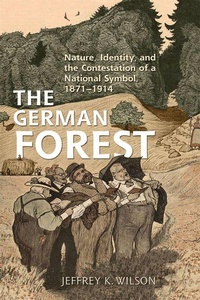
The German Forest
Nature, Identity, and the Contestation of a National Symbol, 1871-1914
Published on 29. June 2012
Book
Hardback
344 pages
978-1-4426-4099-3 (ISBN)
Description
From the late eighteenth century, Germans increasingly identified the fate of their nation with that of their woodlands. A variety of groups soon mobilized the 'German forest' as a national symbol, though often in ways that suited their own social, economic, and political interests. The German Forest is the first book-length history of the development and contestation of the concept of 'German' woodlands.
Jeffrey K. Wilson challenges the dominant interpretation that German connections to nature were based in agrarian romanticism rather than efforts at modernization. He explores a variety of conflicts over the symbol - from demands on landowners for public access to woodlands, to state attempts to integrate ethnic Slavs into German culture through forestry, and radical nationalist visions of woodlands as a model for the German 'race'. Through impressive primary and archival research, Wilson demonstrates that in addition to uniting Germans, the forest as a national symbol could also serve as a vehicle for protest and strife.
Jeffrey K. Wilson challenges the dominant interpretation that German connections to nature were based in agrarian romanticism rather than efforts at modernization. He explores a variety of conflicts over the symbol - from demands on landowners for public access to woodlands, to state attempts to integrate ethnic Slavs into German culture through forestry, and radical nationalist visions of woodlands as a model for the German 'race'. Through impressive primary and archival research, Wilson demonstrates that in addition to uniting Germans, the forest as a national symbol could also serve as a vehicle for protest and strife.
Reviews / Votes
'Wilson's book would be important reading for any student of environmental history or the history of Western Europe in the modern age.'- Charles Closmann (Environment and History vol 21:04:2015) 'The book fills a real gap, not only in its chronological and spatial focus but also in drawing connections between the politics of the forest and the Heimat movement. Wilson offers a significant and persuasively narrated contribution to the history of Imperial Germany, of the forest, and of nationalism.' - Richard HOElzl (German History vol 32:02:2014) 'This well contextualized study provides an interesting example of environmental history, offering insights into the land and human relationships with it as well as revealing how much environment-related issues can tell us about humans as political animals.'
- Brian Vick (American Historical Review, vol 118:03:2013)
More details
Series
Language
English
Place of publication
Toronto
Canada
Target group
Professional and scholarly
Product notice
sewn/stitched
Cloth over boards
With dust jacket
Illustrations
3 Figures, 6 maps
Dimensions
Height: 231 mm
Width: 150 mm
Thickness: 28 mm
Weight
658 gr
ISBN-13
978-1-4426-4099-3 (9781442640993)
Copyright in bibliographic data and cover images is held by Nielsen Book Services Limited or by the publishers or by their respective licensors: all rights reserved.
Schweitzer Classification
Other editions
Additional editions
Jeffrey K. Wilson
The German Forest
Nature, Identity, and the Contestation of a National Symbol, 1871-1914
E-Book
12/2012
1st Edition
University of Toronto Press
€86.95
Available for download
Person
Jeffrey K. Wilson is an assistant professor in the Department of History at California State University, Sacramento.
Content
Acknowledgements Introduction
Chapter I: National Landscape and National Memory
Chapter II: Contested Forests: Ideal Values and Real Estate
Chapter III: Environmental Activism: Berlin and the Grunewald
Chapter IV: Reforestation as Reform: Pomerelia and the Tuchel Heath
Chapter V: Meaningful Woods: Sylvan Metaphors and Arboreal Symbols
Conclusion
Bibliography
index
Chapter I: National Landscape and National Memory
Chapter II: Contested Forests: Ideal Values and Real Estate
Chapter III: Environmental Activism: Berlin and the Grunewald
Chapter IV: Reforestation as Reform: Pomerelia and the Tuchel Heath
Chapter V: Meaningful Woods: Sylvan Metaphors and Arboreal Symbols
Conclusion
Bibliography
index