

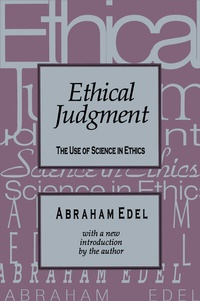
Ethical Judgment
The Use of Science in Ethics
2nd Edition
Published on 18. December 2020
Book
Hardback
348 pages
978-1-138-52303-6 (ISBN)
Description
In Ethical Judgment, Abraham Edel makes clear the part played by biological and social scientific information in ethical judgment and moral action using psychological, anthropological, and economic materials as well as historical studies. Edel suggests that many controversies in ethical theory have emerged because different ethical theories made different scientific assumptions. In the almost forty years since his book was first published, life has become more complex and technological change has accelerated, bringing changes to our morality and ethical theory as well as our conduct. If anything, his observations are even more pertinent, compelling us to examine the empirical core of ethical statements.
Edel maintains that since our knowledge of social life and history is constantly growing, moral theories and ethical judgments ought to embody the best knowledge available at any point in tune. However, because all knowledge and belief is only probable, there is never absolute certainty but only what Edel calls residual indeterminacy in human life and knowledge due to complexity and change.
Edel lists four factors that form the basis for moral decisions: universal needs (food); perennial aspirations (friendships); central necessary conditions (job security); and critical contingent factors under special circumstances (land reform in a landholder-ruled society). In his new introduction, Edel applies those factors to the present day, discussing societal changes over the past forty years, such as the number of women in the workforce, the impact of the civil rights movement, and the fact that isolationism as a national policy is no longer feasible. Ethical Judgment is a recognized classic hi the modern study of ethical theory. It will be valuable reading for sociologists, historians, and all scholars interested in the study of ethics and American culture.
Edel maintains that since our knowledge of social life and history is constantly growing, moral theories and ethical judgments ought to embody the best knowledge available at any point in tune. However, because all knowledge and belief is only probable, there is never absolute certainty but only what Edel calls residual indeterminacy in human life and knowledge due to complexity and change.
Edel lists four factors that form the basis for moral decisions: universal needs (food); perennial aspirations (friendships); central necessary conditions (job security); and critical contingent factors under special circumstances (land reform in a landholder-ruled society). In his new introduction, Edel applies those factors to the present day, discussing societal changes over the past forty years, such as the number of women in the workforce, the impact of the civil rights movement, and the fact that isolationism as a national policy is no longer feasible. Ethical Judgment is a recognized classic hi the modern study of ethical theory. It will be valuable reading for sociologists, historians, and all scholars interested in the study of ethics and American culture.
More details
Edition
2nd edition
Language
English
Place of publication
London
United Kingdom
Publishing group
Taylor & Francis Ltd
Target group
College/higher education
Dimensions
Height: 229 mm
Width: 152 mm
Weight
820 gr
ISBN-13
978-1-138-52303-6 (9781138523036)
Copyright in bibliographic data and cover images is held by Nielsen Book Services Limited or by the publishers or by their respective licensors: all rights reserved.
Schweitzer Classification
Other editions
Additional editions
E-Book
03/2020
2nd Edition
Routledge
€55.49
Available for download
E-Book
03/2020
2nd Edition
Routledge
€55.49
Available for download
Book
02/1995
2nd Edition
Routledge
€71.98
Shipment within 3-4 weeks
Person
Abraham Edel, a distinguished American moral and social philosopher, is research professor of philosophy at the University of Pennsylvania. Among his numerous books are The Theory and Practice of Philosophy, Science and the Structure of Ethics, and Aristotle and His Philosophy.
Content
Introduction to the Transaction Edition, Preface, Part I. Ethical Relativity: Background and Analysis, I. What Is Ethical Relativity, II. Barriers and Tools: Conscience, Moral Law and Reason, III. Barriers and Tools: The Spectre of the Stubborn Man, IV. The Nature and Sources of Indeterminacy, Part II. What the Human Sciences Can Offer, V. Biological Perspectives, VI. Psychological Perspectives, VII. Cultural and Social Perspectives, VIII. Historical Perspectives, Part III. Towards A Common Ethic, IX. The Theory of the Valuational Base, Index