

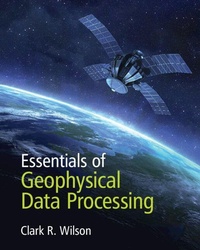
Essentials of Geophysical Data Processing
Published on 21. October 2021
Book
Paperback/Softback
350 pages
978-1-108-93100-7 (ISBN)
Description
A concise introduction to geophysical data processing - many of the techniques associated with the general field of time series analysis - for advanced students, researchers, and professionals. The textbook begins with calculus before transitioning to discrete time series via the sampling theorem, aliasing, use of complex sinusoids, development of the discrete Fourier transform from the Fourier series, and an overview of linear digital filter types and descriptions. Aimed at senior undergraduate and graduate students in geophysics, environmental science, and engineering with no previous background in linear algebra, probability, or statistics, this textbook draws scenarios and datasets from across the world of geophysics, and shows how data processing techniques can be applied to real-world problems using detailed examples, illustrations, and exercises (using MATLAB or similar computing environment). Online supplementary resources include datasets for students, and a solutions manual and all the figures from the book as PowerPoints for course instructors.
Reviews / Votes
'This is an excellent textbook for a course on signal processing for 3rd-year geophysics students. Wilson does a great job of taking explanations that are often scattered across engineering books and adapting them towards the needs of geophysicists using relevant examples from the field. It has the perfect balance between depth and simplicity for undergraduates.' Daniel Trad, University of Calgary 'Wilson's book is an excellent compilation of tools and techniques commonly used by practitioners for analyzing various kinds of data arrays. Although the ideas are presented in the context of geophysics, they can be extended to extract information from geochemical and geobiological datasets with the same finesse. The use of real datasets and easy-to-follow explanations of complex mathematical formulations makes the book a good read.' Priyank Jaiswal, Oklahoma State University '... I would recommend this volume not only for graduate and advanced undergraduate students, but for professional geophysicists who could use it as a refresher course.' Patrick Taylor, The Leading EdgeMore details
Language
English
Place of publication
Cambridge
United Kingdom
Target group
College/higher education
Professional and scholarly
Product notice
Paperback (trade)
Illustrations
Worked examples or Exercises
Dimensions
Height: 254 mm
Width: 203 mm
Thickness: 11 mm
Weight
446 gr
ISBN-13
978-1-108-93100-7 (9781108931007)
Copyright in bibliographic data and cover images is held by Nielsen Book Services Limited or by the publishers or by their respective licensors: all rights reserved.
Schweitzer Classification
Other editions
Additional editions
Clark R. Wilson
Essentials of Geophysical Data Processing
E-Book
10/2021
Cambridge University Press
€41.99
Available for download
Person
Clark R. Wilson is the Carlton Centennial Professor of Geophysics at the University of Texas, Austin. After undergraduate studies in physics (University of California, San Diego) and graduate work in geophysics (Masters and PhD) at Scripps Institution of Oceanography, he joined the faculty of the Department of Geological Sciences at UT Austin. His research has ranged over diverse fields including applied seismology, space geodesy, and hydrology. He has twice served as Department Chair, and spent three years at NASA Headquarters overseeing programs in geodynamics and potential fields.
Content
Preface; 1. An Introduction With Geophysical Time Series Examples; 2. Analog Signals and Digital Time Series; 3. Sinusoids and Fourier Series; 4. The Discrete Fourier Transform; 5. Linear Systems and Digital Filters; 6. Convolution and Related Theorems; 7. Least Squares; 8. Linear Filter Design; 9. Least Square and Correlation Filters; 10. Power and Coherence Spectra; Appendix A. Matrices and Vectors; Appendix B. Fourier Transforms of Continuous Functions; Appendix C. Random Variable Concepts and Applications; Appendix D. Further Reading; Index.