

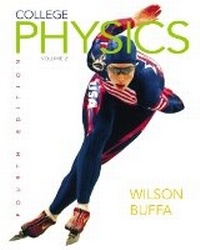
College Physics, Volume 1
4th Edition
Published on 21. September 2000
Book
Paperback/Softback
514 pages
978-0-13-084152-0 (ISBN)
More details
Edition
4th edition
Language
English
Place of publication
United States
Publishing group
Pearson Education (US)
Target group
Professional and scholarly
Dimensions
Height: 265 mm
Width: 220 mm
Thickness: 15 mm
Weight
1125 gr
ISBN-13
978-0-13-084152-0 (9780130841520)
Copyright in bibliographic data and cover images is held by Nielsen Book Services Limited or by the publishers or by their respective licensors: all rights reserved.
Schweitzer Classification
Other editions
New editions
Jerry D. Wilson | Anthony J. Buffa
College Physics, Volume I
Book
09/2002
5th Edition
Pearson
€27.22
Article is exhausted; no reprint
Persons
JERRY D. WILSON a native of Ohio, is now Emeritus Professor of Physics and former Chair of the Division of Biological and Physical Sciences at Lander University in Greenwood, South Carolina. He received his B.S. degree from Ohio University, M.S. degree from Union College, and in 1970, a Ph.D. from Ohio University. He earned his M.S. degree while employed as a Materials Behavior Physicist by the General Electric Co.
As a doctoral graduate student, Professor Wilson held the faculty rank of Instructor and began teaching physical science courses. During this time, he co-authored a physical science text that is now in its eighth edition. In conjunction with his teaching career, Professor Wilson continued his writing and has authored or co-authored six titles. Having retired from full-time teaching, he continues to write, including The Curiosity Corner, a weekly column for local newspapers, which now can also be found on the Internet.
ANTHONY J. BUFFA received his B.S. degree in physics from Rensselaer Polytechnic Institute and both his M.S. and Ph.D. degrees in physics from the University of Illinois, Urbana-Champaign. In 1970, Professor Buffa joined the faculty at California Polytechnic State University, San Luis Obispo, where he is currently Professor of Physics, and has been a research associate with the Department of Physics Radioanalytical Facility since 1980.
Professor Buffa's main interest continues to be teaching. He has taught courses at Cal Poly ranging from introductory physical science to quantum mechanics, has developed and revised many laboratory experiments, and has taught elementary physics to local teachers in an NSF-sponsored workshop. Combining physics with his interests in art and architecture, Dr. Buffa develops his own artwork and sketches, which he uses to increase his effectiveness in teaching physics.
As a doctoral graduate student, Professor Wilson held the faculty rank of Instructor and began teaching physical science courses. During this time, he co-authored a physical science text that is now in its eighth edition. In conjunction with his teaching career, Professor Wilson continued his writing and has authored or co-authored six titles. Having retired from full-time teaching, he continues to write, including The Curiosity Corner, a weekly column for local newspapers, which now can also be found on the Internet.
ANTHONY J. BUFFA received his B.S. degree in physics from Rensselaer Polytechnic Institute and both his M.S. and Ph.D. degrees in physics from the University of Illinois, Urbana-Champaign. In 1970, Professor Buffa joined the faculty at California Polytechnic State University, San Luis Obispo, where he is currently Professor of Physics, and has been a research associate with the Department of Physics Radioanalytical Facility since 1980.
Professor Buffa's main interest continues to be teaching. He has taught courses at Cal Poly ranging from introductory physical science to quantum mechanics, has developed and revised many laboratory experiments, and has taught elementary physics to local teachers in an NSF-sponsored workshop. Combining physics with his interests in art and architecture, Dr. Buffa develops his own artwork and sketches, which he uses to increase his effectiveness in teaching physics.
Content
1. Units and Problem Solving.
2. Kinematics: Description of Motion.
3. Motion in Two Dimensions.
4. Force and Motion.
5. Work and Energy.
6. Momentum and Collisions.
7. Circular Motion and Gravitation.
8. Rotational Motion and Equilibrium.
9. Solids and Fluids.
II. THERMODYNAMICS.
10. Temperature.
11. Heat.
12. Thermodynamics.
III. OSCILLATIONS AND WAVE MOTION.
13. Vibrations and Waves.
14. Sound.
APPENDICES.
Appendix I. Mathematical Relationships.
Appendix II. Kinetic Theory of Gases.
Appendix III. Planetary Data.
Appendix IV. Alphabetical Listing of the Chemical Elements.
Appendix V. Properties of Selected Isotopes.
Answers to Follow-up Exercises.
Answers to Odd-numbered Exercises.
Photo Credits.
Index.
2. Kinematics: Description of Motion.
3. Motion in Two Dimensions.
4. Force and Motion.
5. Work and Energy.
6. Momentum and Collisions.
7. Circular Motion and Gravitation.
8. Rotational Motion and Equilibrium.
9. Solids and Fluids.
II. THERMODYNAMICS.
10. Temperature.
11. Heat.
12. Thermodynamics.
III. OSCILLATIONS AND WAVE MOTION.
13. Vibrations and Waves.
14. Sound.
APPENDICES.
Appendix I. Mathematical Relationships.
Appendix II. Kinetic Theory of Gases.
Appendix III. Planetary Data.
Appendix IV. Alphabetical Listing of the Chemical Elements.
Appendix V. Properties of Selected Isotopes.
Answers to Follow-up Exercises.
Answers to Odd-numbered Exercises.
Photo Credits.
Index.