

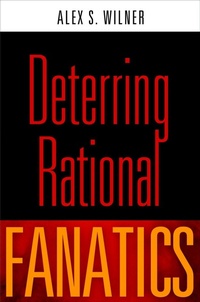
Deterring Rational Fanatics
Will be published approx. on 13. February 2015
Book
Hardback
264 pages
978-0-8122-4668-1 (ISBN)
Description
Cold War-era strategic thinking was driven by the belief that individuals, organizations, and foreign states could be deterred from offensive action by the threat of reprisal. That assurance was shaken with the terrorist attacks of September 11, 2001; suddenly, it seemed that no threat was powerful enough to deter individuals or organizations that valued political objectives over their own lives and the lives of their members. More than a decade later, new research and theory are bringing deterrence back into currency as a viable counterterrorism strategy. Alex S. Wilner updates deterrence theory for conflict in the twenty-first century, arguing for its value against challengers such as rogue states, cyber warriors, and transnational terrorist organizations.
Deterring Rational Fanatics provides a full-scale discussion of deterrence theory concepts and controversies, assessing the utility of relying on the logic of deterrence and coercion to counter contemporary terrorism. In particular, targeted killings directed against the Taliban of Afghanistan provide a vivid illustration of the impact deterrence can have on militant behavior: precision strikes that eliminate militant leaders represent a significant cost to planning and participating in political violence, a cost that can coerce, manipulate, and alter behavior. Though deterrence theory is not a panacea for terrorism, insurgency, or militancy, it can serve as a strategic guide for state responses; as Wilner shows, terrorist violence can indeed be deterred.
Deterring Rational Fanatics provides a full-scale discussion of deterrence theory concepts and controversies, assessing the utility of relying on the logic of deterrence and coercion to counter contemporary terrorism. In particular, targeted killings directed against the Taliban of Afghanistan provide a vivid illustration of the impact deterrence can have on militant behavior: precision strikes that eliminate militant leaders represent a significant cost to planning and participating in political violence, a cost that can coerce, manipulate, and alter behavior. Though deterrence theory is not a panacea for terrorism, insurgency, or militancy, it can serve as a strategic guide for state responses; as Wilner shows, terrorist violence can indeed be deterred.
Reviews / Votes
"Deterring Rational Fanatics provides an accurate and informed assessment of current thinking about deterrence theory and an effort to determine the impact of targeted killings." (James J. Wirtz, School of International Graduate Studies at the Naval Postgraduate School, Monterey) "Wilner's perceptive analysis and detail-driven empirical work are convincing and well anchored in the broader deterrence debate." (Thomas Rid, King's College London)More details
Language
English
Place of publication
Pennsylvania
United States
Target group
College/higher education
Product notice
Paper over boards
Illustrations
18 illus.
Dimensions
Height: 231 mm
Width: 163 mm
Thickness: 28 mm
Weight
544 gr
ISBN-13
978-0-8122-4668-1 (9780812246681)
Copyright in bibliographic data and cover images is held by Nielsen Book Services Limited or by the publishers or by their respective licensors: all rights reserved.
Schweitzer Classification
Other editions
Additional editions
Alex S. Wilner
Deterring Rational Fanatics
E-Book
01/2015
1st Edition
University of Pennsylvania Press
€83.49
Available for download

Alex S. Wilner
Deterring Rational Fanatics
Book
01/1969
University of Pennsylvania Press
€3.10
Article exhausted; check different version
Person
Alex S. Wilner is a Visiting Fellow and Lecturer at the Munk School of Global Affairs at the University of Toronto
Content
Chapter 1. Introduction 1
Chapter 2. Deterrence Theory: Exploring Core Concepts
Chapter 3. Deterring Terrorism: Contemporary Debates
Chapter 4. Targeted Killings: Theory, Practice, and Consequence
Chapter 5. Targeting the Taliban: Coercive Lessons from Afghanistan
Chapter 6. Moving Ahead with Deterrence Theory
Appendix: Research Design and Methodology
Notes
Index
Chapter 2. Deterrence Theory: Exploring Core Concepts
Chapter 3. Deterring Terrorism: Contemporary Debates
Chapter 4. Targeted Killings: Theory, Practice, and Consequence
Chapter 5. Targeting the Taliban: Coercive Lessons from Afghanistan
Chapter 6. Moving Ahead with Deterrence Theory
Appendix: Research Design and Methodology
Notes
Index