

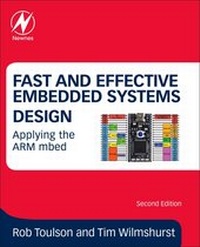
Fast and Effective Embedded Systems Design
Applying the ARM mbed
2nd Edition
Published on 26. October 2016
Book
Paperback/Softback
510 pages
978-0-08-100880-5 (ISBN)
Description
Fast and Effective Embedded Systems Design is a fast-moving introduction to embedded systems design, applying the innovative ARM mbed and its web-based development environment. Each chapter introduces a major topic in embedded systems, and proceeds as a series of practical experiments, adopting a "learning through doing" strategy. Minimal background knowledge is needed to start. C/C++ programming is applied, with a step-by-step approach which allows you to get coding quickly. Once the basics are covered, the book progresses to some "hot" embedded issues - intelligent instrumentation, wireless and networked systems, digital audio and digital signal processing. In this new edition all examples and peripheral devices are updated to use the most recent libraries and peripheral devices, with increased technical depth, and introduction of the "mbed enabled" concept.
Written by two experts in the field, this book reflects on the experimental results, develops and matches theory to practice, evaluates the strengths and weaknesses of the technology and techniques introduced, and considers applications in a wider context.
New Chapters on:
Bluetooth and ZigBee communication
Internet communication and control, setting the scene for the 'Internet of Things'
Digital Audio, with high-fidelity applications and use of the I2S bus
Power supply, and very low power applications
The development process of moving from prototyping to small-scale or mass manufacture, with a commercial case study.
Written by two experts in the field, this book reflects on the experimental results, develops and matches theory to practice, evaluates the strengths and weaknesses of the technology and techniques introduced, and considers applications in a wider context.
New Chapters on:
Bluetooth and ZigBee communication
Internet communication and control, setting the scene for the 'Internet of Things'
Digital Audio, with high-fidelity applications and use of the I2S bus
Power supply, and very low power applications
The development process of moving from prototyping to small-scale or mass manufacture, with a commercial case study.
More details
Edition
2nd edition
Language
English
Place of publication
Oxford
United Kingdom
Publishing group
Elsevier Science & Technology
Target group
College/higher education
Students studying embedded systems using ARM technology, Professional embedded systems engineers, and software engineers developing embedded systems.
Dimensions
Height: 235 mm
Width: 191 mm
Weight
1040 gr
ISBN-13
978-0-08-100880-5 (9780081008805)
Copyright in bibliographic data and cover images is held by Nielsen Book Services Limited or by the publishers or by their respective licensors: all rights reserved.
Schweitzer Classification
Other editions
New editions
Tim Wilmshurst | Rob Toulson | Tom Spink
Fast and Effective Embedded Systems Design
From bits and bytes to IoT, with the Arm Mbed
Book
09/2024
3rd Edition
Elsevier
€86.50
Shipment within 10-15 days
Additional editions
E-Book
10/2016
2nd Edition
Newnes
€46.95
Available for download
Previous edition
Book
07/2012
Newnes
€51.38
Article exhausted; check for reprint
Persons
Tim Wilmshurst has designed numerous embedded and electronic systems, including systems in climatic monitoring, earthquake research, wind tunnels, and autonomous vehicles. He is the author of several textbooks on embedded system design. In his teaching, Tim advocates "learning through doing? and problem-based learning. He has been Head of Electrical Engineering at Botswana Polytechnic, Senior Design Engineer at Cambridge University, and Head of Electronics at Derby University. He is now a freelance technical author and educator.
Rob Toulson is a Visiting Professor at the University of Westminster, as well as founder and director of RT Sixty, a company that develops innovative applications for the audiovisual and music industries. His expertise covers a broad range of fields, including mobile application development, digital signal processing, embedded systems, musical acoustics, music production, and interactive sound design.
Rob Toulson is a Visiting Professor at the University of Westminster, as well as founder and director of RT Sixty, a company that develops innovative applications for the audiovisual and music industries. His expertise covers a broad range of fields, including mobile application development, digital signal processing, embedded systems, musical acoustics, music production, and interactive sound design.
Content
Chapter 1. Embedded Systems, Microcontrollers, and ARM
Part I. Essentials of Embedded Systems, Using the mbed
Chapter 2. Introducing the mbed
Chapter 3. Digital Input and Output
Chapter 4. Analog Output
Chapter 5. Analog Input
Chapter 6. Further Programming Techniques
Chapter 7. Starting with Serial Communication
Chapter 8. Liquid Crystal Displays
Chapter 9. Interrupts, Timers, and Tasks
Chapter 10. Memory and Data Management
Part II. Moving to Advanced and Specialist Applications
Chapter 11. Wireless Communication - Bluetooth and Zigbee
Chapter 12. Internet Communication and Control
Chapter 13. Working With Digital Audio
Chapter 14. Letting Go of the mbed Libraries
Chapter 15. Hardware Insights: Clocks, Resets, and Power Supply
Chapter 16. Developing Commercial Products With mbed
Part I. Essentials of Embedded Systems, Using the mbed
Chapter 2. Introducing the mbed
Chapter 3. Digital Input and Output
Chapter 4. Analog Output
Chapter 5. Analog Input
Chapter 6. Further Programming Techniques
Chapter 7. Starting with Serial Communication
Chapter 8. Liquid Crystal Displays
Chapter 9. Interrupts, Timers, and Tasks
Chapter 10. Memory and Data Management
Part II. Moving to Advanced and Specialist Applications
Chapter 11. Wireless Communication - Bluetooth and Zigbee
Chapter 12. Internet Communication and Control
Chapter 13. Working With Digital Audio
Chapter 14. Letting Go of the mbed Libraries
Chapter 15. Hardware Insights: Clocks, Resets, and Power Supply
Chapter 16. Developing Commercial Products With mbed