

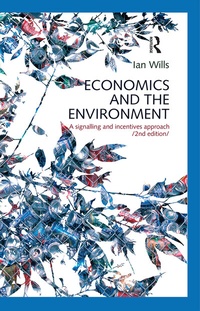
Economics and the Environment
A signalling and incentives approach
2nd Edition
Published on 31. March 2021
Book
Hardback
400 pages
978-0-367-71800-8 (ISBN)
Description
Coordinating our use of the earth's natural resources is not easy. Resource users are many, their goals diverse, and their impacts on the environment often uncertain.
How we use those resources depends on the signals and incentives we receive, from either the market or our governments. These systems encourage certain uses of natural resources, but they are not perfect. We harm the environment not out of malice, but because we do not know the consequences of our actions, or the incentives for harm are too great to ignore.
Economics and the Environment argues that, by lowering the cost and improving the quality of the necessary signals and incentives, we can better reconcile our diverse interests in the environment. It introduces an economic way of thinking about environmental issues, without assuming a background in economics:
* how the economy and the environment interact
* how resource use is coordinated in ideal market and planned economies
* the barriers to ideal signalling and incentives in real markets and real government planning
* the economist's tools for dealing with natural resource issues
* the uncertainty and complexity of environmental issues: climate change, water rights, air pollution and overharvesting of common resources.
This second edition of Economics and the Environment is fully updated and includes new material on sustainability, valuation of environmental changes, the prospects for international cooperation under the Kyoto Protocol and the problems of defining and enforcing measures to protect biodiversity. It offers students in both economics and environmental studies programs a coherent framework for understanding our major environmental problems.
'Ian Wills succeeds in providing a fresh perspective . . . a very interesting and informative textbook.'
Economic Record
How we use those resources depends on the signals and incentives we receive, from either the market or our governments. These systems encourage certain uses of natural resources, but they are not perfect. We harm the environment not out of malice, but because we do not know the consequences of our actions, or the incentives for harm are too great to ignore.
Economics and the Environment argues that, by lowering the cost and improving the quality of the necessary signals and incentives, we can better reconcile our diverse interests in the environment. It introduces an economic way of thinking about environmental issues, without assuming a background in economics:
* how the economy and the environment interact
* how resource use is coordinated in ideal market and planned economies
* the barriers to ideal signalling and incentives in real markets and real government planning
* the economist's tools for dealing with natural resource issues
* the uncertainty and complexity of environmental issues: climate change, water rights, air pollution and overharvesting of common resources.
This second edition of Economics and the Environment is fully updated and includes new material on sustainability, valuation of environmental changes, the prospects for international cooperation under the Kyoto Protocol and the problems of defining and enforcing measures to protect biodiversity. It offers students in both economics and environmental studies programs a coherent framework for understanding our major environmental problems.
'Ian Wills succeeds in providing a fresh perspective . . . a very interesting and informative textbook.'
Economic Record
More details
Edition
2nd edition
Language
English
Place of publication
London
United Kingdom
Publishing group
Taylor & Francis Ltd
Target group
College/higher education
Dimensions
Height: 229 mm
Width: 152 mm
Weight
660 gr
ISBN-13
978-0-367-71800-8 (9780367718008)
Copyright in bibliographic data and cover images is held by Nielsen Book Services Limited or by the publishers or by their respective licensors: all rights reserved.
Schweitzer Classification
Other editions
Additional editions
E-Book
09/2020
2nd Edition
Routledge
€44.99
Available for download
E-Book
09/2020
2nd Edition
Routledge
€44.99
Available for download
Book
06/2006
2nd Edition
Allen & Unwin
€50.40
Article not available at the moment
Person
Ian Wills is Associate Professor in the Department of Economics at Monash University, where he teaches in the economics and graduate environmental science programs.
Content
I: SOCIAL COORDINATION, THE ECONOMY AND THE ENVIRONMENT
1. Introduction
2. Scarcity and systems of social coordination
3. Social coordination in market and planned economies
4. The economy and the environment
II: LIMITATIONS OF MARKET SIGNALLING AND INCENTIVES
5. High costs of markets
6. Non-excludable goods
7. Common pool resources
8. Limitations of government signalling and incentives
III: DECISION-MAKING TOOLS
9. Decision making over time
10. Cost-benefit analysis of environmental changes
11. Valuing the environment
12. Stated preference valuation techniques
13. Monitoring changes in economic-environmental systems (available online)
IV: LOCALISED ENVIRONMENTAL PROBLEMS
14. The economics of pollution control: two parties
15. The economics of pollution control: many parties
16. Social coordination in waste disposal and recycling (available online)
1. Introduction
2. Scarcity and systems of social coordination
3. Social coordination in market and planned economies
4. The economy and the environment
II: LIMITATIONS OF MARKET SIGNALLING AND INCENTIVES
5. High costs of markets
6. Non-excludable goods
7. Common pool resources
8. Limitations of government signalling and incentives
III: DECISION-MAKING TOOLS
9. Decision making over time
10. Cost-benefit analysis of environmental changes
11. Valuing the environment
12. Stated preference valuation techniques
13. Monitoring changes in economic-environmental systems (available online)
IV: LOCALISED ENVIRONMENTAL PROBLEMS
14. The economics of pollution control: two parties
15. The economics of pollution control: many parties
16. Social coordination in waste disposal and recycling (available online)