

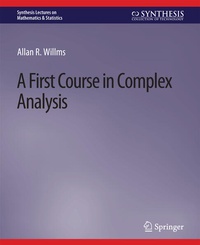
A First Course in Complex Analysis
1st Edition
Published on 19. April 2022
Book
Paperback/Softback
XIX, 217 pages
978-3-031-79171-0 (ISBN)
Description
This book introduces complex analysis and is appropriate for a first course in the subject at typically the third-year University level. It introduces the exponential function very early but does so rigorously. It covers the usual topics of functions, differentiation, analyticity, contour integration, the theorems of Cauchy and their many consequences, Taylor and Laurent series, residue theory, the computation of certain improper real integrals, and a brief introduction to conformal mapping. Throughout the text an emphasis is placed on geometric properties of complex numbers and visualization of complex mappings.
More details
Product info
Paperback
Series
Language
English
Place of publication
Cham
Switzerland
Publishing group
Springer International Publishing
Target group
Professional and scholarly
Illustrations
XIX, 217 p.
Dimensions
Height: 235 mm
Width: 191 mm
Thickness: 14 mm
Weight
456 gr
ISBN-13
978-3-031-79171-0 (9783031791710)
DOI
10.1007/978-3-031-79176-5
Schweitzer Classification
Other editions
Additional editions
Allan R. Willms
A First Course in Complex Analysis
E-Book
06/2022
Springer
€69.54
Available for download

Allan R. Willms
A First Course in Complex Analysis
Book
04/2022
Springer
€85.59
The article will not be published
Person
Allan R. Willms is a professor in the Department of Mathematics & Statistics at the University of Guelph in Canada. He earned a B.Math. (1992) and an M.Math. (1993) from the University of Waterloo in Canada and received a Ph.D. (1997) from Cornell University in Ithaca, NY, USA. He spent five years as a faculty member in the Department of Mathematics & Statistics at the University of Canterbury in Christchurch, New Zealand, after which he moved to Guelph in 2003. He is a generalist applied mathematician and says of himself "I know a little about a lot of things but not much about anything." His research has included neuronal ion channels, antibiotic resistance, Cheyne-Stokes respiration, resonant Hopf bifurcations, Huygens' clocks, climate change, cat bladder measurements, parameter range reduction for ODE models, fish population dynamics, E. coli contamination in beef processing plants, epidemiology, robot path planning, cytokine storms, and pathogen survival in manure.
Allan R. Willms is a professor in the Department of Mathematics & Statistics at the University of Guelph in Canada. He earned a B.Math. (1992) and an M.Math. (1993) from the University of Waterloo in Canada and received a Ph.D. (1997) from Cornell University in Ithaca, NY, USA. He spent five years as a faculty member in the Department of Mathematics & Statistics at the University of Canterbury in Christchurch, New Zealand, after which he moved to Guelph in 2003. He is a generalist applied mathematician and says of himself "I know a little about a lot of things but not much about anything." His research has included neuronal ion channels, antibiotic resistance, Cheyne-Stokes respiration, resonant Hopf bifurcations, Huygens' clocks, climate change, cat bladder measurements, parameter range reduction for ODE models, fish population dynamics, E. coli contamination in beef processing plants, epidemiology, robot path planning, cytokine storms, and pathogen survival in manure.
Allan R. Willms is a professor in the Department of Mathematics & Statistics at the University of Guelph in Canada. He earned a B.Math. (1992) and an M.Math. (1993) from the University of Waterloo in Canada and received a Ph.D. (1997) from Cornell University in Ithaca, NY, USA. He spent five years as a faculty member in the Department of Mathematics & Statistics at the University of Canterbury in Christchurch, New Zealand, after which he moved to Guelph in 2003. He is a generalist applied mathematician and says of himself "I know a little about a lot of things but not much about anything." His research has included neuronal ion channels, antibiotic resistance, Cheyne-Stokes respiration, resonant Hopf bifurcations, Huygens' clocks, climate change, cat bladder measurements, parameter range reduction for ODE models, fish population dynamics, E. coli contamination in beef processing plants, epidemiology, robot path planning, cytokine storms, and pathogen survival in manure.
Content
Preface.- Acknowledgments.- Basics of Complex Numbers.- Functions of a Complex Variable.- Differentiation.- Contour Integration.- Cauchy Theory.- Series.- Residues.- Conformal Mapping.- Author's Biography.- Index.