

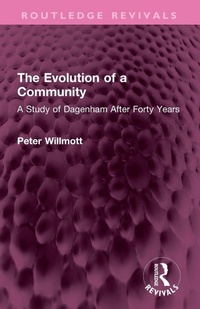
The Evolution of a Community
A Study of Dagenham After Forty Years
1st Edition
Published on 1. August 2025
Book
Paperback/Softback
170 pages
978-1-032-54528-8 (ISBN)
Description
In earlier studies, Peter Willmott and other investigators had documented the social problems of new housing estates - the loneliness, the tensions, the disruption of family and neighbourhood ties. But how far are such troubles transitory? What kind of life would develop in communities like these when time had rubbed off the newness?
Originally published in 1963, in search of an answer, Peter Willmott went to Dagenham in Essex, where forty years before the London County Council began to build a giant estate to rehouse people from the East End of London. His study - of a new estate that had now become an old one - throws light on the long-term effects of this kind of migration. He found at Dagenham, most strikingly, that a way of life very similar to a 'traditional' working-class community had grown up. In this book he discusses the similarities and differences, and shows the influences which had worked for and against this development. After a sketch of the estate's history, he traces the relationships of the people of Dagenham with relatives, friends and neighbours, and then examines their attitudes to each other, to politics and to social class.
His conclusions were not only relevant to housing and town planning policy, but provided insight into the meaning of social class in contemporary Britain at the time.
Originally published in 1963, in search of an answer, Peter Willmott went to Dagenham in Essex, where forty years before the London County Council began to build a giant estate to rehouse people from the East End of London. His study - of a new estate that had now become an old one - throws light on the long-term effects of this kind of migration. He found at Dagenham, most strikingly, that a way of life very similar to a 'traditional' working-class community had grown up. In this book he discusses the similarities and differences, and shows the influences which had worked for and against this development. After a sketch of the estate's history, he traces the relationships of the people of Dagenham with relatives, friends and neighbours, and then examines their attitudes to each other, to politics and to social class.
His conclusions were not only relevant to housing and town planning policy, but provided insight into the meaning of social class in contemporary Britain at the time.
More details
Series
Language
English
Place of publication
London
United Kingdom
Publishing group
Taylor & Francis Ltd
Target group
College/higher education
Professional and scholarly
Postgraduate, Professional, and Undergraduate
Dimensions
Height: 216 mm
Width: 138 mm
Weight
310 gr
ISBN-13
978-1-032-54528-8 (9781032545288)
Copyright in bibliographic data and cover images is held by Nielsen Book Services Limited or by the publishers or by their respective licensors: all rights reserved.
Schweitzer Classification
Other editions
Additional editions
Book
08/2023
1st Edition
Routledge
€144.90
Shipment within 10-20 days
E-Book
05/2023
1st Edition
Routledge
€39.49
Available for download
E-Book
05/2023
1st Edition
Routledge
€39.49
Available for download
Content
Introduction 1. The Estate and its Beginning 2. People and their Jobs 3. Stability and the Place of Relatives 4. Pressures on the Second Generation 5. The Voluntary Emigrants 6. Friends and Neighbours 7. Variations in Sociability 8. Public and Private Living 9. Affluence, Status and Class 10. In Conclusion - the Working-Class Community. Appendices: Methods of Research; Additional Tables; London County Council's House-Room Standards; List of References. Index.