

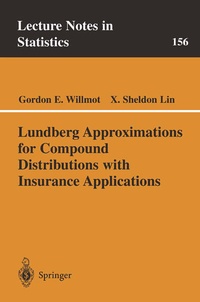
Lundberg Approximations for Compound Distributions with Insurance Applications
Published on 23. October 2000
Book
Paperback/Softback
X, 250 pages
978-0-387-95135-5 (ISBN)
Description
These notes represent our summary of much of the recent research that has been done in recent years on approximations and bounds that have been developed for compound distributions and related quantities which are of interest in insurance and other areas of application in applied probability. The basic technique employed in the derivation of many bounds is induc tive, an approach that is motivated by arguments used by Sparre-Andersen (1957) in connection with a renewal risk model in insurance. This technique is both simple and powerful, and yields quite general results. The bounds themselves are motivated by the classical Lundberg exponential bounds which apply to ruin probabilities, and the connection to compound dis tributions is through the interpretation of the ruin probability as the tail probability of a compound geometric distribution. The initial exponential bounds were given in Willmot and Lin (1994), followed by the nonexpo nential generalization in Willmot (1994). Other related work on approximations for compound distributions and applications to various problems in insurance in particular and applied probability in general is also discussed in subsequent chapters. The results obtained or the arguments employed in these situations are similar to those for the compound distributions, and thus we felt it useful to include them in the notes. In many cases we have included exact results, since these are useful in conjunction with the bounds and approximations developed.
More details
Series
Edition
Softcover reprint of the original 1st ed. 2001
Language
English
Place of publication
New York
United States
Target group
Professional and scholarly
Research
Illustrations
X, 250 p.
Dimensions
Height: 235 mm
Width: 155 mm
Thickness: 15 mm
Weight
406 gr
ISBN-13
978-0-387-95135-5 (9780387951355)
DOI
10.1007/978-1-4613-0111-0
Schweitzer Classification
Persons
Gordon E. Willmot is Munich Re Chair in Insurance and professor in the Department of Statistics and Actuarial Science at the University of Waterloo, Canada. His research interests are in stochastic modelling in insurance. Willmot has (co-)authored over one hundred research papers in leading actuarial and statistical journals. He is also co-author of Lundberg Approximations for Compound Distributions with Insurance Applications (Springer), Loss Models - From Data to Decisions and Loss Models - Further Topics (Wiley), and Insurance Risk Models (Society of Actuaries). He is editor of Insurance: Mathematics and Economics.
Jae-Kyung Woo is Associate Professor in the School of Risk and Actuarial Studies at the University of New South Wales, Sydney. She has worked at the University of Hong Kong and Columbia University prior to joining UNSW. Her research interests are focused on risk theory, reliability theory, aggregate claim analysis,and queueing theory. She has published about twenty papers dealing with the subject of the present monograph and related topics.
Content
1 Introduction.- 2 Reliability background.- 2.1 The failure rate.- 2.2 Equilibrium distributions.- 2.3 The residual lifetime distribution and its mean.- 2.4 Other classes of distributions.- 2.5 Discrete reliability classes.- 2.6 Bounds on ratios of discrete tail probabilities.- 3 Mixed Poisson distributions.- 3.1 Tails of mixed Poisson distributions.- 3.2 The radius of convergence.- 3.3 Bounds on ratios of tail probabilities.- 3.4 Asymptotic tail behaviour of mixed Poisson distributions.- 4 Compound distributions.- 4.1 Introduction and examples.- 4.2 The general upper bound.- 4.3 The general lower bound.- 4.4 A Wald-type martingale approach.- 5 Bounds based on reliability classifications.- 5.1 First order properties.- 5.2 Bounds based on equilibrium properties.- 6 Parametric Bounds.- 6.1 Exponential bounds.- 6.2 Pareto bounds.- 6.3 Product based bounds.- 7 Compound geometric and related distributions.- 7.1 Compound modified geometric distributions.- 7.2 Discrete compound geometric distributions.- 7.3 Application to ruin probabilities.- 7.4 Compound negative binomial distributions.- 8 Tijms approximations.- 8.1 The asymptotic geometric case.- 8.2 The modified geometric distribution.- 8.3 Transform derivation of the approximation.- 9 Defective renewal equations.- 9.1 Some properties of defective renewal equations.- 9.2 The time of ruin and related quantities.- 9.3 Convolutions involving compound geometric distributions.- 10 The severity of ruin.- 10.1 The associated defective renewal equation.- 10.2 A mixture representation for the conditional distribution.- 10.3 Erlang mixtures with the same scale parameter.- 10.4 General Erlang mixtures.- 10.5 Further results.- 11 Renewal risk processes.- 11.1 General properties of the model.- 11.2 The Coxian-2 case.- 11.3 The sum of two exponentials.- 11.4 Delayed and equilibrium renewal risk processes.- Symbol Index.- Author Index.