

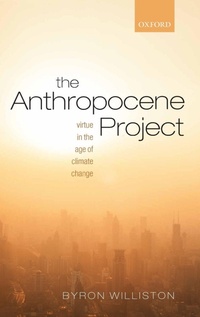
The Anthropocene Project
Virtue in the Age of Climate Change
Published on 24. September 2015
Book
Hardback
224 pages
978-0-19-874671-3 (ISBN)
Description
The evidence presented in the recently released Fifth Assessment Report (AR5) of the Intergovernmental Panel on Climate Change (IPCC) suggests strongly that continued failure to make meaningful cuts to greenhouse gas emissions could bring about disastrous results for the human community, especially for future generations. Summing up the findings of AR5, Rajendra Pachauri, chairman of the IPCC, has stated that our persistent inaction on climate change presents a grave threat to the very social stability of human systems.
The Anthropocene Project attempts to make philosophical sense of this, examining the reasons for the inaction highlighted by the IPCC, and suggests the normative bases for overcoming it. Williston identifies that we are now in the human agethe Anthropocenebut he argues that this is no mere geological marker. It is instead best viewed as the latest permutation of an already existing moral and political project rooted in Enlightenment values. The author shows that it can be fruitful to do climate ethics with this focus because in so many aspects of our culture we already endorse broadly Enlightenment values about progress, equality, and the value of knowledge. But these values must be robustly instantiated in the dispositions of moral agents, and so we require a climate ethics emphasizing the virtues of justice, truthfulness, and rational hope.
One of the books most original claims is that our moral failure on this issue is, in large part, the product of motivated irrationality on the part of the world's most prosperous people. We have failed to live up to our commitments to justice and truthfulness because we are, respectively, morally weak and self-deceived. Understanding this provides the basis for the rational hope that we might yet find a way to avoid climate catastrophe.
The Anthropocene Project attempts to make philosophical sense of this, examining the reasons for the inaction highlighted by the IPCC, and suggests the normative bases for overcoming it. Williston identifies that we are now in the human agethe Anthropocenebut he argues that this is no mere geological marker. It is instead best viewed as the latest permutation of an already existing moral and political project rooted in Enlightenment values. The author shows that it can be fruitful to do climate ethics with this focus because in so many aspects of our culture we already endorse broadly Enlightenment values about progress, equality, and the value of knowledge. But these values must be robustly instantiated in the dispositions of moral agents, and so we require a climate ethics emphasizing the virtues of justice, truthfulness, and rational hope.
One of the books most original claims is that our moral failure on this issue is, in large part, the product of motivated irrationality on the part of the world's most prosperous people. We have failed to live up to our commitments to justice and truthfulness because we are, respectively, morally weak and self-deceived. Understanding this provides the basis for the rational hope that we might yet find a way to avoid climate catastrophe.
Reviews / Votes
By relating his discussion to mainstream ethics, action theory and moral philosophy, Williston provides an excellent bridge for philosophers, from the familiar literature of their discipline to the facts about climate change. For environmentalists and others with little experience in philosophy, the book bears powerful witness to the relevance of our discipline. I recommend this book strongly to all those who want to see how some traditional philosophical notions can be extended in our struggle to cope with climate change. * Dale Jamieson, Notre Dame Philosophical Reviews * Williston presents a novel and compelling thesis which builds on research across many disciplines and provides a refreshing insight into some less prominent areas of debate. Through accessible terminology and a logical and well-presented series of arguments, the book is an excellent addition to the climate change literature and is open to a wide audience. * Ewan J. Woodley, College of Life and Environmental Sciences, University of Exeter * Byron Williston's account of the Anthropocene project provides a compelling exploration of the task that we face in light of climate change and of the virtues that we must embody to complete that task. This book provides a powerful framework for understanding the moral and intellectual failures that have brought us to the point where climate change is likely to gravely harm future generations. It synthesizes a broad philosophical literature, provides insightful analyses of relevant virtues and vices, and engages readers with colorful appeals to film and fiction. * William Throop, Philosophy and Environmental Studies *More details
Language
English
Place of publication
Oxford
United Kingdom
Target group
College/higher education
Dimensions
Height: 240 mm
Width: 161 mm
Thickness: 17 mm
Weight
502 gr
ISBN-13
978-0-19-874671-3 (9780198746713)
Copyright in bibliographic data and cover images is held by Nielsen Book Services Limited or by the publishers or by their respective licensors: all rights reserved.
Schweitzer Classification
Other editions
Additional editions
E-Book
09/2015
1st Edition
OUP eBook
€57.49
Available for download
Person
Dr. Byron Williston is an Associate Professor of Philosophy at Wilfrid Laurier University. He received his PhD in Philosophy at The University of Toronto, and has taught at the University of Toronto, The University of South Florida, and Wilfrid Laurier University. He is the author of Environmental Ethics for Canadians, 2nd edition (forthcoming, Oxford University Press) as well as numerous articles on the History of Philosophy, Ethical Theory, Environmental Ethics, Epistemology, and the problem of motivated irrationality.
Content
1. Introduction: Climate Change and the Virtues ; 2. The Anthropocene Project ; 3. The Spectre of Fragmentation ; 4. Justice ; 5. Truthfulness ; 6. Hope ; 7. Conclusion: Will They Forgive Us?