

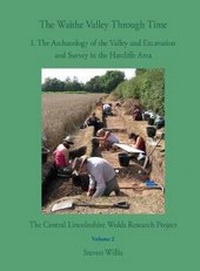
The Waithe Valley Through Time
1. The Archaeology of the Valley and Excavation and Survey in the Hatcliffe Area
Published on 19. February 2020
Book
Paperback/Softback
464 pages
978-1-9996155-4-3 (ISBN)
Description
This volume examines the archaeology of the Waithe Valley as it passes through the central Lincolnshire Wolds. It concentrates on fieldwork and finds from the eastern edge of the Wolds and was undertaken as part of the Central Lincolnshire Wolds Research Project. It documents the development of human presence in and use of the valley from prehistory to recent times, reporting on geophysical survey, fieldwalking and excavations.
The monograph focusses on the evidence for a late Roman settlement, field system and enclosures. Evidence of corn-drying ovens and faunal remains reflect agricultural regimes and the various finds assemblages recovered provide an understanding of the landscape and economy of a later Roman farming complex.
The monograph focusses on the evidence for a late Roman settlement, field system and enclosures. Evidence of corn-drying ovens and faunal remains reflect agricultural regimes and the various finds assemblages recovered provide an understanding of the landscape and economy of a later Roman farming complex.
More details
Series
Language
English
Place of publication
London
United Kingdom
Target group
Professional and scholarly
Illustrations
169
Dimensions
Height: 300 mm
Width: 215 mm
ISBN-13
978-1-9996155-4-3 (9781999615543)
Copyright in bibliographic data and cover images is held by Nielsen Book Services Limited or by the publishers or by their respective licensors: all rights reserved.
Person
Steven Willis is Head of Department and Senior Lecturer in the Department of Classical and Archaeological Studies at the University of Kent. He has expertise in the Iron Age and Roman periods in Britain and Europe. His research interests cover settlement and society, material culture, landscape and environments, and phenomenology, as well as the archaeology of coasts and cultural expression in the Early Modern era.