

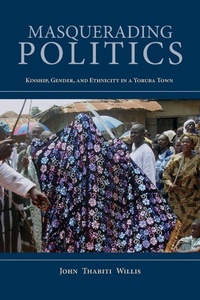
Masquerading Politics
Kinship, Gender, and Ethnicity in a Yoruba Town
Published on 15. January 2018
Book
Paperback/Softback
210 pages
978-0-253-03146-4 (ISBN)
Description
In West Africa, especially among Yoruba people, masquerades have the power to kill enemies, appoint kings, and grant fertility. John Thabiti Willis takes a close look at masquerade traditions in the Yoruba town of Otta, exploring transformations in performers, performances, and the institutional structures in which masquerade was used to reveal ongoing changes in notions of gender, kinship, and ethnic identity. As Willis focuses on performers and spectators, he reveals a history of masquerade that is rich and complex. His research offers a more nuanced understanding of performance practices in Africa and their role in forging alliances, consolidating state power, incorporating immigrants, executing criminals, and projecting individual and group power on both sides of the Afro-Atlantic world.
Reviews / Votes
"[This]book as a whole stands as a major achievement not only in Yoruba history and historical anthropology, but in recent historiographic trends using ritual institutions and performances as primary historical sources. It will have a major impact in Yoruba studies, and in the study of West African history more generally. Willis should be commended for penetrating a complex and socially guarded ritual resource to glean the hidden histories manifested therein."-African Studies Review"Willis's work should be a must-read for students and established scholars alike."-Africa
"John Thabiti Willis cites oral traditions, archival sources, and publications to draw attention to the link between economic development and spectacular and historically influential masquerade performances."-Babatunde Lawal, author of The Gelede Spectacle
"Important in its emphasis on the history of an art form and its specific cultural context; of interest to academic audiences as well as general readers."-Henry Drewal, editor of Sacred Waters
More details
Series
Language
English
Place of publication
Bloomington, IN
United States
Target group
College/higher education
Product notice
Paperback (trade)
Illustrations
27 color illus., 5 maps
Dimensions
Height: 229 mm
Width: 152 mm
Thickness: 14 mm
Weight
471 gr
ISBN-13
978-0-253-03146-4 (9780253031464)
Copyright in bibliographic data and cover images is held by Nielsen Book Services Limited or by the publishers or by their respective licensors: all rights reserved.
Schweitzer Classification
Other editions
Additional editions
E-Book
01/2018
Indiana University Press
€18.18
Available for download
Person
John Thabiti Willis is Associate Professor of African History at Carleton College. He is an associate editor of the Journal of West African History.
Content
Acknowledgements
Introduction
1. The Early History of Otta and the Origins of Egungun and Gelede
2. "Children" and "Wives" in the Politics of the Oyo Empire during the Era of the Atlantic Slave Trade
3. The Emergence of New Warriors, Wards, and Masquerades: The Otta Kingdom during the Era of Imperial Collapse
4. "A Thing to Govern the Town": Gendered Masquerades and the Politics of the Chiefs and the Monarchy in the Rebuilding of a Town, 1848-1859
5. Wives, Warriors, and Masks: Kinship, Gender, and Ethnicity in Otta, 1871-1928
Conclusion: Egungun and Gelede at Otta Today
Bibliography
Index
Introduction
1. The Early History of Otta and the Origins of Egungun and Gelede
2. "Children" and "Wives" in the Politics of the Oyo Empire during the Era of the Atlantic Slave Trade
3. The Emergence of New Warriors, Wards, and Masquerades: The Otta Kingdom during the Era of Imperial Collapse
4. "A Thing to Govern the Town": Gendered Masquerades and the Politics of the Chiefs and the Monarchy in the Rebuilding of a Town, 1848-1859
5. Wives, Warriors, and Masks: Kinship, Gender, and Ethnicity in Otta, 1871-1928
Conclusion: Egungun and Gelede at Otta Today
Bibliography
Index