

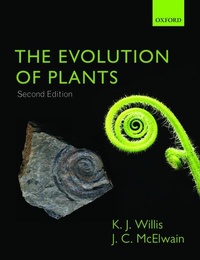
The Evolution of Plants
2nd Edition
Published on 19. December 2013
Book
Paperback/Softback
408 pages
978-0-19-929223-3 (ISBN)
Description
Plants first colonized the land over 430 million years ago, having evolved from some of the most primitive forms of life. Since then, plants have played a major role in supplying the atmospheric oxygen we all need to survive. But how did plants evolve, how has their distribution and diversity been affected by changes in climate over millions of years - and how can these processes be studied?
The Evolution of Plants blends evidence from the fossil record and data from biomolecular studies to tell the story of plant evolution from the earliest forms of life to the present day. Focusing on the key events during the evolution of plants - from the colonization of land to the first forests, the emergence of seed plants to the evolution of flowering plants - its straightforward explanations and clear illustrations provide the reader with the most accessible introduction to plant evolution available.
With stunning biome maps illustrating the global distribution of plants during the different periods of life on Earth, the book explains how the diversity of vegetation has changed in response to climate, reinforcing the close link between climate change and the process of biological evolution.
It is a contemporary account of a dynamic field, which is perfect for any student looking for a broad, balanced introduction to the subject.
Online Resources
The online resources to accompany The Evolution of Plants feature
- figures from the book in electronic format, for use by registered adopters;
- Journal Clubs, which encourage students to critically evaluate and engage with published research related to topics explored in the book
The Evolution of Plants blends evidence from the fossil record and data from biomolecular studies to tell the story of plant evolution from the earliest forms of life to the present day. Focusing on the key events during the evolution of plants - from the colonization of land to the first forests, the emergence of seed plants to the evolution of flowering plants - its straightforward explanations and clear illustrations provide the reader with the most accessible introduction to plant evolution available.
With stunning biome maps illustrating the global distribution of plants during the different periods of life on Earth, the book explains how the diversity of vegetation has changed in response to climate, reinforcing the close link between climate change and the process of biological evolution.
It is a contemporary account of a dynamic field, which is perfect for any student looking for a broad, balanced introduction to the subject.
Online Resources
The online resources to accompany The Evolution of Plants feature
- figures from the book in electronic format, for use by registered adopters;
- Journal Clubs, which encourage students to critically evaluate and engage with published research related to topics explored in the book
Reviews / Votes
Review from previous edition This is one of those rare books that one can honestly label 'outstanding' * Amazon *More details
Edition
2nd Revised edition
Language
English
Place of publication
Oxford
United Kingdom
Target group
College/higher education
Professional and scholarly
Edition type
Revised edition
Dimensions
Height: 246 mm
Width: 189 mm
Thickness: 20 mm
Weight
690 gr
ISBN-13
978-0-19-929223-3 (9780199292233)
Copyright in bibliographic data and cover images is held by Nielsen Book Services Limited or by the publishers or by their respective licensors: all rights reserved.
Schweitzer Classification
Other editions
Previous edition
Kathy Willis | Jenny McElwain
The Evolution of Plants
Book
01/2002
Oxford University Press
€47.03
Article exhausted; check for reprint
Persons
Kathy Willis is Director of the Biodiversity Institute in the Zoology Department at the University of Oxford and a Professorial Fellow at Merton College. She gained her first degree in Geography and Environmental Science from the University of Southampton, and a Ph.D. from the University of Cambridge in Plant Sciences. In her early postdoctoral career, Kathy held a Selwyn College Research Fellowship and then a NERC Postdoctoral Fellowship in the Department of Plant Sciences, University of Cambridge. This was followed by a Royal Society University Research Fellowship in the Godwin Institute for Quaternary Research, University of Cambridge. Kathy moved to a University Lectureship in the School of Geography and the Environment, University of Oxford in 1999 where she established the Oxford Long-term Ecology Laboratory in 2002 and was made a Professor of Long-term Ecology in 2008.
Jennifer C McElwain received her B.A. in Botany from Trinity College Dublin in 1993 and her PhD in Paleobotany in 1997 from Royal Holloway College, University of London. She was a Natural Environment Research Council Post Doctoral research associate between 1997 and 1998 and a Leverhulme Postdoctoral Fellow between 1998 and 2000. McElwain held the position of Assistant Curator of Paleobotany at the Field Museum of Natural History in Chicago between 2000 and 2003 and was Associate Curator of Paleobotany from 2003 until 2006, when she took up her current position as Lecturer in Plant Palaeobiology and Palaeoecology in the School of Biology and Environmental Science at University College Dublin. She is a Research Associate of the Field Museum and an Adjunct Associate Professor at Northwestern University, USA.
Jennifer C McElwain received her B.A. in Botany from Trinity College Dublin in 1993 and her PhD in Paleobotany in 1997 from Royal Holloway College, University of London. She was a Natural Environment Research Council Post Doctoral research associate between 1997 and 1998 and a Leverhulme Postdoctoral Fellow between 1998 and 2000. McElwain held the position of Assistant Curator of Paleobotany at the Field Museum of Natural History in Chicago between 2000 and 2003 and was Associate Curator of Paleobotany from 2003 until 2006, when she took up her current position as Lecturer in Plant Palaeobiology and Palaeoecology in the School of Biology and Environmental Science at University College Dublin. She is a Research Associate of the Field Museum and an Adjunct Associate Professor at Northwestern University, USA.
Content
1. The evolutionary record and methods of reconstruction ; 2. Earliest forms of plant life ; 3. The colonization of land ; 4. The first forests ; 5. Major emergence of the seed plants ; 6. Flowering plant origins ; 7. The past 65 million years ; 8. Mass extinctions and persistent populations ; 9. Ancient DNA and the biomolecular record ; 10. Evolutionary theories and the plant fossil record