

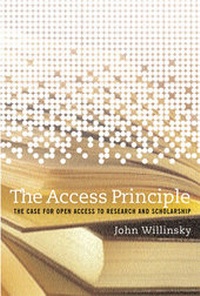
The Access Principle
The Case for Open Access to Research and Scholarship
Published on 7. October 2005
Book
Hardback
312 pages
978-0-262-23242-5 (ISBN)
Description
Questions about access to scholarship go back farther than recent debates
over subscription prices, rights, and electronic archives suggest. The great
libraries of the past -- from the fabled collection at Alexandria to the early
public libraries of nineteenth-century America -- stood as arguments for increasing
access. In The Access Principle, John Willinsky describes the latest chapter in this
ongoing story -- online open access publishing by scholarly journals -- and makes a
case for open access as a public good.A commitment to scholarly work, writes
Willinsky, carries with it a responsibility to circulate that work as widely as
possible: this is the access principle. In the digital age, that responsibility
includes exploring new publishing technologies and economic models to improve access
to scholarly work. Wide circulation adds value to published work; it is a
significant aspect of its claim to be knowledge. The right to know and the right to
be known are inextricably mixed. Open access, argues Willinsky, can benefit both a
researcher-author working at the best-equipped lab at a leading research university
and a teacher struggling to find resources in an impoverished high school.Willinsky
describes different types of access -- the New England Journal of Medicine, for
example, grants open access to issues six months after initial publication, and
First Monday forgoes a print edition and makes its contents immediately accessible
at no cost. He discusses the contradictions of copyright law, the reading of
research, and the economic viability of open access. He also considers broader
themes of public access to knowledge, human rights issues, lessons from publishing
history, and "epistemological vanities." The debate over open access, writes
Willinsky, raises crucial questions about the place of scholarly work in a larger
world -- and about the future of knowledge.
over subscription prices, rights, and electronic archives suggest. The great
libraries of the past -- from the fabled collection at Alexandria to the early
public libraries of nineteenth-century America -- stood as arguments for increasing
access. In The Access Principle, John Willinsky describes the latest chapter in this
ongoing story -- online open access publishing by scholarly journals -- and makes a
case for open access as a public good.A commitment to scholarly work, writes
Willinsky, carries with it a responsibility to circulate that work as widely as
possible: this is the access principle. In the digital age, that responsibility
includes exploring new publishing technologies and economic models to improve access
to scholarly work. Wide circulation adds value to published work; it is a
significant aspect of its claim to be knowledge. The right to know and the right to
be known are inextricably mixed. Open access, argues Willinsky, can benefit both a
researcher-author working at the best-equipped lab at a leading research university
and a teacher struggling to find resources in an impoverished high school.Willinsky
describes different types of access -- the New England Journal of Medicine, for
example, grants open access to issues six months after initial publication, and
First Monday forgoes a print edition and makes its contents immediately accessible
at no cost. He discusses the contradictions of copyright law, the reading of
research, and the economic viability of open access. He also considers broader
themes of public access to knowledge, human rights issues, lessons from publishing
history, and "epistemological vanities." The debate over open access, writes
Willinsky, raises crucial questions about the place of scholarly work in a larger
world -- and about the future of knowledge.
More details
Series
Language
English
Place of publication
Cambridge, Mass.
United States
Publishing group
MIT Press Ltd
Target group
Professional and scholarly
Illustrations
0 illus.
Dimensions
Height: 229 mm
Width: 152 mm
Thickness: 0 mm
Weight
544 gr
ISBN-13
978-0-262-23242-5 (9780262232425)
Copyright in bibliographic data and cover images is held by Nielsen Book Services Limited or by the publishers or by their respective licensors: all rights reserved.
Schweitzer Classification
Person
John Willinsky is Pacific Press Professor of Literacy and Technology at
the University of British Columbia. He is the author of Empire of Words: The Reign
of the OED and a developer of Open Journals Systems software.
the University of British Columbia. He is the author of Empire of Words: The Reign
of the OED and a developer of Open Journals Systems software.