

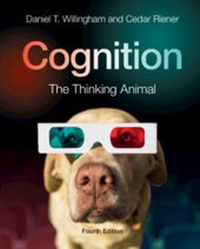
Cognition
The Thinking Animal
4th Edition
Published on 1. August 2019
Book
Paperback/Softback
448 pages
978-1-107-52512-2 (ISBN)
Description
By describing experiments that control, manipulate and measure mental processes, this book shows how we can discover the answers to key questions about the mind, such as: 'Can we focus attention on more than one thing?' and 'Is language unique to humans?' Written in a down-to-earth narrative prose that avoids jargon, addresses the reader directly and draws on the authors' unique style ('suppose Willingham split his pants at a junior high dance ...'), this text takes complex experiments in cognitive psychology and describes them for undergraduate students. Willingham has a record of excellence in translating cognitive psychology research for K-12 teachers with his bestselling Why Don't Students Like School? and other popular books. This book applies the clear and approachable prose style towards building foundational knowledge in cognitive psychology for undergraduates.
Reviews / Votes
'In my experience, cognitive psychology texts are seldom engaging for students. Cognition: The Thinking Animal, by Willingham and Riener, is markedly different. The conversational writing style, extensive use of real-life examples, and the way the authors help readers to understand the mind-sets of researchers offers a heightened learning experience for students.' Jeffrey Walczyk, Louisiana Tech University 'A model textbook; well-reasoned, engaging, clear and accurate. The imagery debate of Chapter 12 is particularly memorable, reading like a gripping scientific mystery story. A wonderful resource for students and instructors alike.' Nora S. Newcombe, Temple University, Pennsylvania 'Clearly written and beautifully illustrated, this textbook provides not only a compelling picture of what we know about human cognitive processes, but also a primer on the role the scientific method has played in revealing the complex dynamics of human cognition.' Robert A. Bjork, University of California 'An excellent choice for an introductory cognitive psychology course. The writing style is clear and engaging, and the authors provide fun, real-world examples that help make the information relatable to daily life.' Carmen Westerberg, Texas State UniversityMore details
Edition
4th Revised edition
Language
English
Place of publication
Cambridge
United Kingdom
Target group
College/higher education
Professional and scholarly
Edition type
Revised edition
Product notice
Paperback (trade)
Illustrations
6 Tables, black and white; 250 Plates, color; 250 Line drawings, color
Dimensions
Height: 254 mm
Width: 205 mm
Thickness: 22 mm
Weight
1100 gr
ISBN-13
978-1-107-52512-2 (9781107525122)
Copyright in bibliographic data and cover images is held by Nielsen Book Services Limited or by the publishers or by their respective licensors: all rights reserved.
Schweitzer Classification
Other editions
New editions
Book
03/2025
5th Edition
Cambridge University Press
€136.40
Shipment within 15-20 days
Additional editions
E-Book
08/2019
Cambridge University Press
€73.99
Available for download
E-Book
07/2019
4th Edition
Cambridge University Press
€80.49
Available for download
Book
4th Edition
Cambridge University Press
Unfortunately, price unknown
The article will not be published
Persons
Daniel T. Willingham is Professor of Psychology at the University of Virginia, where he has taught since 1992. He has won multiple department and university teaching awards. His research focuses on the application of cognitive principles to K-16 education, and his work on that subject has appeared in sixteen languages. In 2017 he was appointed by President Obama to serve as a Member of the National Board for Education Sciences. Cedar Riener is a cognitive psychologist and Associate Professor of Psychology at Randolph-Macon College, Virginia. He researches perception of the natural world and how the state of our body influences that perception.
Content
1. Introduction: cognitive psychologists' approach to research; 2. Methods of cognitive psychology; 3. Visual perception; 4. Attention; 5. Sensory and working memory; 6. Long term memory structure; 7. Long term memory processes. Memory encoding; 8. Memory retrieval; 9. Concepts and categories; 10. Language structure; 11. Language processing; 12. Visual imagery; 13. Decision making and reasoning; 14. Problem solving.