

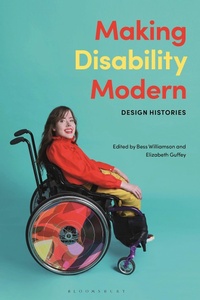
Making Disability Modern
Design Histories
Published on 20. August 2020
Book
Paperback/Softback
264 pages
978-1-350-07042-4 (ISBN)
Description
Making Disability Modern: Design Histories brings together leading scholars from a range of disciplinary and national perspectives to examine how designed objects and spaces contributes to the meanings of ability and disability from the late 18th century to the present day, and in homes, offices, and schools to realms of national and international politics. The contributors reveal the social role of objects - particularly those designed for use by people with disabilities, such as walking sticks, wheelchairs, and prosthetic limbs - and consider the active role that makers, users and designers take to reshape the material environment into a usable world. But it also aims to make clear that definitions of disability-and ability-are often shaped by design.
Reviews / Votes
Making Disability Modern makes a good reader that maps out the areas of tension, new discourse, and discussion points about design and disability from practical, social, cultural, and technological perspectives. * Technology and Culture * This book makes visible often-obscured aspects of human life, the built environment, and societal factors that materialize through design, disability, and their intersections over history and across continents. -- Meryl Alper, Assistant Professor of Communication Studies, Northeastern University, USA A fascinating collection of critical cultural histories of disability objects, woven together with a narrative of 'the modern' and its connotations in society, industry and design. We need more books like this to connect disability studies and design. -- Graham Pullin, Professor of Design and Disability, University of Dundee, UK At last! Since the publication in 2002 of the groundbreaking anthology, Artificial Parts, Practical Lives: Modern Histories of Prosthetics (NYU Press), scholarship has boomed at the intersection of disability studies and the history of technology. This new collection from Bloomsbury brings readers up to date with developments in the field, revising familiar historical throughlines with an original "design model of disability." Rather than situate disability outside modernism, with its predilection for clean lines and average bodies, the authors in Making Disability Modern rethink "dismodern" design and the modern ambitions of disabled designers themselves. -- Mara Mills, Associate Professor of Media, Culture and Communication, New York University, USAMore details
Language
English
Place of publication
London
United Kingdom
Publishing group
Bloomsbury Publishing PLC
Target group
College/higher education
Illustrations
20 bw illus
Dimensions
Height: 229 mm
Width: 150 mm
Thickness: 15 mm
Weight
407 gr
ISBN-13
978-1-350-07042-4 (9781350070424)
Copyright in bibliographic data and cover images is held by Nielsen Book Services Limited or by the publishers or by their respective licensors: all rights reserved.
Schweitzer Classification
Other editions
Additional editions
E-Book
07/2020
1st Edition
Bloomsbury Visual Arts
€27.49
Available for download
E-Book
07/2020
1st Edition
Bloomsbury Visual Arts
€27.49
Available for download
Persons
Elizabeth Guffey is Professor of Art and Design History at Purchase College, State University of New York, USA, where she also heads the MA in Modern and Contemporary Art. She is the author of Designing Disability: Symbols, Space, and Society (Bloomsbury, 2017), Posters: A Global History (2014), and Retro: The Culture of Revival (2002).
Bess Williamson is Associate Professor of Design History at the School of the Art Institute of Chicago, where she teaches courses on modern and contemporary design in relation to politics and social change. Her book, Accessible America: A History of Disability and Design (2019), describes the role of design in the US Disability Rights cause of the last half of the 20th century.
Bess Williamson is Associate Professor of Design History at the School of the Art Institute of Chicago, where she teaches courses on modern and contemporary design in relation to politics and social change. Her book, Accessible America: A History of Disability and Design (2019), describes the role of design in the US Disability Rights cause of the last half of the 20th century.
Content
Acknowledgments
Introduction: Rethinking Design History through Disability, Rethinking Disability through Design
Elizabeth Guffey and Bess Williamson, School of the Art Institute of Chicago, USA
Section I: Designers and Users From Craft to Industry
Introduction
1. The Material Culture of Gout in Early America, Nicole Belolan (Rutgers University, USA)
2. Walking Cane Style and Medicalized Mobility, Cara Kiernan Fallon (University of Pennsylvania, USA)
3. Artificial Limbs on the Panama Canal, Caroline Lieffers (Yale University, USA)
4. Technologies for the Deaf in British India, 1850-1950, Aparna Nair (University of Oklahoma, USA)
Section II: Disability and World-Making in the Twentieth Century
Introduction
5. The Ideologies of Designing for Disability, Elizabeth Guffey (Purdue University, USA)
6. Architecture, Science, and Disabled Citizenship, Wanda Katja Liebermann (Florida Atlantic University, USA)
7. Disability and Modern Chemical Sensitivities, Debra Riley Parr (Columbia College Chicago, USA)
8. Design for Deaf Education: An Early History of the National Technical Institute for the Deaf, Kristoffer Whitney (Rochester Institute of Technology, USA)
9. Designing the Japanese Walking Bag, Elizabeth Guffey (Purdue University, USA)
Section III: Making Disability Digital
Introduction
10. The Politics and Logistics of Ergonomic Design, Jennifer Kaufmann-Buhler (Purdue University, USA)
11. Designing Emergency Access: Lifeline & LifeCall, Elizabeth Ellcessor (University of Virginia, USA)
12. 3D Printed Prosthetics and the Uses of Design, Bess Williamson (School of the Art Institute of Chicago, USA)
13. Materializing User Identities and Digital Humanities, Jaipreet Virdi (University of Delaware, USA)
Introduction: Rethinking Design History through Disability, Rethinking Disability through Design
Elizabeth Guffey and Bess Williamson, School of the Art Institute of Chicago, USA
Section I: Designers and Users From Craft to Industry
Introduction
1. The Material Culture of Gout in Early America, Nicole Belolan (Rutgers University, USA)
2. Walking Cane Style and Medicalized Mobility, Cara Kiernan Fallon (University of Pennsylvania, USA)
3. Artificial Limbs on the Panama Canal, Caroline Lieffers (Yale University, USA)
4. Technologies for the Deaf in British India, 1850-1950, Aparna Nair (University of Oklahoma, USA)
Section II: Disability and World-Making in the Twentieth Century
Introduction
5. The Ideologies of Designing for Disability, Elizabeth Guffey (Purdue University, USA)
6. Architecture, Science, and Disabled Citizenship, Wanda Katja Liebermann (Florida Atlantic University, USA)
7. Disability and Modern Chemical Sensitivities, Debra Riley Parr (Columbia College Chicago, USA)
8. Design for Deaf Education: An Early History of the National Technical Institute for the Deaf, Kristoffer Whitney (Rochester Institute of Technology, USA)
9. Designing the Japanese Walking Bag, Elizabeth Guffey (Purdue University, USA)
Section III: Making Disability Digital
Introduction
10. The Politics and Logistics of Ergonomic Design, Jennifer Kaufmann-Buhler (Purdue University, USA)
11. Designing Emergency Access: Lifeline & LifeCall, Elizabeth Ellcessor (University of Virginia, USA)
12. 3D Printed Prosthetics and the Uses of Design, Bess Williamson (School of the Art Institute of Chicago, USA)
13. Materializing User Identities and Digital Humanities, Jaipreet Virdi (University of Delaware, USA)