

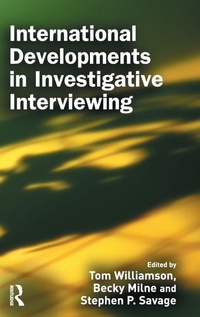
International Developments in Investigative Interviewing
1st Edition
Published on 1. April 2009
Book
Hardback
240 pages
978-1-84392-276-6 (ISBN)
Description
This book examines international developments in investigative interviewing. It analyses the cases and other factors leading to the paradigm shift in a number of countries, it considers issues that are of current interest to practitioners and academics including the continuing calls for the use of torture, whether it is possible to detect deception and the contribution of investigative interviewing methods to concepts of therapeutic and restorative justice.
The book responds to the recognition that there are currently no international human rights instruments that relate specifically to custodial questioning, whilst also offering a critical analysis of the attempts to influence investigator and prosecutor behaviour by recourse to human rights. This book will be essential reading for practitioners designing and delivering investigative interviewing training programmes as well as academics and students studying international criminal justice.
The book responds to the recognition that there are currently no international human rights instruments that relate specifically to custodial questioning, whilst also offering a critical analysis of the attempts to influence investigator and prosecutor behaviour by recourse to human rights. This book will be essential reading for practitioners designing and delivering investigative interviewing training programmes as well as academics and students studying international criminal justice.
Reviews / Votes
"The editors have assembled a magnificent collaboration between Criminologists and Psychologists internationally, bringing forth critical knowledge and insight. I believe that from an international perspective, its comparative approach will be invaluable. This handbook is essential reading and a comprehensive resource, and challenges the attitudes, beliefs, and assumptions for a wide potential readership." - Carol Spaderna, Aberystwyth University, UKMore details
Language
English
Place of publication
Cullompton
United Kingdom
Publishing group
Taylor & Francis Ltd
Target group
College/higher education
Dimensions
Height: 240 mm
Width: 161 mm
Thickness: 18 mm
Weight
531 gr
ISBN-13
978-1-84392-276-6 (9781843922766)
Copyright in bibliographic data and cover images is held by Nielsen Book Services Limited or by the publishers or by their respective licensors: all rights reserved.
Schweitzer Classification
Other editions
Additional editions
Tom Williamson | Becky Milne | Stephen Savage
International Developments in Investigative Interviewing
Book
06/2015
1st Edition
CRC Press
€71.40
Shipment within 10-20 days
Tom Williamson | Becky Milne | Stephen Savage
International Developments in Investigative Interviewing
E-Book
01/2013
1st Edition
Willan Publishing
€64.49
Available for download
Tom Williamson | Becky Milne | Stephen Savage
International Developments in Investigative Interviewing
E-Book
01/2013
1st Edition
Willan Publishing
€64.49
Available for download
Persons
Tom Williamson was a senior police officer in both the Metropolitan and Nottinghamshire police forces. He was also one of the pioneers behind the establishment of the Institute of Criminal Justice at Portsmouth University in 1992.
Becky Milne is a Reader in Forensic Psychology at the Institute of Criminal Justice Studies at the University of Portsmouth.
Stephen Savage is Professor of Criminology at the Institute of Criminal Justice Studies, Portsmouth University.
Becky Milne is a Reader in Forensic Psychology at the Institute of Criminal Justice Studies at the University of Portsmouth.
Stephen Savage is Professor of Criminology at the Institute of Criminal Justice Studies, Portsmouth University.
Content
Foreword Introduction Part 1: Investigative interviewing and interrogation around the world 1. Investigative interviewing of suspects in Australia 2. Investigative interviewing in the UK 3. Investigative interviewing in the Nordic region 4. Police interviewing in France, Belgium and the Netherlands: something is moving 5. Police interrogation in Canada: from the quest for confession to the search for the truth 6. Interview and interrogation: a perspective and update from the USA Part 2: Current issues in interrogation and investigative interviewing 7. A critical analysis of the Utilitarian case for torture and the situational factors that lead some people to become torturers 8. Investigative interviewing as a therapeutic jurisprudential approach 9. Increasing cognitive load in interviews to detect deceit 10. Detecting deceit: current issues