

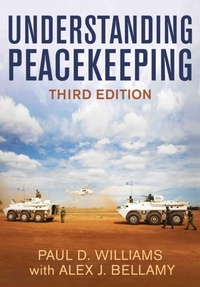
Understanding Peacekeeping
Published on 24. December 2020
Book
Paperback/Softback
456 pages
978-0-7456-8672-1 (ISBN)
Description
Peace operations remain a principal tool for managing armed conflict and protecting civilians. The fully revised, expanded and updated third edition of Understanding Peacekeeping provides a comprehensive and up-to-date introduction to the theory, history, and politics of peace operations.
Drawing on a dataset of nearly two hundred historical and contemporary missions, this book evaluates the changing characteristics of the contemporary international environment in which peace operations are deployed, the strategic purposes peace operations are intended to achieve, and the major challenges facing today's peacekeepers. All the chapters have been revised and updated and five new chapters have been added on stabilisation, force generation, use of force, organized crime, and exit strategies.
Part 1 summarizes the central concepts and issues related to peace operations. It includes updated discussion of the theories of peace operations, how they are authorized, financed and assembled, as well as surveying evidence of their impact in the field. Part 2 charts the historical development of peacekeeping from 1945 through to 2020. Part 3 analyzes the strategic purposes that United Nations and other peace operations are intended to achieve, namely, prevention, observation, assistance, enforcement, stabilisation, and administration. Part 4 looks forward and examines the central challenges facing today's peacekeepers: force generation, the regionalization and privatization of peace operations, the use of force, civilian protection, gender issues, policing and organized crime, and exit strategies.
The third edition of Understanding Peacekeeping will be essential reading for students and scholars of peace and conflict studies, security studies, and international relations.
Reviews / Votes
"This book is magisterial in bringing together the various strands of research and viewpoints into a clear, accessible, remarkably comprehensive and very readable format."Katharina Coleman, University of British Columbia
"This book is the perfect introduction to peacekeeping - complete with little-known facts, reliable statistics, insightful theories, provoking debates, and in-depth analyses. It will be incredibly useful to students and experienced researchers alike."
Severine Autesserre, Author of Peaceland and The Frontlines of Peace
"This book is by far the most comprehensive and readable overview of the evolution, challenges, and controversies of peace operations yet written. It will be exceptionally valuable not only as an introduction to the subject but also as a reference document for experts."
Roland Paris, University of Ottawa
More details
Other editions
Additional editions
Paul D. Williams
Understanding Peacekeeping
Book
12/2020
Polity Press
€81.00
Shipment within 15-20 days
Paul D. Williams | Alex J. Bellamy
Understanding Peacekeeping
E-Book
12/2020
3rd Edition
Wiley
€20.99
Available for download
Person
Paul D. Williams is Professor in the Elliott School of International Affairs at the George Washington University.
Alex J. Bellamy is Professor of Peace and Conflict Studies at the University of Queensland, and Director of the Asia Pacific Centre for the Responsibility to Protect.
Content
List of Figures
List of Maps
List of Boxes
List of Tables
List of Abbreviations
Acknowledgments
Introduction
Part I: Concepts and Issues
1. Peace Operations in Global Politics
2. Who Deploys Peace Operations?
Part II: Historical Development
3. Peace Operations during the Cold War
4. Peace Operations during the 1990s
5. Peace Operations in the Twenty-First Century
Part III: The Purposes of Peace Operations
6. Prevention
7. Observation
8. Assistance
9. Enforcement
10. Stabilisation
11. Administration
Part IV: Contemporary Challenges
12. Force Generation
13. Regionalization
14. Privatization
15. Use of Force
16. Civilian Protection
17. Gender
18. Policing
19. Organized Crime
20. Exit
Appendix
References
Index