

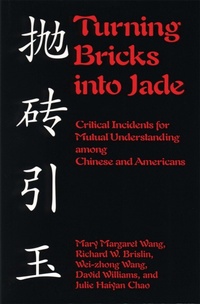
Turning Bricks Into Jade
Critical Incidents for Mutual Understanding Among Chinese and Americans
Will be published approx. on 5. October 2000
Book
Paperback/Softback
246 pages
978-1-877864-81-0 (ISBN)
Description
The Chinese are fond of using four-character phrases, known as cheng yu, to improve their writing style. The Chinese characters on the cover spell out one such idiom: pao zhuan yin yu. Translated literally, this would be "throw bricks attract jade." It can also express the idea of throwing out something of little value to induce a potential business partner to offer something more valuable.
The authors of Turning Bricks into Jade, a more idiomatic rendering of pao zhuan yin yu, like to think of each critical incident in this collection as a brick, which, when combined with similar bricks, good sense and effort, can be used to construct relationships more valuable even than jade.
A critical incident is a story about cross-cultural conflict or misunderstanding. Many of the forty-one incidents are based on actual events that involved one or more of the authors or their acquaintances. Some are a composite of several authors' experiences. You choose one of four or five possible alternatives that explain the misunderstanding. Following each incident is a discussion of possible solutions, based on the authors' experiences and grounded in current research.
Misunderstandings between Chinese and American interactants are complicated; there is almost never just one thing going on. One result of this complexity is that many of the incidents have more than one correct explanation. Forty-one Americans and Chinese with considerable experience in both cultures read the collection of incidents for validation. As you work through the incidents, you may feel the need for a more detailed explanation or definition of certain recurring themes. A section on key theoretical concepts in Chinese-American interactions provides such detail.
Included are individualism and collectivism, guanxi (interpersonal connections), hierarchies, gender relations in the workplace, regulations, deference to authority, work incentives and ownership. The Index of Incidents According to Themes and Concepts is also helpful.
The authors of Turning Bricks into Jade, a more idiomatic rendering of pao zhuan yin yu, like to think of each critical incident in this collection as a brick, which, when combined with similar bricks, good sense and effort, can be used to construct relationships more valuable even than jade.
A critical incident is a story about cross-cultural conflict or misunderstanding. Many of the forty-one incidents are based on actual events that involved one or more of the authors or their acquaintances. Some are a composite of several authors' experiences. You choose one of four or five possible alternatives that explain the misunderstanding. Following each incident is a discussion of possible solutions, based on the authors' experiences and grounded in current research.
Misunderstandings between Chinese and American interactants are complicated; there is almost never just one thing going on. One result of this complexity is that many of the incidents have more than one correct explanation. Forty-one Americans and Chinese with considerable experience in both cultures read the collection of incidents for validation. As you work through the incidents, you may feel the need for a more detailed explanation or definition of certain recurring themes. A section on key theoretical concepts in Chinese-American interactions provides such detail.
Included are individualism and collectivism, guanxi (interpersonal connections), hierarchies, gender relations in the workplace, regulations, deference to authority, work incentives and ownership. The Index of Incidents According to Themes and Concepts is also helpful.
More details
Language
English
Place of publication
United States
Publishing group
John Murray Press
Target group
College/higher education
Product notice
Paperback (UK-trade)
Dimensions
Height: 233 mm
Width: 147 mm
Thickness: 13 mm
Weight
345 gr
ISBN-13
978-1-877864-81-0 (9781877864810)
Copyright in bibliographic data and cover images is held by Nielsen Book Services Limited or by the publishers or by their respective licensors: all rights reserved.
Schweitzer Classification
Persons
Mary Wang, Richard Brislin, Wei-zhong Wang, David Williams, and Julie Haiyan Chao represent a wide range of diverse socialization and experiences in both Chinese and American cultures.