

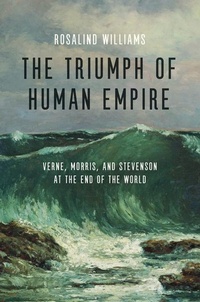
The Triumph of Human Empire
Verne, Morris, and Stevenson at the End of the World
Will be published approx. on 30. September 2013
Book
Hardback
432 pages
978-0-226-89955-8 (ISBN)
Description
In the early 1600s, in a haunting tale titled New Atlantis, Sir Francis Bacon imagined the discovery of an uncharted island, home to the descendants of the lost realm of Atlantis, who had organized themselves to seek "the knowledge of Causes, and secret motions of things; and the enlarging of the bounds of Human Empire, to the effecting of all things possible." Bacon's make-believe island was not an empire in the usual sense, marked by territorial control; instead, it was the center of a vast general expansion of human knowledge and power. Rosalind Williams uses Bacon's island as a jumping-off point to explore the overarching historical event of our time: the rise and triumph of human empire. Confronting an intensely humanized world was a singular event of consciousness, which Williams explores through the lives and works of three writers of the late nineteenth century: Jules Verne, William Morris, and Robert Louis Stevenson. As the century drew to a close, these writers were unhappy with the direction in which their world seemed to be headed and worried that organized humanity would use knowledge and power for unworthy ends.
In response, Williams shows, each engaged in a lifelong quest to make a home in the midst of human empire, to transcend it, and most of all to understand it. They accomplished this first by taking to the water: in life and in art, this shift offered them release from the condition of human domination. At the same time, each writer experimented with romance and fantasy and how these traditions allowed them to express their growing awareness of the need for a new relationship between humans and Earth. As environmental consciousness rises in our time, along with evidence that our seeming control over nature is pathological and unpredictable, Williams' history is one that speaks very much to the present.
In response, Williams shows, each engaged in a lifelong quest to make a home in the midst of human empire, to transcend it, and most of all to understand it. They accomplished this first by taking to the water: in life and in art, this shift offered them release from the condition of human domination. At the same time, each writer experimented with romance and fantasy and how these traditions allowed them to express their growing awareness of the need for a new relationship between humans and Earth. As environmental consciousness rises in our time, along with evidence that our seeming control over nature is pathological and unpredictable, Williams' history is one that speaks very much to the present.
Reviews / Votes
"Engaging, highly informative, and entertaining. Rosalind Williams follows the advice of the authors she discusses-of finding the right balance between factual detail, narrative drive, and human interest-yet presents a strikingly original and timely synthesis of literary history, history of technology, and environmental history." -John Tresch, University of Pennsylvania"More details
Language
English
Place of publication
Chicago
United States
Publishing group
The University of Chicago Press
Target group
Professional and scholarly
Product notice
sewn/stitched
Cloth over boards
With dust jacket
Dimensions
Height: 236 mm
Width: 156 mm
Thickness: 32 mm
Weight
735 gr
ISBN-13
978-0-226-89955-8 (9780226899558)
Copyright in bibliographic data and cover images is held by Nielsen Book Services Limited or by the publishers or by their respective licensors: all rights reserved.
Schweitzer Classification
Other editions
Additional editions
E-Book
12/2022
University of Chicago Press
€18.18
Available for download
Person
Rosalind Williams is the Bern Dibner Professor of the History of Science and Technology at the Massachusetts Institute of Technology. She is past president of the Society for the History of Technology and the author of several books, most recently, Retooling: A Historian Confronts Technological Change.