

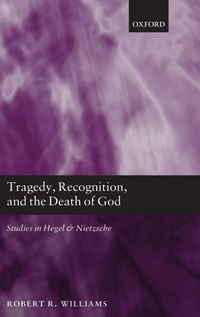
Tragedy, Recognition, and the Death of God
Studies in Hegel and Nietzsche
1st Edition
Published on 27. September 2012
Book
Hardback
424 pages
978-0-19-965605-9 (ISBN)
Description
Hegel and Nietzsche are two of the most important figures in philosophy and religion. Robert R. Williams challenges the view that they are mutually exclusive. He identifies four areas of convergence. First, Hegel and Nietzsche express and define modern interest in tragedy as a philosophical topic. Each seeks to correct the traditional philosophical and theological suppression of a tragic view of existence. This suppression of the tragic is required by the moral vision of the world, both in the tradition and in Kant's practical philosophy and its postulates. For both Hegel and Nietzsche, the moral vision of the world is a projection of spurious, life-negating values that Nietzsche calls the ascetic ideal, and that Hegel identifies as the spurious infinite. The moral God is the enforcer of morality. Second, while acknowledging a tragic dimension of existence, Hegel and Nietzsche nevertheless affirm that existence is good in spite of suffering. Both affirm a vision of human freedom as open to otherness and requiring recognition and community. Struggle and contestation have affirmative significance for both. Third, while the moral God is dead, this does not put an end to the God-question. Theology must incorporate the death of God as its own theme. The union of God and death expressing divine love is for Hegel the basic speculative intuition. This implies a dipolar, panentheistic concept of a tragic, suffering God, who risks, loves, and reconciles. Fourth, Williams argues that both Hegel and Nietzsche pursue theodicy, not as a justification of the moral God, but rather as a question of the meaningfulness and goodness of existence despite nihilism and despite tragic conflict and suffering. The inseparability of divine love and anguish means that reconciliation is no conflict-free harmony, but includes a paradoxical tragic dissonance: reconciliation is a disquieted bliss in disaster.
Reviews / Votes
an exceptional, remarkable book. Written in clear and precise languageit provides a powerful, extremely convincing argument against those deflationary readings that regard the metaphysical, theological, and religious dimensions of Hegel's philosophy as dispensable. * Martin Thibodeau, Journal of Existential and Phenomenological Theory and Culture * a major achievement based on years of thoughtful engagement with these fascinating philosophers . . . Williams's is a provocative book that, I hope, will provoke many to take up the challenges it poses to, among many other things, contemporary conceptions of philosophy itself. * Paul Redding, Notre Dame Philosophical Reviews *More details
Language
English
Place of publication
Oxford
United Kingdom
Target group
College/higher education
Professional and scholarly
Scholars and advanced students in history of philosophy and philosophy of religion; intellectual historians.
Dimensions
Height: 240 mm
Width: 161 mm
Thickness: 27 mm
Weight
798 gr
ISBN-13
978-0-19-965605-9 (9780199656059)
Copyright in bibliographic data and cover images is held by Nielsen Book Services Limited or by the publishers or by their respective licensors: all rights reserved.
Schweitzer Classification
Other editions
Additional editions
E-Book
10/2012
1st Edition
OUP Oxford
€97.09
Available for download
Person
Robert R. Williams is Professor Emeritus of Germanic Studies, Philosophy, and Religious Studies at the University of Illinois at Chicago. He is Past President of the Hegel Society of America (1998-2000), and author of Schleiermacher the Theologian (1978), Recognition: Fichte and Hegel on the Other (1992), Hegel's Ethics of Recognition (1998). He is also editor of Beyond Liberalism and Communitarianism: Studies in Hegel's Philosophy of Right (2001), translator (with Claude Welch) of I. A. Dorner's Divine Immutability: A Reconsideration (1994), and translator and editor of Hegel's Lectures on the Philosophy of Spirit, 1827-8 (2007).
Content
PART I: RECOGNITION ; PART II: TRAGEDY ; PART III: OVERCOMING THE KANTIAN FRAME: THE TRUE INFINITE ; PART IV: GOD BEYOND THE DEATH OF GOD