

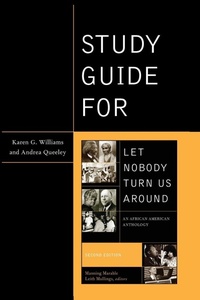
Study Guide for Let Nobody Turn Us Around
2nd Edition
Published on 16. September 2009
Book
Paperback/Softback
150 pages
978-1-4422-0013-5 (ISBN)
Description
The Study Guide for Let Nobody Turn Us Around, 2/e offers key points, comprehension and thought questions, essay questions, suggested research topics, classroom exercises, and media and Internet resources as well as additional selected readings for each section of the book as well as the preface and introduction. Appendices provide guidelines on citation styles and style manuals (MLA, CMS, CBE, APA, and APSA), directions for citing Internet and other electronic sources, suggested Internet resources in four social sciences (anthropology, history, political science, and sociology), a checklist on quoting and paraphrasing, and the table of contents of the second edition of Let Nobody Turn Us Around.
More details
Edition
2nd edition
Language
English
Place of publication
United States
Publishing group
Bloomsbury Publishing Plc
Dimensions
Height: 229 mm
Width: 152 mm
Thickness: 8 mm
Weight
231 gr
ISBN-13
978-1-4422-0013-5 (9781442200135)
Copyright in bibliographic data and cover images is held by Nielsen Book Services Limited or by the publishers or by their respective licensors: all rights reserved.
Schweitzer Classification
Other editions
Additional editions
Karen Williams | Andrea Queeley
Study Guide for Let Nobody Turn Us Around
E-Book
08/2009
2nd Edition
Rowman & Littlefield Publishers
€22.19
Available for download
Karen Williams | Andrea Queeley
Study Guide for Let Nobody Turn Us Around
E-Book
08/2009
2nd Edition
Rowman & Littlefield Publishers
€24.49
Available for download
Persons
Karen G. Williams is an adjunct lecturer in the Urban Studies Department at Queens College.
Andrea Queeley is assistant professor of African and African Diaspora Studies and Global and Sociocultural Studies at Florida International University.
Andrea Queeley is assistant professor of African and African Diaspora Studies and Global and Sociocultural Studies at Florida International University.
Content
Part 1 Introduction: Key Points, Essay Questions, Classroom Exercises
Part 2 Section One. Foundations: Slavery and Abolitionism, 1789-1861
Chapter 3 Key Points; Comprehension and Thought Questions; Essay Questions; Suggested Research Topics; Classroom Exercises; Media and Internet
Part 4 Section Two. Reconstruction and Reaction: The Aftermath of Slavery and the Dawn of Segregation, 1861-1915
Chapter 5 Key Points; Comprehension and Thought Questions; Essay Questions; Suggested Research Topics; Classroom Exercises; Media and Internet Resources
Part 6 Section Three. From Plantation to Ghetto: The Great Migration, Harlem Renaissance, and World War, 1915-1954
Chapter 7 Key Points; Comprehension and Thought Questions; Essay Questions; Suggested Research Topics; Classroom Exercises; Media and Internet Resources
Part 8 Section Four. We Shall Overcome: The Second Reconstruction, 1954-1975
Chapter 9 Key Points; Comprehension an Thought Questions; Essay Questions; Suggested Research Topics; Classroom Exercises; Media and Internet Resources
Part 10 Section Five. The Future in the Present: Contemporary African-American Thought, 1975-Present
Chapter 11 Key Points; Comprehension and Thought Questions; Essay Questions; Suggested Research Topics; Classroom Exercises; Media and Internet Resources
Part 12 Appendixes: Additional Resources for Research and Writing
Part 2 Section One. Foundations: Slavery and Abolitionism, 1789-1861
Chapter 3 Key Points; Comprehension and Thought Questions; Essay Questions; Suggested Research Topics; Classroom Exercises; Media and Internet
Part 4 Section Two. Reconstruction and Reaction: The Aftermath of Slavery and the Dawn of Segregation, 1861-1915
Chapter 5 Key Points; Comprehension and Thought Questions; Essay Questions; Suggested Research Topics; Classroom Exercises; Media and Internet Resources
Part 6 Section Three. From Plantation to Ghetto: The Great Migration, Harlem Renaissance, and World War, 1915-1954
Chapter 7 Key Points; Comprehension and Thought Questions; Essay Questions; Suggested Research Topics; Classroom Exercises; Media and Internet Resources
Part 8 Section Four. We Shall Overcome: The Second Reconstruction, 1954-1975
Chapter 9 Key Points; Comprehension an Thought Questions; Essay Questions; Suggested Research Topics; Classroom Exercises; Media and Internet Resources
Part 10 Section Five. The Future in the Present: Contemporary African-American Thought, 1975-Present
Chapter 11 Key Points; Comprehension and Thought Questions; Essay Questions; Suggested Research Topics; Classroom Exercises; Media and Internet Resources
Part 12 Appendixes: Additional Resources for Research and Writing