

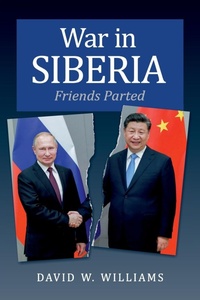
War In Siberia
Friends Parted
Published on 1. December 2023
Book
Paperback/Softback
198 pages
978-1-78963-396-2 (ISBN)
Description
War In Siberia is a work of fiction based on fact. Time will tell of the outcome of the inevitable confrontation.
China becomes seriously concerned about the poor military capability displayed in Ukraine by Russia, previously regarded as the protector of its far western border.
Within China, nationalists liken Russia's attempt at annexation of Ukraine to the former's actual annexation of over a million square kilometres of Chinese North Eastern Siberia, confirmed in the 'Unfair' Treaties of Aigun and Peking in 1858/60.
In order to protect its Western border and recover its lost lands, China invades Siberia. The outcomes of its action include the demise of Russia's Imperial ambitions, the creation of a new Republic - SIBIR - in Central Siberia, the cessation of North East Siberia to the USA and the recovery of its lost land.
China becomes seriously concerned about the poor military capability displayed in Ukraine by Russia, previously regarded as the protector of its far western border.
Within China, nationalists liken Russia's attempt at annexation of Ukraine to the former's actual annexation of over a million square kilometres of Chinese North Eastern Siberia, confirmed in the 'Unfair' Treaties of Aigun and Peking in 1858/60.
In order to protect its Western border and recover its lost lands, China invades Siberia. The outcomes of its action include the demise of Russia's Imperial ambitions, the creation of a new Republic - SIBIR - in Central Siberia, the cessation of North East Siberia to the USA and the recovery of its lost land.
More details
Language
English
Place of publication
Gloucester
United Kingdom
Illustrations
23 colour maps 1 mono chart
Dimensions
Height: 234 mm
Width: 156 mm
Thickness: 11 mm
Weight
310 gr
ISBN-13
978-1-78963-396-2 (9781789633962)
Copyright in bibliographic data and cover images is held by Nielsen Book Services Limited or by the publishers or by their respective licensors: all rights reserved.
Schweitzer Classification
Person
David W Williams was born in 1935 - old enough in February 1941 to watch the Luftwaffe engage with the RAF in dog fights over his home town: Swansea. He has memories of walking over firehose pipes playing on burning buildings in the devastated city centre. He went on to attend Gowerton Grammar School from where, to the surprise of his peers and headmaster, he was accepted into The Royal Military Academy, Sandhurst as an officer cadet. He was commissioned as a subaltern into the Royal Engineers on 4th February 1955.
In his early commissioned years he commanded units which built roads and bridges in Malaysia, a Wilderness park in Canada and a Sports Stadium in Gibraltar. He also served tours in the 12 Infantry Brigade as part of the British Army of the Rhine confronting the Warsaw Pact armies headed by the Soviet Union.
As a Major, he attended Technical and General Staff Colleges and was also nominated to attend the National Defence College. This process was interrupted by the advent of miliary tuberculosis and leukemia, leading to a break of two years from active service.
As a Lieutenant Colonel and Colonel he lectured on the strategy and tactics of nuclear warfare and served in General Staff appointments concerned with a weapon design and procurement. Ill health returned in the form of pneumonia and meningitis and he was discharged prematurely from service in 1988.
For the next 25 years he started and ran a furniture manufacturing Company from which he retired in 2015. Along the way he suffered colon cancer and a stroke. He is now a partner in a family-owned vineyard. His wife died of very late diagnosed cancer in 2021. He remains healthy and retains an interest in international economic and military matters
He was a contributing author to The Third World War: A Future History by General Sir John Hackett published in 1979.
In his early commissioned years he commanded units which built roads and bridges in Malaysia, a Wilderness park in Canada and a Sports Stadium in Gibraltar. He also served tours in the 12 Infantry Brigade as part of the British Army of the Rhine confronting the Warsaw Pact armies headed by the Soviet Union.
As a Major, he attended Technical and General Staff Colleges and was also nominated to attend the National Defence College. This process was interrupted by the advent of miliary tuberculosis and leukemia, leading to a break of two years from active service.
As a Lieutenant Colonel and Colonel he lectured on the strategy and tactics of nuclear warfare and served in General Staff appointments concerned with a weapon design and procurement. Ill health returned in the form of pneumonia and meningitis and he was discharged prematurely from service in 1988.
For the next 25 years he started and ran a furniture manufacturing Company from which he retired in 2015. Along the way he suffered colon cancer and a stroke. He is now a partner in a family-owned vineyard. His wife died of very late diagnosed cancer in 2021. He remains healthy and retains an interest in international economic and military matters
He was a contributing author to The Third World War: A Future History by General Sir John Hackett published in 1979.
Content
Preface to War in Siberia - China claims its lost Province; The Aigun Treaty - Historical Background; Chapter 1 Russia has Problems in Ukraine; Chapter 2 Combatant Experiences; Chapter 3 The War Goes On; Chapter 4 Chinese and NATO Comments on the War; Chapter 5 A Short-lived Truce; Chapter 6 Resumption of Hostilities; Chapter 7 China Revisits the Treaty of Aigun; Chapter 8 Siberia and its People; Chapter 9 China in the United Nations; Chapter 10 China invades Siberia; Chapter 11 Operations following the Battle of the River Amur; Chapter 12 The Possibility of Nuclear War; Chapter 13 The Assassination of the Russian President; Chapter 14 The Involvement of the EU and NATO; Chapter 15 The Interest of the United States of America in Siberia ; Chapter 16 The Belarus Government Collapses; Chapter 17 A Second Meeting of Russian and EU/NATO Delegates hear of NATO's plans to confront the Chinese invaders ; Chapter 18 Assumptions that the much-reduced combat strength of the Russian East Army will be able to delay the Chinese Invasion Force East of Lake Baikal; Chapter 19 Russia withdraws from East Siberia. Local hostilities end; Chapter 20 The EU Commission discusses with China the outcome of the War in Siberia; World Peace -A reinvigorated United Nations; Narrative Ends: Actions Now Required; What Happens Next?; Epilogue: A Review of The Strategic Implications of The Russian/Chinese War;