

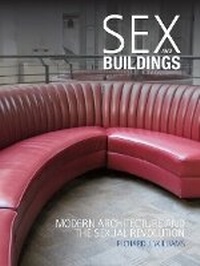
Sex and Buildings
Modern Architecture and the Sexual Revolution
Published on 1. May 2013
Book
Hardback
224 pages
978-1-78023-104-4 (ISBN)
Description
How, over the last century, have changing ideas of the body and sexuality influenced the design of buildings? And how, in turn, can certain structures influence the bodies within them? We invariably think of towers as phallic, but there are countless other ways buildings connote sex. The built environment provides the framework for our sexual lives; places and structures can act as reminders of our sexual histories; interior design can both embody and trigger erotic fantasies. Since Freud, Western societies have given sex an unprecedented centrality in public and private lives. The relationship between sex and buildings matters now more than ever.
Part architectural history, part cultural analysis and part travelogue, Sex and Buildings explores how sexual attitudes appear in architecture. It asks what a sexually progressive architecture might look like - and how we understand some architectures as repressive. In search of the revolutionary, the enlightened and the buttoned-up, this book tours California's modernist houses, the Playboy Mansion, Brazilian love hotels, 1960s communes and the architecture of Mad Men. Their relationship to evolving attitudes towards the family, women and homosexuality is assessed along the way, as well as the sexual theories of Sigmund Freud, Wilhelm Reich, Betty Friedan, Michel Foucault, Esther Perel and many others.
A thought-provoking and highly readable look at a period of extraordinary social change coupled with aesthetic invention, Sex and Buildings offers a unique perspective on the buildings that surround us.
To hear the Times Higher Education book podcast with Richard J. Williams please click here.
Part architectural history, part cultural analysis and part travelogue, Sex and Buildings explores how sexual attitudes appear in architecture. It asks what a sexually progressive architecture might look like - and how we understand some architectures as repressive. In search of the revolutionary, the enlightened and the buttoned-up, this book tours California's modernist houses, the Playboy Mansion, Brazilian love hotels, 1960s communes and the architecture of Mad Men. Their relationship to evolving attitudes towards the family, women and homosexuality is assessed along the way, as well as the sexual theories of Sigmund Freud, Wilhelm Reich, Betty Friedan, Michel Foucault, Esther Perel and many others.
A thought-provoking and highly readable look at a period of extraordinary social change coupled with aesthetic invention, Sex and Buildings offers a unique perspective on the buildings that surround us.
To hear the Times Higher Education book podcast with Richard J. Williams please click here.
Reviews / Votes
an adventurous sex-travelogue, beautifully written and pleasurable from cover to cover. * <i> Times Higher Education</i> * The necessary part on tall towers is a mere sliver in a study that makes a very thorough fist of exploring twentieth-century connections between sex and buildings. From psychologists to modernists, communards, hippy free-thinkers, novelists, and film-makers, theres a big cast, plus queer-space makers, hotel designers, feminists and of course architects. * <i>Architecture Today</i> * Williams observes in Sex and Buildings that, on the whole, sexual experimentation and research burgeoned during the 20th century. He examines how architecture, modern or otherwise, reflected and/or shaped this new behavior. Architects rarely have discussed how their buildings accommodate or promote sexual activity. To measure architectures potential to suggest or trigger erotic impulses, the author considers a diverse range of structures, including Richard Neutras Lovell Health House, Mad Men television sets, Wilhelm Reichs orgone accumulator, John Portmans Bonaventure Hotel, and various utopian commune experiments. He describes their erotic symbolism and examines them from various, often conflicting, methodological viewpoints . . . This approach demonstrates a great nimbleness of mind. Recommended. * <i>Choice</i> * A fast-paced and insightful journey through architectures in which sex and sexuality are writ large. A thought-provoking, fascinating book. * Iain Borden, Professor of Architecture and Urban Culture, The Bartlett, University College London *More details
Language
English
Place of publication
London
United Kingdom
Target group
College/higher education
Illustrations
66 illustrations
Dimensions
Height: 156 mm
Width: 208 mm
ISBN-13
978-1-78023-104-4 (9781780231044)
Copyright in bibliographic data and cover images is held by Nielsen Book Services Limited or by the publishers or by their respective licensors: all rights reserved.
Schweitzer Classification
Other editions
Additional editions
E-Book
07/2013
Reaktion Books
€30.99
Available for download
Person
Richard J. Williams is Professor of Contemporary Visual Cultures at the University of Edinburgh. His most recent books are Why Cities Look the Way They Do (2019), The Architecture of Art History (with Mark Crinson, 2018), and Sex and Buildings (2013).
Content
ACKNOWLEDGEMENTS FIGURES: CREDITS AND CAPTIONS CHAPTERS 1. Sex and Buildings 2. The Care of the Body 2. Inside the Orgone Box 3. Communal Fantasies 4. Phallic Towers and Mad Men 5. Pornomodernism 6. Hotel Dreams 7. What would a Feminist City Look Like? 8. Queer space 9. Conclusions REFERENCES BIBLIOGRAPHY