

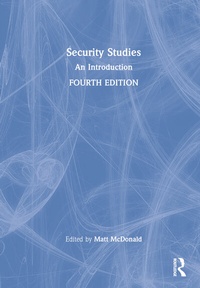
Security Studies
An Introduction
4th Edition
Published on 29. March 2023
Book
Hardback
728 pages
978-1-032-16271-3 (ISBN)
Description
Security Studies: An Introduction, 4th edition, is the most comprehensive textbook available on the subject, providing students with in-depth coverage of traditional and critical approaches and an essential grounding in the debates, frameworks, and issues of the contemporary security agenda.
This new edition has been completely revised and updated, to cover major developments such as COVID-19, the rise of populism, climate change, China and Russia's place in the world, and the Trump administration. It also includes new chapters on great power rivalry, emerging technologies, and economic threats.
Divided into four parts, the text provides students with a detailed, accessible overview of the major theoretical approaches, key themes, and most significant issues within security studies.
Part 1 explores the main theoretical approaches from both traditional and critical standpoints
Part 2 explains the central concepts underpinning contemporary debates
Part 3 presents an overview of the institutional security architecture
Part 4 examines some of the key contemporary challenges to global security
Collecting these related strands into a single textbook creates a valuable teaching tool and a comprehensive, accessible learning resource for undergraduates and MA students.
This new edition has been completely revised and updated, to cover major developments such as COVID-19, the rise of populism, climate change, China and Russia's place in the world, and the Trump administration. It also includes new chapters on great power rivalry, emerging technologies, and economic threats.
Divided into four parts, the text provides students with a detailed, accessible overview of the major theoretical approaches, key themes, and most significant issues within security studies.
Part 1 explores the main theoretical approaches from both traditional and critical standpoints
Part 2 explains the central concepts underpinning contemporary debates
Part 3 presents an overview of the institutional security architecture
Part 4 examines some of the key contemporary challenges to global security
Collecting these related strands into a single textbook creates a valuable teaching tool and a comprehensive, accessible learning resource for undergraduates and MA students.
More details
Edition
4th edition
Language
English
Place of publication
London
United Kingdom
Publishing group
Taylor & Francis Ltd
Target group
College/higher education
Postgraduate and Undergraduate
Illustrations
7 s/w Abbildungen, 7 farbige Abbildungen, 4 Farbfotos bzw. farbige Rasterbilder, 7 s/w Zeichnungen, 3 farbige Zeichnungen, 10 s/w Tabellen
10 Tables, black and white; 3 Line drawings, color; 7 Line drawings, black and white; 4 Halftones, color; 7 Illustrations, color; 7 Illustrations, black and white
Dimensions
Height: 246 mm
Width: 174 mm
Weight
1760 gr
ISBN-13
978-1-032-16271-3 (9781032162713)
Copyright in bibliographic data and cover images is held by Nielsen Book Services Limited or by the publishers or by their respective licensors: all rights reserved.
Schweitzer Classification
Other editions
Additional editions
E-Book
03/2023
4th Edition
Routledge
€55.49
Available for download
Book
03/2023
4th Edition
Routledge
€52.50
Available immediately
E-Book
03/2023
4th Edition
Routledge
€55.49
Available for download
Previous edition
Book
03/2018
3rd Edition
Routledge
€215.41
Article exhausted; check for reprint
Persons
Paul D. Williams is Professor and Associate Director of the Security Policy Studies MA Program in the Elliott School of International Affairs at the George Washington University. His most recent publications include Fighting for Peace in Somalia: A History and Analysis of the African Union Mission (AMISOM), 2007-2017 (Oxford University Press, 2018); War and Conflict in Africa (Polity Press, 2nd edition, 2016); and Understanding Peacekeeping, with A.J. Bellamy (Polity Press, 3rd edition, 2021).
Matt McDonald is Reader in International Relations at the School of Political Science and International Studies at the University of Queensland. His most recent publications include Ecological Security (Cambridge University Press, 2021); Ethics and Global Security: A Cosmopolitan Approach, with Anthony Burke and Katrina Lee-Koo (Routledge, 2014); and Security, the Environment and Emancipation (Routledge, 2012).
Matt McDonald is Reader in International Relations at the School of Political Science and International Studies at the University of Queensland. His most recent publications include Ecological Security (Cambridge University Press, 2021); Ethics and Global Security: A Cosmopolitan Approach, with Anthony Burke and Katrina Lee-Koo (Routledge, 2014); and Security, the Environment and Emancipation (Routledge, 2012).
Content
An Introduction to Security Studies Paul D. Williams and Matt McDonald Part 1: Theoretical ApproachesTraditional Approaches 1.Realisms 2.Liberalisms 3.Constructivisms Critical Approaches 4.Critical Theory 5.Feminisms 6.Poststructuralism 7.Securitization 8.Postcolonialism Part 2: Key Concepts 9.Uncertainty 10.Great Power Rivalry 11.Culture 12.War 13.Coercion 14.Peace and Violence 15.Human Security 16.Responsibility to Protect 17.Development Part 3: Institutions 18.Alliances 19.Regional Organizations 20.The United Nations 21.Peace Operations 22.The Nuclear Disarmament and Non-Proliferation Regime 23.Private Military and Security Companies Part 4: Contemporary Challenges 24.Genocide and Crimes Against Humanity 25.Ethnic Conflict 26.Terrorism 27.Counterterrorism 28.Counterinsurgency 29.Intelligence 30.Economic Threats 31.Transnational Organized Crime 32.Global Arms Trade 33.Migration and Refugees 34.Energy Security 35.Women, Peace, and Security 36.Environmental Change 37.Health 38.Emerging Technologies 39.Cybersecurity 40.Outer Space