

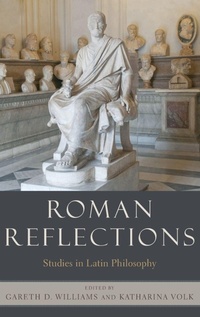
Roman Reflections
Studies in Latin Philosophy
Published on 2. November 2015
Book
Hardback
320 pages
978-0-19-999976-7 (ISBN)
Description
When the Romans adopted Greek literary genres, artistic techniques, and iconographies, they did not slavishly imitate their models. Rather, the Romans created vibrant and original literature and art. The same is true for philosophy, though the rich Roman philosophical tradition is still too often treated as a mere footnote to the history of Greek philosophy. This volume aims to reassert the significance of Roman philosophy and to explore the "Romanness" of
philosophical writings and practices in the Roman world. The contributors reveal that the Romans, in their creative adaptation of Greek modes of thought, developed sophisticated forms of philosophical discourse shaped by their own history and institutions, concepts and values-and last, but not least, by the
Latin language, which nearly all Roman philosophers used to express their ideas.
The thirteen chapters-which are authored by an international group of specialists in ancient philosophy, Latin literature, and Roman social and intellectual history-move from Roman attitudes to and practices of philosophy to the great late Republican writers Cicero and Lucretius, then onwards to the early Empire and the work of Seneca the Younger, and finally to Epictetus, Apuleius, and Augustine. Using a variety of approaches, the essays do not combine into one grand narrative but instead
demonstrate the diversity and originality of the Roman philosophical discourse over the centuries.
philosophical writings and practices in the Roman world. The contributors reveal that the Romans, in their creative adaptation of Greek modes of thought, developed sophisticated forms of philosophical discourse shaped by their own history and institutions, concepts and values-and last, but not least, by the
Latin language, which nearly all Roman philosophers used to express their ideas.
The thirteen chapters-which are authored by an international group of specialists in ancient philosophy, Latin literature, and Roman social and intellectual history-move from Roman attitudes to and practices of philosophy to the great late Republican writers Cicero and Lucretius, then onwards to the early Empire and the work of Seneca the Younger, and finally to Epictetus, Apuleius, and Augustine. Using a variety of approaches, the essays do not combine into one grand narrative but instead
demonstrate the diversity and originality of the Roman philosophical discourse over the centuries.
Reviews / Votes
"According to the preface, the volume was designed to answer the question, "Is there a Latin philosophy?" It certainly succeeds in indicating the specific concerns Romans display in their philosophy as well as the distinct philosophical questions opened up by writing in their language." --Miriam Griffin, Journal of the History of Philosophy"This volume makes a distinctive and striking contribution by focusing on the question what is Roman about Roman philosophy. The contributors make a genuine and sustained attempt to bring to bear on the subject a combination of philosophical, literary, and cultural perspectives. The result is a highly illuminating collection of new essays." --Christopher Gill, University of Exeter"This is a wide-ranking and thought-provoking collection...the thirteen papers presented here provide (in addition to many excellent specialist discussions) a rich resource for reflection on those topics." --Notre Dame Philosophical Reviews"This terrific collection of essays contributes to the discussion by scrutinizing philosophical arguments, historical exempla, and applications of the Latin language to philosophy that are uniquely Roman... As the contributors demonstrate, the Romans did not simply deck out Greek philosophy in the Roman toga...but rather reflected seriously upon Greek thought, and then responded to, adapted, criticized, reframed, and even altered it to suit their own interests and to appeal to a new contemporary context." -The Classical Journal "This volume makes a distinctive and striking contribution by focusing on the question what is Roman about Roman philosophy. The contributors make a genuine and sustained attempt to bring to bear on the subject a combination of philosophical, literary, and cultural perspectives. The result is a highly illuminating collection of new essays." --Christopher Gill, University of Exeter"This is a wide-ranking and thought-provoking collection...the thirteen papers presented here provide (in addition to many excellent specialist discussions) a rich resource for reflection on those topics." --Notre Dame Philosophical Reviews"This terrific collection of essays contributes to the discussion by scrutinizing philosophical arguments, historical exempla, and applications of the Latin language to philosophy that are uniquely Roman... As the contributors demonstrate, the Romans did not simply deck out Greek philosophy in the Roman toga...but rather reflected seriously upon Greek thought, and then responded to, adapted, criticized, reframed, and even altered it to suit their own interests and to appeal to a new contemporary context." -The Classical Journal "This volume makes a distinctive and striking contribution by focusing on the question what is Roman about Roman philosophy. The contributors make a genuine and sustained attempt to bring to bear on the subject a combination of philosophical, literary, and cultural perspectives. The result is a highly illuminating collection of new essays." --Christopher Gill, University of Exeter"This is a wide-ranking and thought-provoking collection...the thirteen papers presented here provide (in addition to many excellent specialist discussions) a rich resource for reflection on those topics." --Notre Dame Philosophical ReviewsMore details
Other editions
Additional editions
E-Book
10/2015
1st Edition
OUP eBook
€53.49
Available for download
Gareth D. Williams | Katharina Volk
Roman Reflections: Studies in Latin Philosophy
E-Book
10/2015
1st Edition
Oxford University Press
€57.59
Available for download
Persons
Gareth D. Williams is Professor of Classics at Columbia University and a specialist in Latin literature of the early empire.
Katharina Volk is Professor of Classics at Columbia University and a specialist in Latin literature and Roman culture.
Katharina Volk is Professor of Classics at Columbia University and a specialist in Latin literature and Roman culture.
Content
Contents ; Contributors ; Preface ; Introduction ; Part I ; 1. Philosophy and philosophi: From Cicero to Apuleius ; Harry Hine ; Part II ; 2. Roman Pythagoras ; Katharina Volk ; 3. Philosophy Is in the Streets ; James E. G. Zetzel ; 4. To See and to Be Seen: On Vision and Perception in Lucretius and Cicero ; Tobias Reinhardt ; 5. Teaching Pericles: Cicero on the Study of Nature ; Gretchen Reydams-Schils ; Part III ; 6. Tyrants, Fire, and Dangerous Things Andrew M. Riggsby ; 7. Precept(or) and Example in Seneca ; Matthew Roller ; 8. True Greatness of Soul in Seneca's De constantia sapientis ; Yelena Baraz ; 9. Minding the Gap: Seneca, the Self, and the Sublime ; Gareth D. Williams ; 10. The Emotional Intelligence of Epicureans: Doctrinalism and Adaptation in Seneca's Epistles ; Margaret Graver ; Part IV ; 11. <"You're Playing You Now>": Helvidius Priscus as a Stoic Hero ; Wolfgang-Rainer Mann ; 12. Platonizing Latin: Apuleius' Phaedo ; Richard Fletcher ; 13. Why Ancient Skeptics Don't Doubt the Existence of the External World: Augustine and the Beginnings of Modern Skepticism ; Katja Maria Vogt ; Works Cited