

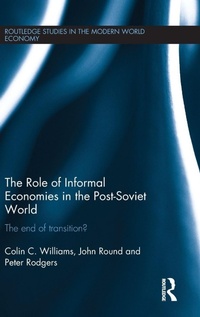
The Role of Informal Economies in the Post-Soviet World
The End of Transition?
1st Edition
Published on 28. May 2013
Book
Hardback
244 pages
978-0-415-56721-3 (ISBN)
Description
Based on extensive ethnographic and quantitative research, conducted in Ukraine and Russia between 2004 and 2012, this book's central argument is that for many people the informal economy, such as cash in hand work, subsistence production and the use of social networks, is of great importance to everyday life. Formal work is both a facilitator of such processes and is often supported by them, as people can only afford to undertake low paid formal work as a result of their informal incomes. By looking at the informal nature of formal work and practices, informal practices, gift giving, volunteer work and the economies of the household the book is one of the first to give an overview of the nature of the informal economy in all spheres of everyday practice.
Reviews / Votes
"The authors challenge the very notion of market transition as that of moving from command and control plan-based economy to a market one. Instead, they offer a true mosaic of post-Soviet transformation, a largely incomplete and frequently confusing multifaceted non-linear process...I strongly encourage everyone interested in post- Soviet transformations to read this book. A landmark work on informal economies, it offers a totally new perspective on economies in transition. Moreover, it serves as a methodological sample work for similar possible future studies of socio-economic transformations in different parts of the world. This brilliant work that proves that the adjective 'ethnographic' is directly related to another adjective 'economic', may be regarded as nothing less than an alternative and insightful interpretation of post-Soviet transformation." - Ararat L. Osipian, Vanderbilt UniversityMore details
Series
Language
English
Place of publication
London
United Kingdom
Publishing group
Taylor & Francis Ltd
Target group
College/higher education
Illustrations
11 s/w Abbildungen, 11 s/w Zeichnungen, 39 s/w Tabellen
39 Tables, black and white; 11 Line drawings, black and white; 11 Illustrations, black and white
Dimensions
Height: 240 mm
Width: 161 mm
Thickness: 19 mm
Weight
564 gr
ISBN-13
978-0-415-56721-3 (9780415567213)
Copyright in bibliographic data and cover images is held by Nielsen Book Services Limited or by the publishers or by their respective licensors: all rights reserved.
Schweitzer Classification
Other editions
Additional editions
Colin C. Williams | John Round | Peter Rodgers
The Role of Informal Economies in the Post-Soviet World
The End of Transition?
Book
03/2015
1st Edition
Routledge
€78.30
Shipment within 10-20 days
Colin C. Williams | John Round | Peter Rodgers
The Role of Informal Economies in the Post-Soviet World
The End of Transition?
E-Book
06/2013
1st Edition
Routledge
€72.49
Available for download
Colin C. Williams | John Round | Peter Rodgers
The Role of Informal Economies in the Post-Soviet World
The End of Transition?
E-Book
06/2013
1st Edition
Routledge
€72.49
Available for download
Persons
Colin C. Williams is Professor of Public Policy at the Management School at Sheffield University, UK.
John Round is Senior Lecturer in Human Geography, School of Geography, Earth and Environmental Sciences, University of Birmingham.
Peter Rodgers is Lecturer in Strategy and International Business, Management School, University of Sheffield, UK.
John Round is Senior Lecturer in Human Geography, School of Geography, Earth and Environmental Sciences, University of Birmingham.
Peter Rodgers is Lecturer in Strategy and International Business, Management School, University of Sheffield, UK.
Content
1. Introduction: Part I (Re)theorising Transition Economies 2. Re-visiting the recurring question of transition 3. Re-theorising the economic 4. Beyond the formal/informal economy dualism: unpacking the diverse economies of post-Soviet societies Part II The Lived Experience of Transition 5. The role of the informal in the formal sphere 6. Informal employment 7. One-to-one unpaid labour, reimbursed family work and paid favours 8. Formal and informal unpaid employment 9. The internal economies of the household 10. Conclusions