

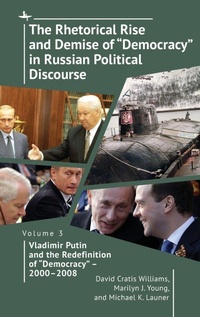
The Rhetorical Rise and Demise of "Democracy" in Russian Political Discourse, Volume Three
Vladimir Putin and the Redefinition of "Democracy" 2000-2008
Published on 7. March 2024
Book
Hardback
400 pages
979-8-88719-356-4 (ISBN)
Description
In Volume Three of this four-volume series, we examine the rhetorical development that occurred during the first two terms of Vladimir Putin's tenure as president of the Russian Federation. Initially, Putin appeared to follow in the path set by his predecessor, Boris Yeltsin, vowing that Russia was, at heart, a European nation and would be a westward facing democracy going forward. He even mentioned partnering with the EU and NATO. Eight years later, at the 2007 Munich Security Conference, Putin excoriated the West for, in his words, attempting to create a "unipolar world" in which NATO expansion threatened Russia's security, the United States acted as the world's sole "hegemon," and Europe simply followed orders, relinquishing any sense of agency in its own affairs.
Reviews / Votes
"In this important volume Professors Williams, Young, and Launer undertake thorough and comprehensive studies of the rhetorical, argumentative, and media strategies that Vladimir Putin has employed in an attempt to shape Russian identity and to relaunch and rehabilitate the Russian empire. The work deepens our understanding of Russian culture, history, politics, and media systems and helps explain Putin's goals, resentments, and ambitions. Chapters include foundational theoretical examinations of Russian symbols and key terms and case studies of discourse created to manage public crises and controversies. The volume is of course urgently important today given the war in Ukraine and the open confrontation between Putin's Russia and the Western democratic alliance."-Thomas Hollihan, University of Southern California
"Williams, Young, and Launer's third volume is a tour de force in its skillful unpacking of Putin's definitional shifts and reconfiguring of the lexicon of Russian 'democracy.' Using the tools of rhetorical criticism and argumentation, the authors offer a compelling case for the ways in which Putin's public discourse both reflects and helps construct the movement from a national identity embracing democratic norms to an increasingly authoritative state."
- J. Robert Cox, Professor Emeritus, University of North Carolina at Chapel Hill
"This much anticipated third volume of a long-standing collaborative project gathers an expansive and revealing rhetorical archive to provide insight into the discursive forces fueling Russia's gradual abandonment of the project of liberal democratization. In four sections covering the years between 2000 and 2008, the authors explore the philosophical and political exigencies that shaped President Vladimir Putin's attitudes toward the West, the rhetorical production of Russian national identity in the transition from Yeltsin to Putin's leadership, Russia's evolving communication culture as a structural backdrop for its political development, as well as the reorganization of the county's foreign policy. In each chapter, the reader encounters consistent effort at historical contextualization, painstaking application of rhetorical and argumentation theory, and an impressive body of primary materials that add up to a forceful explication and critique of Russia's slide toward authoritarianism."
- Zornitsa D. Keremidchieva, Assistant Professor, Dept. of Communication Studies, University of Minnesota-Twin Cities
More details
Language
English
Place of publication
Brighton
United States
Target group
College/higher education
Professional and scholarly
Product notice
Laminated cover
Illustrations
Illustrations
Dimensions
Height: 240 mm
Width: 161 mm
Thickness: 30 mm
Weight
878 gr
ISBN-13
979-8-88719-356-4 (9798887193564)
Copyright in bibliographic data and cover images is held by Nielsen Book Services Limited or by the publishers or by their respective licensors: all rights reserved.
Schweitzer Classification
Persons
David Cratis Williams is recently retired Professor of Communication and Rhetorical Studies at Florida Atlantic University. His scholarship focuses on argumentation, rhetorical theory, and criticism; he is a recognized authority on Kenneth Burke. His work on Russian political discourse began during a meeting in Russia in January 1992.
Marilyn J. Young is the Wayne C. Minnick Professor of Communication Emerita at Florida State University. Her research has focused on political argument with an emphasis on the development of political rhetoric and argument in the former Soviet Union, particularly Russia. She remains an active scholar in retirement.
Michael K. Launer is Professor Emeritus of Russian at Florida State University. In 1987 he interpreted for the first group of Soviet scientists visiting the United States following the Chernobyl nuclear accident. A State Department certified technical interpreter, he supported Nuclear Regulatory Commission and Department of Energy assistance programs through 2012.
Marilyn J. Young is the Wayne C. Minnick Professor of Communication Emerita at Florida State University. Her research has focused on political argument with an emphasis on the development of political rhetoric and argument in the former Soviet Union, particularly Russia. She remains an active scholar in retirement.
Michael K. Launer is Professor Emeritus of Russian at Florida State University. In 1987 he interpreted for the first group of Soviet scientists visiting the United States following the Chernobyl nuclear accident. A State Department certified technical interpreter, he supported Nuclear Regulatory Commission and Department of Energy assistance programs through 2012.
Content
Contents
List of Photos
Acknowledgements
Contributors
Note to Readers
Preface
Introduction to Volume Three
Part One: Initial Considerations
1. The Rhetorical Sources of Putin's Evolving Governance Philosophy
Alexander Panarin
Alexander Dugin, 2017
Alexander Dugin, undated
Lev Gumilev-Passionarity Party
Lev Gumilev and Anna Akhmatova
Statue of Lev Gumilev
2. Strategic Goals Underpinning the Struggle to Maintain a Slavic Majority in Russia:
Putin, Compatriots, and Fellow Countrymen
3. The Sinking of the Kursk: A Soviet Response to a Russian Tragedy
The Kursk Nuclear Submarine
4. The Political Lexicon of Putin the "Democrat"
Part Two: Redefinition of the Russian Nation
The Russian Tricolor
The Russian Coat of Arms
The Russian Armed Forces Flag
5. New/Old Russian Symbols as Arguments for Identity Transformation:
Reviving Ghosts Is a Tricky Business
Vladimir Putin and Boris Yeltsin, 1999
6. Reconstituting the Body Politic: Yeltsin, Putin, and the Struggle
for Russian (Self-)Identity
7. Identification, Division, and Consubstantiality Between:
A Burkean Assessment of Political Transformations in Post-Soviet Russia
8. Russian National Identity as Argument Construction: An Assessment
of Political Transformations in Russia
9. Argumentation, Globalization, and the New Nationalism:
Implications and New Directions
Part Three: "Democracy in Action" or "Democracy Inaction"
10. Argumentation and Education: Preparing Citizens
in Cultures of Democratic Communication
11. Liberty vs. Security in Putin's "Managed Democracy": Back to the Future?
12. The Role of Communication in Political Transition: A Review Essay
13. Definition and Political (Un)change: The State of Political Rhetoric
in Putin's Russia
14. The Authoritarian Turn: Vladimir Putin's 2005 Presidential Address
to the Federal Assembly
15. Citizen Putin: Presidential Argument and the Invitation
to (Democratic) Citizenship
Part Four: International Relations
Alexei Salmin
16. Foreign Policy Challenges and the Historical "Anchors" of Russian Federation
Foreign Policy after September 11, 2001
Vladimir Putin and George Bush, 2001
Vladimir Putin at the UN
17. Managing "Democracy" in the Age of Terrorism: Putin, Bush,
and Arguments from Definition
Viktor Yushchenko, 2004
Viktor Yanukovich, 2004
18. Presidential Rhetoric on a National and International Scale:
The Ukrainian Presidency through the Lens of Russian and Ukrainian Politics
Vladimir Putin and Robert Gates, 2007
Angela Merkel in Munich, 2007
Robert Gates, John McCain, and Joseph Lieberman with Angela Merkel, 2007
Robert Gates, John McCain, and Joseph Lieberman with Vladimir Putin, 2007
Robert Gates, John McCain, and Joseph Lieberman in Conversation, 2007
19. Rhetorical and Argumentative Strategies in Putin's 2007 Munich Speech
Afterword
Vladimir Putin and Dmitri Medvedev
Bibliography
Index
List of Photos
Acknowledgements
Contributors
Note to Readers
Preface
Introduction to Volume Three
Part One: Initial Considerations
1. The Rhetorical Sources of Putin's Evolving Governance Philosophy
Alexander Panarin
Alexander Dugin, 2017
Alexander Dugin, undated
Lev Gumilev-Passionarity Party
Lev Gumilev and Anna Akhmatova
Statue of Lev Gumilev
2. Strategic Goals Underpinning the Struggle to Maintain a Slavic Majority in Russia:
Putin, Compatriots, and Fellow Countrymen
3. The Sinking of the Kursk: A Soviet Response to a Russian Tragedy
The Kursk Nuclear Submarine
4. The Political Lexicon of Putin the "Democrat"
Part Two: Redefinition of the Russian Nation
The Russian Tricolor
The Russian Coat of Arms
The Russian Armed Forces Flag
5. New/Old Russian Symbols as Arguments for Identity Transformation:
Reviving Ghosts Is a Tricky Business
Vladimir Putin and Boris Yeltsin, 1999
6. Reconstituting the Body Politic: Yeltsin, Putin, and the Struggle
for Russian (Self-)Identity
7. Identification, Division, and Consubstantiality Between:
A Burkean Assessment of Political Transformations in Post-Soviet Russia
8. Russian National Identity as Argument Construction: An Assessment
of Political Transformations in Russia
9. Argumentation, Globalization, and the New Nationalism:
Implications and New Directions
Part Three: "Democracy in Action" or "Democracy Inaction"
10. Argumentation and Education: Preparing Citizens
in Cultures of Democratic Communication
11. Liberty vs. Security in Putin's "Managed Democracy": Back to the Future?
12. The Role of Communication in Political Transition: A Review Essay
13. Definition and Political (Un)change: The State of Political Rhetoric
in Putin's Russia
14. The Authoritarian Turn: Vladimir Putin's 2005 Presidential Address
to the Federal Assembly
15. Citizen Putin: Presidential Argument and the Invitation
to (Democratic) Citizenship
Part Four: International Relations
Alexei Salmin
16. Foreign Policy Challenges and the Historical "Anchors" of Russian Federation
Foreign Policy after September 11, 2001
Vladimir Putin and George Bush, 2001
Vladimir Putin at the UN
17. Managing "Democracy" in the Age of Terrorism: Putin, Bush,
and Arguments from Definition
Viktor Yushchenko, 2004
Viktor Yanukovich, 2004
18. Presidential Rhetoric on a National and International Scale:
The Ukrainian Presidency through the Lens of Russian and Ukrainian Politics
Vladimir Putin and Robert Gates, 2007
Angela Merkel in Munich, 2007
Robert Gates, John McCain, and Joseph Lieberman with Angela Merkel, 2007
Robert Gates, John McCain, and Joseph Lieberman with Vladimir Putin, 2007
Robert Gates, John McCain, and Joseph Lieberman in Conversation, 2007
19. Rhetorical and Argumentative Strategies in Putin's 2007 Munich Speech
Afterword
Vladimir Putin and Dmitri Medvedev
Bibliography
Index