

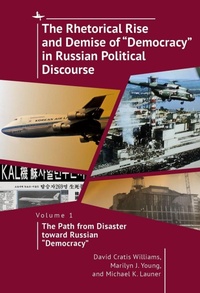
The Rhetorical Rise and Demise of "Democracy" in Russian Political Discourse, Vol I
The Path from Disaster toward Russian "Democracy"
Published on 30. December 2021
Book
Hardback
506 pages
978-1-64469-732-0 (ISBN)
Description
The essays in this book examine the arguments and rhetoric used by the United States and the USSR following two catastrophes that impacted both countries, as blame is cast and consequences are debated. In this environment, it was perhaps inevitable that conspiracy theories would arise, especially about the downing of Korean Air Lines Flight 007 over the Sea of Japan. Those theories are examined, resulting in at least one method for addressing conspiracy arguments. In the case of Chernobyl, the disaster ruptured the "social compact" between the Soviet government and the people; efforts to overcome the resulting disillusionment quickly became the focus of state efforts.
Reviews / Votes
"In bringing dramatically different kinds of scholarship (lengthy rhetorical critiques, technical analyses, and Op-Eds) together, the book highlights the authors' versatility and commitment to reaching multiple audiences with their work."- Gordon R. Mitchell, Ph.D., University of Pittsburgh, Journal of Argumentation in Context
More details
Language
English
Place of publication
Brighton
United States
Product notice
Laminated cover
Illustrations
Illustrations
Dimensions
Height: 240 mm
Width: 161 mm
Thickness: 32 mm
Weight
919 gr
ISBN-13
978-1-64469-732-0 (9781644697320)
Copyright in bibliographic data and cover images is held by Nielsen Book Services Limited or by the publishers or by their respective licensors: all rights reserved.
Schweitzer Classification
Other editions
Additional editions
David Cratis Williams | Marilyn J. Young | Michael K. Launer
The Rhetorical Rise and Demise of "Democracy" in Russian Political Discourse, Volume 1
The Path from Disaster toward Russian "Democracy"
E-Book
12/2021
1st Edition
Academic Studies Press
€137.99
Available for download
Persons
David Cratis Williams is Professor of Communication and Rhetorical Studies at Florida Atlantic University. His scholarship focuses on argumentation, rhetorical theory, and criticism; he is a recognized authority on Kenneth Burke. His work on Russian political discourse began during a meeting in Russia in January 1992.
Marilyn J. Young is the Wayne C. Minnick Professor of Communication Emerita at Florida State University. Her research has focused on political argument with an emphasis on the development of political rhetoric and argument in the former Soviet Union, particularly Russia. She remains an active scholar in retirement.
Michael K. Launer is Professor Emeritus of Russian at Florida State University. In 1987 he interpreted for the first group of Soviet scientists visiting the US following Chernobyl. A State Department certified technical interpreter, he supported Nuclear Regulatory Commission and Department of Energy assistance programs through 2012.
Marilyn J. Young is the Wayne C. Minnick Professor of Communication Emerita at Florida State University. Her research has focused on political argument with an emphasis on the development of political rhetoric and argument in the former Soviet Union, particularly Russia. She remains an active scholar in retirement.
Michael K. Launer is Professor Emeritus of Russian at Florida State University. In 1987 he interpreted for the first group of Soviet scientists visiting the US following Chernobyl. A State Department certified technical interpreter, he supported Nuclear Regulatory Commission and Department of Energy assistance programs through 2012.
Content
Table of Contents Acknowledgements
List of Interviews and Personal Communications
Note to Readers
Preface
Introduction to Volume One. Image and Reality: The Declining Role of Evidence in Public Discourse
Part One: Kal and Cracks in the Rhetorical Wall
Route R-20-Terry Graves Illustration
Takahashi-Novosti Satellite Map
Ogarkov Double Loop Map-The New York Times
Map Credits
1. Did the United States Suppress Ground-to-Air Communications?
2. KAL 007 and the Superpowers: An International Argument
3. The KAL Tapes
4. BCAS Correspondence: "Flight 007: Was There Foul Play?"
5. The Need for Evaluative Criteria: Conspiracy Argument Revisited
6. Soviet Media Tactics and the Body Politic: Prevention and Treatment of Communicable Diseases
7. When the Shoe Is on the Other Foot: Comparative Treatments of the KAL 007 and Iran Air Shootdowns
8. Of Mighty Mice and Meek Men: Contextual Reconstruction of the Iranian Airbus Shootdown
9. "007"-Conspiracy or Accident?
10. Flight 007
11. Carlos the Jackal Attacks RFE/RL!
Part Two: Chernobyl, Eco-Nationalism, and Loss of Rhetorical Control
The Original Sarcophagus (1989)
The Interior Access Door to Unit 4-??????? (1989)
A Billboard at the Rovno Nuclear Station (1996)
New Secure Confinement (2019)
Photo Credits
12. Chernobyl in the Soviet Media: Unintentional Ironies, Unprecedented Events
13. Redefining Glasnost in the Soviet Media: The Recontextualization of Chernobyl
14. Chernobyl: From the Ashes a New Society?
15. Nuclear Power in the USSR
16. Civilian Nuclear Power in the Commonwealth of Independent States: A Case of Cognitive Dissonance
17. Soviet News Media: Uncertainty in the Throes of Change
18. Nuclear Power and Ecological Debates in the Soviet Press, Mid-1988 to Mid-1989
19. The Final Days: The Development of Argumentative Discourse in the Soviet Union
20. Ukraine Nuclear Power Struggles for Survival
21. Nonrational Assessment of Risk and the Development of Civilian Nuclear Power
22. Ukraine, Russia, and the Question of Nuclear Safety
23. Soviet Bureaucracy and Nuclear Safety
24. Review of Two Books by David R. Marples
25. Review of Plutopia
26. Review of Plokhy, Chernobyl
27. Pseudo-Science and Potemkin-History
28. Confronting Climate Change: Assessing the Role of Nuclear Power
Afterword
Index
Bibliography
List of Interviews and Personal Communications
Note to Readers
Preface
Introduction to Volume One. Image and Reality: The Declining Role of Evidence in Public Discourse
Part One: Kal and Cracks in the Rhetorical Wall
Route R-20-Terry Graves Illustration
Takahashi-Novosti Satellite Map
Ogarkov Double Loop Map-The New York Times
Map Credits
1. Did the United States Suppress Ground-to-Air Communications?
2. KAL 007 and the Superpowers: An International Argument
3. The KAL Tapes
4. BCAS Correspondence: "Flight 007: Was There Foul Play?"
5. The Need for Evaluative Criteria: Conspiracy Argument Revisited
6. Soviet Media Tactics and the Body Politic: Prevention and Treatment of Communicable Diseases
7. When the Shoe Is on the Other Foot: Comparative Treatments of the KAL 007 and Iran Air Shootdowns
8. Of Mighty Mice and Meek Men: Contextual Reconstruction of the Iranian Airbus Shootdown
9. "007"-Conspiracy or Accident?
10. Flight 007
11. Carlos the Jackal Attacks RFE/RL!
Part Two: Chernobyl, Eco-Nationalism, and Loss of Rhetorical Control
The Original Sarcophagus (1989)
The Interior Access Door to Unit 4-??????? (1989)
A Billboard at the Rovno Nuclear Station (1996)
New Secure Confinement (2019)
Photo Credits
12. Chernobyl in the Soviet Media: Unintentional Ironies, Unprecedented Events
13. Redefining Glasnost in the Soviet Media: The Recontextualization of Chernobyl
14. Chernobyl: From the Ashes a New Society?
15. Nuclear Power in the USSR
16. Civilian Nuclear Power in the Commonwealth of Independent States: A Case of Cognitive Dissonance
17. Soviet News Media: Uncertainty in the Throes of Change
18. Nuclear Power and Ecological Debates in the Soviet Press, Mid-1988 to Mid-1989
19. The Final Days: The Development of Argumentative Discourse in the Soviet Union
20. Ukraine Nuclear Power Struggles for Survival
21. Nonrational Assessment of Risk and the Development of Civilian Nuclear Power
22. Ukraine, Russia, and the Question of Nuclear Safety
23. Soviet Bureaucracy and Nuclear Safety
24. Review of Two Books by David R. Marples
25. Review of Plutopia
26. Review of Plokhy, Chernobyl
27. Pseudo-Science and Potemkin-History
28. Confronting Climate Change: Assessing the Role of Nuclear Power
Afterword
Index
Bibliography