


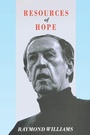
Resources of Hope
Culture, Democracy, Socialism
Published on 1. January 1989
Book
Hardback
352 pages
978-0-86091-229-3 (ISBN)
Description
Raymond Williams possessed unique authority as Britain's foremost cultural theorist and public intellectual. Informed by an unparalleled range of reference and the resources of deep personal experience, his life's work represents a patient, exemplary commitment to the building of a socialist future.
This book brings together important early writings including "Culture is Ordinary," "The British Left," "Welsh Culture" and "Why Do I Demonstrate?" with major essays and talks of the last decade. It includes work on such central themes as the nature of a democratic culture, the value of community, Green socialism, the nuclear threat, and the relation between the state and the arts. Here too, collected for the first time, are the important later political essays which undertake a thorough revaluation of the principles fundamental to the idea of socialist democracy, and confirm Williams as a shrewd and imaginative political theorist. In a sober yet constructive assessment of the possibilities for socialist advance, Williams-in the face of much recent intellectual fashion-powerfully reasserts his lifelong commitment to "making hope practical, rather than despair convincing."
This valuable collection confirms Raymond Williams as a thinker of rare versatility and one of the outstanding intellectuals of our century.
This book brings together important early writings including "Culture is Ordinary," "The British Left," "Welsh Culture" and "Why Do I Demonstrate?" with major essays and talks of the last decade. It includes work on such central themes as the nature of a democratic culture, the value of community, Green socialism, the nuclear threat, and the relation between the state and the arts. Here too, collected for the first time, are the important later political essays which undertake a thorough revaluation of the principles fundamental to the idea of socialist democracy, and confirm Williams as a shrewd and imaginative political theorist. In a sober yet constructive assessment of the possibilities for socialist advance, Williams-in the face of much recent intellectual fashion-powerfully reasserts his lifelong commitment to "making hope practical, rather than despair convincing."
This valuable collection confirms Raymond Williams as a thinker of rare versatility and one of the outstanding intellectuals of our century.
More details
Language
English
Place of publication
London
United Kingdom
Target group
College/higher education
Professional and scholarly
ISBN-13
978-0-86091-229-3 (9780860912293)
Copyright in bibliographic data is held by Nielsen Book Services Limited or its licensors: all rights reserved.
Schweitzer Classification
Other editions
New editions
Book
02/1989
Verso Books
€28.50
Shipment within 3-4 weeks
Persons
Raymond Williams was born in 1921 in the Welsh border village of Pandy, and was educated at the village school, at Abergavenny Grammar School, and at Trinity College, Cambridge. He was elected Fellow of Jesus College, Cambridge, in 1961 and was later appointed University Professor of Drama.
His books include Culture and Society (1958), The Long Revolution (1961) and its sequel Towards 2000 (1983); Communications (1962) and Television: Technology and Cultural Form (1974); Drama in Performance (1954), Modern Tragedy (1966) and Drama from Ibsen to Brecht (1968); The English Novel from Dickens to Lawrence (1970), Orwell (1971) and The Country and the City (1973); Politics and Letters (interviews) (1979) and Problems in Materialism and Culture (selected essays) (1980); and four novels - the Welsh trilogy of Border Country (1960), Second Generation (1964) and The Fight for Manod (1979), and The Volunteers (1978).
His books include Culture and Society (1958), The Long Revolution (1961) and its sequel Towards 2000 (1983); Communications (1962) and Television: Technology and Cultural Form (1974); Drama in Performance (1954), Modern Tragedy (1966) and Drama from Ibsen to Brecht (1968); The English Novel from Dickens to Lawrence (1970), Orwell (1971) and The Country and the City (1973); Politics and Letters (interviews) (1979) and Problems in Materialism and Culture (selected essays) (1980); and four novels - the Welsh trilogy of Border Country (1960), Second Generation (1964) and The Fight for Manod (1979), and The Volunteers (1978).