

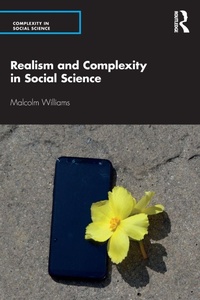
Realism and Complexity in Social Science
1st Edition
Published on 31. December 2020
Book
Paperback/Softback
232 pages
978-1-138-33555-4 (ISBN)
Description
Realism and Complexity in Social Science is an argument for a new approach to investigating the social world, that of complex realism. Complex realism brings together a number of strands of thought, in scientific realism, complexity science, probability theory and social research methodology.
It proposes that the reality of the social world is that it is probabilistic, yet there exists enough invariance to make the discovery and explanation of social objects and causal mechanisms possible. This forms the basis for the development of a complex realist foundation for social research, that utilises a number of new and novel approaches to investigation, alongside the more traditional corpus of quantitative and qualitative methods. Research examples are drawn from research in sociology, epidemiology, criminology, social policy and human geography.
The book assumes no prior knowledge of realism, probability or complexity and in the early chapters, the reader is introduced to these concepts and the arguments against them. Although the book is grounded in philosophical reasoning, this is in a direct and accessible style that will appeal both to social researchers with a methodological interest and philosophers with an interest in social investigation.
It proposes that the reality of the social world is that it is probabilistic, yet there exists enough invariance to make the discovery and explanation of social objects and causal mechanisms possible. This forms the basis for the development of a complex realist foundation for social research, that utilises a number of new and novel approaches to investigation, alongside the more traditional corpus of quantitative and qualitative methods. Research examples are drawn from research in sociology, epidemiology, criminology, social policy and human geography.
The book assumes no prior knowledge of realism, probability or complexity and in the early chapters, the reader is introduced to these concepts and the arguments against them. Although the book is grounded in philosophical reasoning, this is in a direct and accessible style that will appeal both to social researchers with a methodological interest and philosophers with an interest in social investigation.
More details
Series
Language
English
Place of publication
London
United Kingdom
Publishing group
Taylor & Francis Ltd
Target group
College/higher education
Illustrations
2 s/w Abbildungen, 2 s/w Photographien bzw. Rasterbilder
2 Halftones, black and white; 2 Illustrations, black and white
Dimensions
Height: 234 mm
Width: 156 mm
Thickness: 14 mm
Weight
380 gr
ISBN-13
978-1-138-33555-4 (9781138335554)
Copyright in bibliographic data and cover images is held by Nielsen Book Services Limited or by the publishers or by their respective licensors: all rights reserved.
Schweitzer Classification
Other editions
Additional editions
Malcolm Williams
Realism and Complexity in Social Science
Book
12/2020
1st Edition
Routledge
€206.40
Shipment within 10-20 days
Malcolm Williams
Realism and Complexity in Social Science
E-Book
12/2020
1st Edition
Routledge
€40.49
Available for download
Malcolm Williams
Realism and Complexity in Social Science
E-Book
12/2020
1st Edition
Routledge
€55.49
Available for download
Person
Malcolm Williams is Professor and Co-Director of the Q-Step Centre, at Cardiff University.
Content
1. Introduction: Knowing the Social World: Challenges and Possibilities
2. Realism and Its Discontents
3. Complexity, Probability and Necessity in the Social World
4. Causes and Complexity
5. Representation and Reality
6. Theory Choice - Verification, Falsification and Inference
7. Objective Knowledge
8. Mechanisms
9. A Methodological Toolkit: From Micro Complexity to Macro Explanation.
10. A Manifesto for Complex Realism
2. Realism and Its Discontents
3. Complexity, Probability and Necessity in the Social World
4. Causes and Complexity
5. Representation and Reality
6. Theory Choice - Verification, Falsification and Inference
7. Objective Knowledge
8. Mechanisms
9. A Methodological Toolkit: From Micro Complexity to Macro Explanation.
10. A Manifesto for Complex Realism