

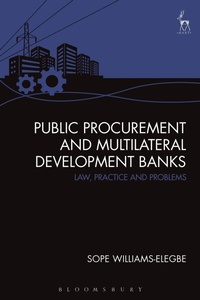
Public Procurement and Multilateral Development Banks
Law, Practice and Problems
Published on 25. July 2019
Book
Paperback/Softback
344 pages
978-1-5099-3079-1 (ISBN)
Description
The multilateral development banks cumulatively channel billions of dollars annually in development assistance to borrower countries. This finance is usually spent through processes that incorporate the public procurement regulations of the banks and it is often a condition of this finance that the funds must be spent using the procurement regulations of the lender institution.
This book examines the issues and challenges raised by procurement regulation in the multilateral development banks. The book examines the history of procurement regulation in the banks; the tripartite relationship created between the banks, borrowers and contractors in funded procurements; the procurement documents and procurement cycle; as well as how the banks ensure competition and value for money in funded procurements. The book also examines the banks' approach to sustainability concerns in public procurement such as environmental, social or industrial concerns; as well as how the banks address the issue of corruption and fraud in funded contracts. Another issue that is addressed by this book is how the banks have implemented the aid effectiveness agenda. It will be seen that the development banks have undertaken steps to harmonise their policies and practices, increased borrower procurement capacity, taken steps to reduce the tying of aid, and play an important role in the reform of borrower procurement systems, all in an effort to improve the effectiveness of development finance. The book also considers the contractual and other remedies that are available to parties that may be aggrieved as a result of a funded procurement.
The book analyses, compares and contrasts the legal, practical and institutional approaches to procurement regulation in the World Bank, the Inter-American Development Bank, the African Development Bank, the Asian Development Bank and the European Bank for Reconstruction and Development.
This book examines the issues and challenges raised by procurement regulation in the multilateral development banks. The book examines the history of procurement regulation in the banks; the tripartite relationship created between the banks, borrowers and contractors in funded procurements; the procurement documents and procurement cycle; as well as how the banks ensure competition and value for money in funded procurements. The book also examines the banks' approach to sustainability concerns in public procurement such as environmental, social or industrial concerns; as well as how the banks address the issue of corruption and fraud in funded contracts. Another issue that is addressed by this book is how the banks have implemented the aid effectiveness agenda. It will be seen that the development banks have undertaken steps to harmonise their policies and practices, increased borrower procurement capacity, taken steps to reduce the tying of aid, and play an important role in the reform of borrower procurement systems, all in an effort to improve the effectiveness of development finance. The book also considers the contractual and other remedies that are available to parties that may be aggrieved as a result of a funded procurement.
The book analyses, compares and contrasts the legal, practical and institutional approaches to procurement regulation in the World Bank, the Inter-American Development Bank, the African Development Bank, the Asian Development Bank and the European Bank for Reconstruction and Development.
More details
Language
English
Place of publication
Oxford
United Kingdom
Publishing group
Bloomsbury Publishing PLC
Target group
Professional and scholarly
College/higher education
Dimensions
Height: 234 mm
Width: 156 mm
Thickness: 19 mm
Weight
524 gr
ISBN-13
978-1-5099-3079-1 (9781509930791)
Copyright in bibliographic data and cover images is held by Nielsen Book Services Limited or by the publishers or by their respective licensors: all rights reserved.
Schweitzer Classification
Other editions
Additional editions
E-Book
03/2017
1st Edition
Hart Publishing
€46.49
Available for download
E-Book
03/2017
1st Edition
Hart Publishing
€46.49
Available for download
Person
Sope Williams-Elegbe is an Associate Professor at Stellenbosch University, South Africa, a public procurement consultant and former lecturer at University of Nottingham.
Content
Part I: History and Law
1. Introduction
2. A Historical Overview of the MDBs and the History of Public Procurement Regulation in the World Bank
3. The MDBs and International Law
Part II: Practice: Documents, Processes and Procedures
4. The Procurement Documents
5. The Project Cycle and the Procurement Process
6. Value for Money, Competition and Selection Procedures
7. Secondary (Sustainability) Concerns in MDB Procurement
Part III: Problems and Issues Affecting MDB Procurement
8. Corruption in MDB Funded Procurement
9. The Aid Effectiveness Agenda: Harmonisation, Tied Aid and Use of Country Systems
10. Public Procurement Reform and the Development of Procurement Capacity in Developing Countries:
The Role of MDBs
11. Remedies Under MDB-funded Procurement
1. Introduction
2. A Historical Overview of the MDBs and the History of Public Procurement Regulation in the World Bank
3. The MDBs and International Law
Part II: Practice: Documents, Processes and Procedures
4. The Procurement Documents
5. The Project Cycle and the Procurement Process
6. Value for Money, Competition and Selection Procedures
7. Secondary (Sustainability) Concerns in MDB Procurement
Part III: Problems and Issues Affecting MDB Procurement
8. Corruption in MDB Funded Procurement
9. The Aid Effectiveness Agenda: Harmonisation, Tied Aid and Use of Country Systems
10. Public Procurement Reform and the Development of Procurement Capacity in Developing Countries:
The Role of MDBs
11. Remedies Under MDB-funded Procurement