

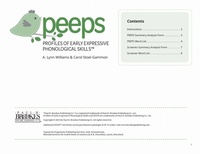
Profiles of Early Expressive Phonological Skills (PEEPS (TM)) Forms
Published on 15. May 2023
Book
Paperback/Softback
8 pages
978-1-68125-739-6 (ISBN)
Description
Phonological development is linked with a child's later success with language and literacy, but tests of early phonological skills are often not sensitive enough for the youngest children. That's why clinicians need PEEPS (TM), a comprehensive assessment of early phonological skills developed specifically for toddlers 18-36 months. Created by leading experts in early phonological development and speech sound disorders, PEEPS helps speech-language pathologists detect speech and language delays early, so children can receive the intervention and support they need to be effective communicators on track for academic achievement. This product is sold in a package of 10.
Why PEEPS?
Developmentally appropriate. Unlike similar tools, PEEPS is specially developed to screen young children and uses elicitation techniques and vocabulary words that are appropriate for this population.
In-depth assessment of an overlooked skill set. Early phonological skills are often not assessed, even though they affect early lexical development. PEEPS is the tool clinicians need to analyze the key components of phonological development, including phonetic inventory, syllable structure, accuracy of consonant production, and error patterns.
Accurately identifies delays. Because most phonological measures aren't designed for the young age range, young children may be overidentified as struggling with phonological skills-or a wait-and-see approach is taken with these children, which can delay starting early intervention. PEEPS helps accurately evaluate children struggling with phonological skills, so they can receive support as early as possible.
Quick, convenient, and flexible. PEEPS gives clinicians a comprehensive picture of early phonological skills in less than 20 minutes. The kit includes the full PEEPS assessment (60 words) and a shorter PEEPS screener (20 words) that helps determine if in-depth testing with the full PEEPS is warranted.
How PEEPS Works
To conduct either the full PEEPS or the screener, the clinician will:
Present a stimulus to the child to elicit each word on the PEEPS word list. The clinician may point to a small toy, a body part or article of clothing, or an illustration in the included board book, A Book of Things.
Transcribe the child's speech production onto the test form.
Complete the scoring and summary page to create a profile of the child's phonological development.
Use this profile to help determine if the child is developing within expected limits or displaying delays or red flags that warrant intervention.
PEEPS is easy to administer. The Examiner's Manual guides clinicians step by step through the process, and the kit includes access to a helpful video in which the authors clearly demonstrate how to deliver PEEPS.
Why PEEPS?
Developmentally appropriate. Unlike similar tools, PEEPS is specially developed to screen young children and uses elicitation techniques and vocabulary words that are appropriate for this population.
In-depth assessment of an overlooked skill set. Early phonological skills are often not assessed, even though they affect early lexical development. PEEPS is the tool clinicians need to analyze the key components of phonological development, including phonetic inventory, syllable structure, accuracy of consonant production, and error patterns.
Accurately identifies delays. Because most phonological measures aren't designed for the young age range, young children may be overidentified as struggling with phonological skills-or a wait-and-see approach is taken with these children, which can delay starting early intervention. PEEPS helps accurately evaluate children struggling with phonological skills, so they can receive support as early as possible.
Quick, convenient, and flexible. PEEPS gives clinicians a comprehensive picture of early phonological skills in less than 20 minutes. The kit includes the full PEEPS assessment (60 words) and a shorter PEEPS screener (20 words) that helps determine if in-depth testing with the full PEEPS is warranted.
How PEEPS Works
To conduct either the full PEEPS or the screener, the clinician will:
Present a stimulus to the child to elicit each word on the PEEPS word list. The clinician may point to a small toy, a body part or article of clothing, or an illustration in the included board book, A Book of Things.
Transcribe the child's speech production onto the test form.
Complete the scoring and summary page to create a profile of the child's phonological development.
Use this profile to help determine if the child is developing within expected limits or displaying delays or red flags that warrant intervention.
PEEPS is easy to administer. The Examiner's Manual guides clinicians step by step through the process, and the kit includes access to a helpful video in which the authors clearly demonstrate how to deliver PEEPS.
More details
Language
English
Place of publication
Baltimore
United States
Target group
Professional and scholarly
Product notice
Saddle-stitched
Dimensions
Height: 280 mm
Width: 215 mm
Thickness: 5 mm
Weight
218 gr
ISBN-13
978-1-68125-739-6 (9781681257396)
Copyright in bibliographic data and cover images is held by Nielsen Book Services Limited or by the publishers or by their respective licensors: all rights reserved.
Schweitzer Classification
Other editions
Additional editions

A. Lynn Williams | Carol Stoel-Gammon
Profiles of Early Expressive Phonological Skills (PEEPS (TM)) Assessment Kit
Profiles of Early Expressive Phonological Skills
Other
05/2023
Brookes Publishing Co
€285.97
Shipment within 3-4 weeks

A. Lynn Williams | Carol Stoel-Gammon
Profiles of Early Expressive Phonological Skills (PEEPS) Board Book
Book
05/2023
Brookes Publishing Co
€20.00
The article will not be published
A. Lynn Williams | Carol Stoel-Gammon
Profiles of Early Expressive Phonological Skills (PEEPS (TM)) Examiner's Manual
Book
05/2023
Brookes Publishing Co
€47.00
Shipment within 3-4 weeks
Persons
A. Lynn Williams, Ph.D. is Associate Dean in the College of Clinical and Rehabilitative Health Sciences and a professor in the Department of Audiology and Speech-Language Pathology at East Tennessee State University. Most of her research has involved clinical investigations of models of phonological treatment for children with severe to profound speech sound disorders. She developed a new model of phonological intervention called multiple oppositions that has been the basis of federally funded intervention studies by the National Institutes of Health (NIH), and she developed a phonological intervention software program, Sound Contrasts in Phonology (SCIP), that was funded by NIH. Dr. Williams served as associate editor of Language, Speech, and Hearing Services in Schools and most recently served as the associate editor of the American Journal of Speech-Language Pathology. Dr. Williams is a Fellow of the American Speech-Language-Hearing Association and served as ASHA Vice President for Academic Affairs in Speech-Language Pathology (2016-2018). She currently serves as ASHA's 2020 President-Elect (2021 ASHA President).
Dr. Carol Stoel-Gammon is Professor Emerita in the Department of Speech and Hearing Sciences at the University of Washington, Seattle. She received her doctoral degree in Linguistics from Stanford University, and has taught, mentored and carried out research in the area of phonological development and disorders for many years. Her book Normal and Disordered Phonology in Children, co-authored with Carla Dunn was published in 1985. Her research interests focus on prelinguistic vocal development and early phonological development in children who are typically developing, and speech development of children with autism, cleft palate, Down syndrome, Fragile X, childhood apraxia of speech, children who are deaf or hard-of-hearing, and late talkers. Dr. Stoel-Gammon as served as Associate Editor of the Journal of Speech and Hearing Disorders, the Journal of Speech and Hearing Research, the American Journal of Speech-Language Pathology, and the Journal of Child Language.
Dr. Carol Stoel-Gammon is Professor Emerita in the Department of Speech and Hearing Sciences at the University of Washington, Seattle. She received her doctoral degree in Linguistics from Stanford University, and has taught, mentored and carried out research in the area of phonological development and disorders for many years. Her book Normal and Disordered Phonology in Children, co-authored with Carla Dunn was published in 1985. Her research interests focus on prelinguistic vocal development and early phonological development in children who are typically developing, and speech development of children with autism, cleft palate, Down syndrome, Fragile X, childhood apraxia of speech, children who are deaf or hard-of-hearing, and late talkers. Dr. Stoel-Gammon as served as Associate Editor of the Journal of Speech and Hearing Disorders, the Journal of Speech and Hearing Research, the American Journal of Speech-Language Pathology, and the Journal of Child Language.