

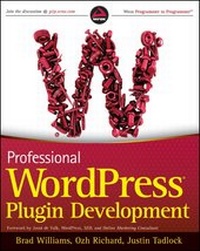
Professional WordPress Plugin Development
Published on 15. March 2011
Book
Paperback/Softback
552 pages
978-0-470-91622-3 (ISBN)
Description
Taking WordPress to the next level with advanced plugin development
WordPress is used to create self-hosted blogs and sites, and it's fast becoming the most popular content management system (CMS) on the Web. Now you can extend it for personal, corporate and enterprise use with advanced plugins and this professional development guide. Learn how to create plugins using the WordPress plugin API: utilize hooks, store custom settings, craft translation files, secure your plugins, set custom user roles, integrate widgets, work with JavaScript and AJAX, create custom post types. You'll find a practical, solutions-based approach, lots of helpful examples, and plenty of code you can incorporate!
* Shows you how to develop advanced plugins for the most popular CMS platform today, WordPress
* Covers plugin fundamentals, how to create and customize hooks, internationalizing your site with translation files, securing plugins, how to create customer users, and ways to lock down specific areas for use in corporate settings
* Delves into advanced topics, including creating widgets and metaboxes, debugging, using JavaScript and AJAX, Cron integration, custom post types, short codes, multi site functions, and working with the HTTP API
* Includes pointers on how to debug, profile and optimize your code, and how to market your custom plugin
Learn advanced plugin techniques and extend WordPress into the corporate environment.
WordPress is used to create self-hosted blogs and sites, and it's fast becoming the most popular content management system (CMS) on the Web. Now you can extend it for personal, corporate and enterprise use with advanced plugins and this professional development guide. Learn how to create plugins using the WordPress plugin API: utilize hooks, store custom settings, craft translation files, secure your plugins, set custom user roles, integrate widgets, work with JavaScript and AJAX, create custom post types. You'll find a practical, solutions-based approach, lots of helpful examples, and plenty of code you can incorporate!
* Shows you how to develop advanced plugins for the most popular CMS platform today, WordPress
* Covers plugin fundamentals, how to create and customize hooks, internationalizing your site with translation files, securing plugins, how to create customer users, and ways to lock down specific areas for use in corporate settings
* Delves into advanced topics, including creating widgets and metaboxes, debugging, using JavaScript and AJAX, Cron integration, custom post types, short codes, multi site functions, and working with the HTTP API
* Includes pointers on how to debug, profile and optimize your code, and how to market your custom plugin
Learn advanced plugin techniques and extend WordPress into the corporate environment.
More details
Other editions
New editions
Brad Williams | Justin Tadlock | John James Jacoby
Professional Wordpress Plugin Development
Book
05/2020
2nd Edition
Wiley-Blackwell
€47.00
Shipment within 15-20 days
Persons
Brad Williams is the CEO and cofounder of webdevstudios.com. He is a coauthor of Professional WordPress.
Ozh Richard has released a number of popular WordPress plugins and won an Annual WordPress Plugin Competition.
Justin Tadlock has developed numerous plugins and teaches users how to use plugins and themes at his WordPress site ThemeHybrid.com.
Ozh Richard has released a number of popular WordPress plugins and won an Annual WordPress Plugin Competition.
Justin Tadlock has developed numerous plugins and teaches users how to use plugins and themes at his WordPress site ThemeHybrid.com.
Content
INTRODUCTION.
CHAPTER 1: AN INTRODUCTION TO PLUGINS.
CHAPTER 2: PLUGIN FOUNDATION.
CHAPTER 3: HOOKS.
CHAPTER 4: INTEGRATING IN WORDPRESS.
CHAPTER 5: INTERNATIONALIZATION.
CHAPTER 6: PLUGIN SECURITY.
CHAPTER 7: PLUGIN SETTINGS.
CHAPTER 8: USERS.
CHAPTER 9: HTTP API.
CHAPTER 10: THE SHORTCODE API.
CHAPTER 11: EXTENDING POSTS: METADATA, CUSTOM POST TYPES, AND TAXONOMIES.
CHAPTER 12: JAVASCRIPT AND AJAX IN WORDPRESS.
CHAPTER 13: CRON.
CHAPTER 14: THE REWRITE API.
CHAPTER 15: MULTISITE.
CHAPTER 16: DEBUGGING AND OPTIMIZING.
CHAPTER 17: MARKETING YOUR PLUGIN.
CHAPTER 18: THE DEVELOPER TOOLBOX.
INDEX.
CHAPTER 1: AN INTRODUCTION TO PLUGINS.
CHAPTER 2: PLUGIN FOUNDATION.
CHAPTER 3: HOOKS.
CHAPTER 4: INTEGRATING IN WORDPRESS.
CHAPTER 5: INTERNATIONALIZATION.
CHAPTER 6: PLUGIN SECURITY.
CHAPTER 7: PLUGIN SETTINGS.
CHAPTER 8: USERS.
CHAPTER 9: HTTP API.
CHAPTER 10: THE SHORTCODE API.
CHAPTER 11: EXTENDING POSTS: METADATA, CUSTOM POST TYPES, AND TAXONOMIES.
CHAPTER 12: JAVASCRIPT AND AJAX IN WORDPRESS.
CHAPTER 13: CRON.
CHAPTER 14: THE REWRITE API.
CHAPTER 15: MULTISITE.
CHAPTER 16: DEBUGGING AND OPTIMIZING.
CHAPTER 17: MARKETING YOUR PLUGIN.
CHAPTER 18: THE DEVELOPER TOOLBOX.
INDEX.