

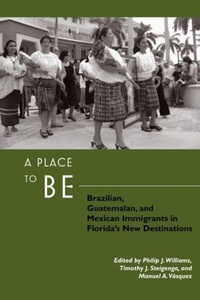
A Place to Be
Brazilian, Guatemalan, and Mexican Immigrants in Florida's New Destinations
Published on 3. March 2009
Book
Paperback/Softback
288 pages
978-0-8135-4493-9 (ISBN)
Description
A Place to Be is the first book to explore migration dynamics and community settlement among Brazilian, Guatemalan, and Mexican immigrants in America's new South. The book adopts a fresh perspective to explore patterns of settlement in Florida, including the outlying areas of Miami and beyond. The stellar contributors from Latin America and the United States address the challenges faced by Latino immigrants, their cultural and religious practices, as well as the strategies used, as they move into areas experiencing recent large-scale immigration.Contributors to this volume include Patricia Fortuny Loret de Mola, Carol GirOn SolOrzano, Silvia Irene Palma, LUcia Ribeiro, Mirian Solfs Lizama, JosE ClaUdio Souza Alves, Timothy J. Steigenga, Manuel A. VAsquez, and Philip J. Williams.
Reviews / Votes
"A Place to Be is a must-read for everyone interested in religion and transnational communities. The book's innovative focus on lived religion and collective mobilization considerably advances theories of both international migration and religion." - Alex Stepick (Director, Immigration & Ethnicity Institute, Florida International University) "A cutting edge contribution that focuses on non-traditional placesof settlement, models new methods for analyzing religious geographies, andhighlights the important role of space, place, and time in immigrantincorporation and mobilization." - Peggy Levitt (author of God Needs No Passport) "This volume makes important contributions to immigration studies as well as to the study of 'lived religion' and its intersection with the livelihoods of Latin American immigrants in Florida."(Journal of American Ethnic History) "A Place to Be is a must-read for everyone interested in religion and transnational communities. The book's innovative focus on lived religion and collective mobilization considerably advances theories of both international migration and religion." - Alex Stepick (Director, Immigration & Ethnicity Institute, Florida International University) "A cutting edge contribution that focuses on non-traditional placesof settlement, models new methods for analyzing religious geographies, andhighlights the important role of space, place, and time in immigrantincorporation and mobilization." - Peggy Levitt (author of God Needs No Passport) "This volume makes important contributions to immigration studies as well as to the study of 'lived religion' and its intersection with the livelihoods of Latin American immigrants in Florida."
(Journal of American Ethnic History)
More details
Edition
None edition
Language
English
Place of publication
New Brunswick NJ
United States
Target group
Professional and scholarly
Product notice
Paperback (trade)
Unsewn / adhesive bound
Dimensions
Height: 227 mm
Width: 153 mm
Thickness: 15 mm
Weight
372 gr
ISBN-13
978-0-8135-4493-9 (9780813544939)
Copyright in bibliographic data and cover images is held by Nielsen Book Services Limited or by the publishers or by their respective licensors: all rights reserved.
Schweitzer Classification
Persons
Philip J. Williams is a professor of political science at the University of Florida and coeditor of Christianity, Social Change, and Globalization in the Americas (Rutgers University Press).Timothy J. Steigenga is a professor of political science at Florida Atlantic University and coeditor of Conversion of a Continent (Rutgers University Press).Manuel A. VAsquez is an associate professor of religion at the University of Florida and coauthor of Globalizing the Sacred (Rutgers University Press).
Content
Acknowledgments
Introduction
Part I. Transnational Lives
Beyond Homo Anomicus
From Jacaltenango to Jupiter
Solidarities among Mexican Immigrants in Immokalee
Part II. Collective Mobilization and Empowerment
Transnationalism and Collective Action among Guatemalan and Mexican Immigrants in Two Florida Communities
Immigrant Regime of Production
Part III. Identities and Lived Religion
Lived Religion and a Sense of Home
Looking for Lived Religion in Immokalee
Brazilian and Mexican Women
A Place to Be
Introduction
Part I. Transnational Lives
Beyond Homo Anomicus
From Jacaltenango to Jupiter
Solidarities among Mexican Immigrants in Immokalee
Part II. Collective Mobilization and Empowerment
Transnationalism and Collective Action among Guatemalan and Mexican Immigrants in Two Florida Communities
Immigrant Regime of Production
Part III. Identities and Lived Religion
Lived Religion and a Sense of Home
Looking for Lived Religion in Immokalee
Brazilian and Mexican Women
A Place to Be