

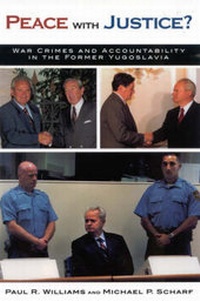
Peace with Justice?
War Crimes and Accountability in the Former Yugoslavia
Published on 27. August 2002
Book
Paperback/Softback
352 pages
978-0-7425-1856-8 (ISBN)
Description
Resolving the Yugoslav conflict was the last great foreign policy challenge of the twentieth century. Never before in history was so much emphasis placed on the need to employ the concept of justice in the peace process or was so much energy devoted to creating and utilizing international justice-based institutions. In this provocative and insightful book, two former State Department lawyers, Paul R. Williams and Michael P. Scharf, tell the true story, 'warts and all,' of the role of justice in building peace in the former Yugoslavia.
Reviews / Votes
A rich, complex and nuanced presentation of the various motivations and perceptions driving American and European policy on the violence and war crimes in the Balkans. The Royal Institute of International Affairs Williams and Scharf have written the book that everyone who values justice in the face of atrocities must read. Readers will benefit from their thorough research and understanding of both law and politics. Whatever one's views of how peace-building has fused with justice in the Balkans, this book will be the touchstone for all future inquiries. -- David Scheffer, former U.S. Ambassador at Large for War Crimes Issues Nowhere else is the argument for justice norms and accountability procedures addressed with such insight and intelligence. Peace with Justice? makes a distinctive contribution to the vast Balkans literature. -- Richard Falk, Albert G. Milbank Professor of International Law Emeritus, Princeton University Williams and Scharf set out a compelling case for international justice after war crimes. Their study ably captures the development and proceedings of The Hague Tribunal, critically analyzes the price of political fecklessness, and mercilessly skewers the Western politicians who refused to implement the law. A powerful argument based on solid fact. -- Roy Gutman, Pulitzer Prize-winning journalist with Newsweek In 14 chapters with an extensive notes section, the authors not only examine in depth the carnage wrought by the conflict in Yugoslavia, but, more importantly, lay out the steps that they allege will bring about a lasting peace in this blighted portion of Europe. Recommended. CHOICE Williams and Scharf expertly explain in a few hundred pages what I learned the hard way as a division commander in Bosnia-Herzegovina and a United Nations administrator in Kosovo. -- Major General William L. Nash, (ret), former Commander of the U.S. forces in Bosnia An interesting contribution relevant for scholars and policy-makers alike, as it provides a new perspective on the way the norms and institutions of justice worked, did not work, or could have worked better, in the Yugoslav peace-building process. Slavonica In this book, Williams and Scharf shine a spotlight on some of the most egregious improprieties of a few of the worst offenders and demonstrate with agonizing clarity and in abundant detail what a high price was paid to bring an end to the fighting. Williams and Scharf describe the pusillanimity of all the major players. They illuminate how the international community and its strongest and seemingly most accountable actors time and again at crucial moments chose the low road of appeasement instead of the high road of justice and accountability. Slavic Review A valuable contribution to the ongoing debate about how to manage the tensions between the competing values of truth, peace, compassion, and justice in the struggle for peace. European Foreign Affairs Review What is the relationship between peace and justice? Is one possible without the other? In this important new work, Paul R. Williams and Michael P. Scharf examine the norm of justice and the role it played in third-party efforts to bring an end to the Yugoslav wars of dissolution and build piece in the region. In an account of the conflict that is at once thorough and compelling, William and Scharf argue that justice and accountability took second place consistently to the accommodation of political and military leaders tolerant of, if not responsible for, the commission of war crimes. The consequence, they demonstrate, was appeasement that frequently had the effect of encouraging further violence and atrocities. -- Richard Caplan, Department of Politics and International Relations, University of Oxford SeerMore details
Series
Language
English
Place of publication
United States
Publishing group
Bloomsbury Publishing Plc
Illustrations
bibliography, index
Dimensions
Height: 232 mm
Width: 143 mm
Thickness: 19 mm
Weight
454 gr
ISBN-13
978-0-7425-1856-8 (9780742518568)
Copyright in bibliographic data and cover images is held by Nielsen Book Services Limited or by the publishers or by their respective licensors: all rights reserved.
Schweitzer Classification
Persons
Paul R. Williams is the Rebecca Grazier Professor of Law and International Relations at American University, where he holds a joint appointment in the School of International Service and the Washington College of Law. Michael P. Scharf is professor of international law and director of the International War Crimes Research Office at Case Western Reserve University School of Law.
Content
Part 1 Part I: Structuring an Inquiry into the Role of Justice During the Peace-building Process Chapter 2 The Cognitive Contextual Process: Melding International Relations and International Legal Theory Chapter 3 Justice and Anti-Justice: The Functions of Accountability in the Peace-building Process Chapter 4 Peace vs. Justice: The Relationship between Accountability and Other Relevant Peace-building Approaches Part 5 Part II: Precursors to Justice: Self-Identity, Political Will, and Moral Obligation in the Peace-building Process Chapter 6 The Road to War: War Crimes and the Crime of War in Yugoslavia Chapter 7 The International Response: Self-Interest Wrongly Understood Part 8 Part III: Creating and Employing Justice Based Institutions During the Initial Phases of the Peace-building Process Chapter 9 Establishing the Yugoslav War Crimes Commission and Yugoslav Tribunal: A Judicial Placebo Chapter 10 The Operation of the Yugoslav Tribunal: A Record of Self-Imposed Limits Chapter 11 The International Court of Justice: A Blunt Tool for Peace-building Part 12 Part IV: The Role of Justice in the Negotiation Phase of Peace Building Chapter 13 The Dayton Negotiations: Getting to Yes with War Criminals Chapter 14 Seeking Peace in Kosovo: The Relegation of Justice Chapter 15 The Rambouillet/Paris Negotiations: From Coercive Appeasement to Humanitarian Intervention Part 16 Part V: The Role of Justice in the Implementation Phase of Peace-building Chapter 17 Apprehending War Criminals: Mission Creep or Mission Impossible? Chapter 18 Linking Justice and Economic Inducements: A Road to Peace Chapter 19 The Cohabitation of Justice and Peace: Concluding Observations