

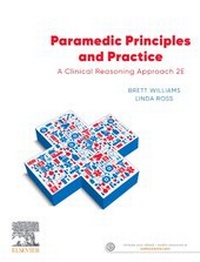
Paramedic Principles and Practice
A Clinical Reasoning Approach
2nd Edition
Published on 1. November 2020
Book
Paperback/Softback
1100 pages
978-0-7295-4306-4 (ISBN)
Description
Edited by expert academics and educators, Brett Williams and Linda Ross, and written by content specialists and experienced clinicians, this essential resource encourages readers to see the links between the pathophysiology of a disease, how this creates the signs and symptoms and how these should to be managed in the out-of-hospital environment. Additionally, Paramedic Principles and Practice 2e will arm readers with not only technical knowledge and expertise, but also the non-technical components of providing emergency care, including professional attitudes and behaviours, decision-making, teamwork and communication skills.
Case studies are strategically used to contextualise the principles, step readers through possible scenarios that may be encountered and, importantly, reveal the process of reaching a safe and effective management plan. The case studies initially describe the pathology and typical presentation of a particular condition and progress to more-complex and less-typical scenarios where the practitioner faces increasing uncertainty.
- The only paramedic-specific text designed for Australian and New Zealand students and paramedics
- Progressive case studies that bridge the gap from principles to practice
- More than 40 essential pathologies covering common paramedic call-outs
- Covers both technical and non-technical skills to develop the graduate into expert clinician
- Includes an eBook with the purchase of the print book
Additional resources on Evolve
- An eBook on VitalSource
Instructor/and Student resources:
- Image collection
- New chapters, including: Paediatric patients; Child abuse and intimate partner violence; Geriatric patients; Tropical conditions; Mass casualty; Interpersonal communication and patient-focused care; Evidence-based practice in paramedicine; Pharmacokinetics and pharmacodynamics
- New case studies on major incidents and major trauma
- Focused 'Implications for' boxes specific to considerations including geriatrics, cultural diversity, communication challenges
- 'Summary of therapeutic goals' included with each case study
- Learning outcomes added to open each chapter
- Considered revision of pathophysiology across all chapters
Case studies are strategically used to contextualise the principles, step readers through possible scenarios that may be encountered and, importantly, reveal the process of reaching a safe and effective management plan. The case studies initially describe the pathology and typical presentation of a particular condition and progress to more-complex and less-typical scenarios where the practitioner faces increasing uncertainty.
- The only paramedic-specific text designed for Australian and New Zealand students and paramedics
- Progressive case studies that bridge the gap from principles to practice
- More than 40 essential pathologies covering common paramedic call-outs
- Covers both technical and non-technical skills to develop the graduate into expert clinician
- Includes an eBook with the purchase of the print book
Additional resources on Evolve
- An eBook on VitalSource
Instructor/and Student resources:
- Image collection
- New chapters, including: Paediatric patients; Child abuse and intimate partner violence; Geriatric patients; Tropical conditions; Mass casualty; Interpersonal communication and patient-focused care; Evidence-based practice in paramedicine; Pharmacokinetics and pharmacodynamics
- New case studies on major incidents and major trauma
- Focused 'Implications for' boxes specific to considerations including geriatrics, cultural diversity, communication challenges
- 'Summary of therapeutic goals' included with each case study
- Learning outcomes added to open each chapter
- Considered revision of pathophysiology across all chapters
More details
Edition
2nd edition
Language
English
Place of publication
Chatswood
Australia
Target group
College/higher education
Dimensions
Height: 276 mm
Width: 216 mm
ISBN-13
978-0-7295-4306-4 (9780729543064)
Copyright in bibliographic data and cover images is held by Nielsen Book Services Limited or by the publishers or by their respective licensors: all rights reserved.
Schweitzer Classification
Other editions
Additional editions
BHlthSc Williams BAVEd | GradDipPhysEd Ross BTeach
Paramedic Principles and Practice eBook
A Clinical Reasoning Approach
E-Book
10/2020
2nd Edition
Elsevier
€74.99
Available for download
Previous edition
Book
05/2015
Elsevier
€143.76
Article exhausted; check for reprint
Persons
Content
Part 1: PARAMEDIC PRINCIPLES
SECTION 1: INTRODUCTION TO PARAMEDIC
SECTION 2: FOUNDATION KNOWLEDGE
SECTION 3: FOUNDATION CONCEPTS
SECTION 4: COMMUNICATION AND NON-TECHNICAL SKILLS
SECTION 5: THE AUSTRALIAN AND NEW ZEALAND HEALTHCARE SYSTEMS
SECTION 6: PATIENT AND PARAMEDIC SAFETY
SECTION 7: LEGAL, ETHICAL AND PROFESSIONAL CONSIDERATIONS
Part 2: PARAMEDIC PRACTICE
SECTION 8: THE PARAMEDIC CLINICAL APPROACH
SECTION 9: THE PARAMEDIC APPROACH TO THE PATIENT WITH A RESPIRATORY CONDITION
SECTION 10: THE PARAMEDIC APPROACH TO THE PATIENT WITH A CARDIAC CONDITION
SECTION 11: THE PARAMEDIC APPROACH TO THE PATIENT WITH A MEDICAL CONDITION
SECTION 12: THE PARAMEDIC APPROACH TO THE TRAUMA PATIENT
SECTION 13: THE PARAMEDIC APPROACH TO THE PATIENT WITH AN ENVIRONMENTAL CONDITIONS
SECTION 14: THE PARAMEDIC APPROACH TO COMPLEX CASES: SPECIFIC CHALLENGES TO PARAMEDIC REASONING AND MANAGEMENT
SECTION 15: THE PARAMEDIC APPROACH TO THE PATIENT WITH A MENTAL HEALTH CONDITION
SECTION 16: THE PARAMEDIC APPROACH TO OBSTETRIC, NEONATAL AND PAEDIATRIC PATIENTS
Appendix 1: Medications commonly encountered in paramedic practice
SECTION 1: INTRODUCTION TO PARAMEDIC
SECTION 2: FOUNDATION KNOWLEDGE
SECTION 3: FOUNDATION CONCEPTS
SECTION 4: COMMUNICATION AND NON-TECHNICAL SKILLS
SECTION 5: THE AUSTRALIAN AND NEW ZEALAND HEALTHCARE SYSTEMS
SECTION 6: PATIENT AND PARAMEDIC SAFETY
SECTION 7: LEGAL, ETHICAL AND PROFESSIONAL CONSIDERATIONS
Part 2: PARAMEDIC PRACTICE
SECTION 8: THE PARAMEDIC CLINICAL APPROACH
SECTION 9: THE PARAMEDIC APPROACH TO THE PATIENT WITH A RESPIRATORY CONDITION
SECTION 10: THE PARAMEDIC APPROACH TO THE PATIENT WITH A CARDIAC CONDITION
SECTION 11: THE PARAMEDIC APPROACH TO THE PATIENT WITH A MEDICAL CONDITION
SECTION 12: THE PARAMEDIC APPROACH TO THE TRAUMA PATIENT
SECTION 13: THE PARAMEDIC APPROACH TO THE PATIENT WITH AN ENVIRONMENTAL CONDITIONS
SECTION 14: THE PARAMEDIC APPROACH TO COMPLEX CASES: SPECIFIC CHALLENGES TO PARAMEDIC REASONING AND MANAGEMENT
SECTION 15: THE PARAMEDIC APPROACH TO THE PATIENT WITH A MENTAL HEALTH CONDITION
SECTION 16: THE PARAMEDIC APPROACH TO OBSTETRIC, NEONATAL AND PAEDIATRIC PATIENTS
Appendix 1: Medications commonly encountered in paramedic practice