

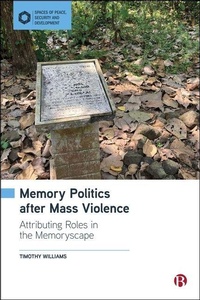
Memory Politics After Mass Violence
Attributing Roles in the Memoryscape
1st Edition
Will be published approx. on 1. December 2026
Book
Paperback/Softback
254 pages
978-1-5292-2759-8 (ISBN)
Description
This book explores how political actors draw on memories of violent pasts to generate political power and legitimacy in the present. Drawing on fieldwork in post-violence Cambodia, Rwanda and Indonesia, the book demonstrates in what way power is derived from how roles are assigned, exploring who is deemed a perpetrator, victim or hero, as well as ambivalences in this memory.
The author interrogates the ways in which these roles are attributed and ambivalences created in each society's political discourses, transitional justice processes and cultural heritage. The comparative empirical analysis illustrates the importance of memory for political power and legitimacy today.
More details
Other editions
Additional editions
Book
06/2025
1st Edition
Bristol University Press
€130.50
Shipment within 3-4 weeks
E-Book
06/2025
1st Edition
Bristol University Press
€47.49
Available for download
Person
Timothy Williams is Junior Professor of Insecurity and Social Order at the Institute for Political Science in the Department of Social Science and Public Affairs at the University of the Bundeswehr Munich, Germany.
Content
1. Introduction
2. Memoryscapes' Complex Negotiation of the Past and Present: Mnemonic Role Attributions and Ambivalence
3. Cambodia: From Demonization to Universal Victimhood
4. Rwanda: Ethnic Essentialism and Rwandan Patriotic Front Heroism
5. Indonesia: Ambivalent Silence and Communist Threat Constructions
6. Mnemonic Role Attributions and Ambivalence in Post-Violence Memoryscapes: Comparative Insights
7. Conclusion
2. Memoryscapes' Complex Negotiation of the Past and Present: Mnemonic Role Attributions and Ambivalence
3. Cambodia: From Demonization to Universal Victimhood
4. Rwanda: Ethnic Essentialism and Rwandan Patriotic Front Heroism
5. Indonesia: Ambivalent Silence and Communist Threat Constructions
6. Mnemonic Role Attributions and Ambivalence in Post-Violence Memoryscapes: Comparative Insights
7. Conclusion