

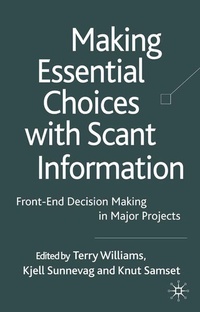
Making Essential Choices with Scant Information
Front-End Decision Making in Major Projects
Published on 26. March 2009
Book
Paperback/Softback
XVI, 417 pages
978-1-349-30224-6 (ISBN)
Description
An in-depth look at how to improve decisions on major projects at the concept stage, when there is scant information available. This book describes how to evaluate judgemental information. It looks at how scant information can actually be a strength, and can help establish a broad overall perspective.
More details
Edition
1st ed. 2009
Language
English
Place of publication
London
United Kingdom
Target group
Professional and scholarly
Illustrations
45 s/w Abbildungen
XVI, 417 p. 45 illus.
Dimensions
Height: 216 mm
Width: 140 mm
Thickness: 24 mm
Weight
545 gr
ISBN-13
978-1-349-30224-6 (9781349302246)
DOI
10.1057/9780230236837
Schweitzer Classification
Other editions
Additional editions
T. Williams | K. Samset | K. Sunnevåg
Making Essential Choices with Scant Information
Front-End Decision Making in Major Projects
Book
03/2009
Palgrave Macmillan
€106.99
Shipment within 15-20 days
T. Williams | K. Samset | K. Sunnevåg
Making Essential Choices with Scant Information
Front-End Decision Making in Major Projects
E-Book
03/2009
1st Edition
Palgrave Macmillan
€96.29
Available for download
Persons
TERRY WILLIAMS is a Management Scientist at Southampton University, UK. After 9 years in engineering consultancy developing project risk management, he worked at Strathclyde University, becoming Professor and Department Head, researching the behaviour of major projects and supporting post-project claims. He is a speaker/writer on project modelling, and has written 60 refereed journal articles and books on modelling and learning from complex projects. He is a member of many leading research networks.
KJELL SUNNEVÅG is a senior adviser at the Norwegian Competition Authority. He has worked as a research economist since 1987. His first position was at the Christian Michelsen Institute (CMI) in Bergen, research focus being on petroleum economics. Later, he moved to the Foundation for research in Economics and Business Administration (SNF), extending the research interests to energy economics and public policy and economics. One of his last assignments there was editing/contribute to a report on making decisions based on scant information.
KNUT SAMSET is Professor at the Norwegian University of Science and Technology and director of a research program on front-end management of major investment projects. He has a background in engineering and social science and has worked many years as consultant and advisor to national and international governmental organizations. He has written a number of books on project design, evaluation, and project risk management.
Content
PART I: INTRODUCTION Decisions Made on Scant Information: Overview; T.Williams Projects, their Quality at Entry - and Challenges in the Front-end Phase; K.Samset PART II: ALIGNING PROJECTS Implementing Strategy through Project Management: The Importance of Managing the Project Front-end; P. Morris Scenarios Planning; K. van der Heijden Up-front Assessment of Needs; P.Naess Front-end Alignment of Projects - Doing the Right Project; T.Cooke-Davies Using Soft Systems Methodology to Structure Project Definition; M.Winter PART III: GENERATING INFORMATION Optimism and Misrepresentation in Early Project Development; B.Flyvbjerg Decision Behaviour - Improving Expert Judgement; G.Kirkebøen Useful Heuristics; B.Scheibehenne& B.von Helversen Expert Judgment of Probability and Risk; G.Wright, F.Bolger,& G.Rowe Evaluation of Risks in Complex Problems; G.Parnell Obtaining Distributions from Groups for Decisions under Uncertainty; R.Cooke PART IV: ANALYSING INFORMATION Exploratory Quantitative Analysis of Emergent Problems with Scant Information; T.Bedford Analyzing Information: Techniques and Analyses; B.Andersen Parametric Analysis; P.Pugh PART V: MAKING DECISIONS The Impact of New Information; K.Sunnevaag The Complexity of Decision-making in Large Projects with Multiple Partners: Be Prepared to Change; R.Miller& B.Hobbs From Analysis to Decision - Economic Assessment; K.Hagen