

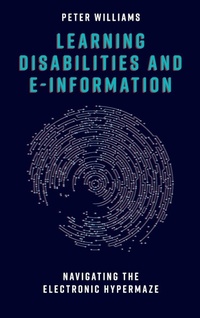
Learning Disabilities and e-Information
Navigating the Electronic Hypermaze
Published on 30. June 2020
Book
Hardback
200 pages
978-1-78973-152-1 (ISBN)
Description
Digital Technology is becoming ever more used by people with learning disabilities for information, entertainment and to enjoy self-expression. Despite this, there is a paucity of research into how this cohort negotiate electronic interfaces, interpret images, navigate pages and read online; what barriers there might be, and how these could be obviated. This book explores these issues, establishing how these and other factors facilitate or inhibit information access and behaviour more generally. There are plenty of guidelines and accessibility standards regarding electronic information presentation, but most are outdated or have been formulated without empirical evidence. Unlike prior literature this book is the result of many years's research in the field, considers specific information contexts, and develops new concepts in information behaviour. It is written in non-technical, jargon-free language, relevant for academics, students and professionals; from human-computer interaction researchers, learning disability specialists and information scientists to formal and informal carers and supporters, college tutors, family members and others.
Reviews / Votes
"This book presents important new evidence about the benefits of digital technologies for people with learning disabilities providing much-needed new insights of value to carers, learning practitioners and social policy-makers." -- Barrie Gunter 'I cannot stress strongly enough how important this work is for social inclusion, in particular understanding vulnerable users and providing input to information/digital literacy programmes or information systems designs, to provide a much better chance of independent living for the cohort.' -- Andy Macfarlane People with disabilities are increasingly looking to use technology to enable them to live informed and connected lives. The challenge is ensuring that e-technology responds to people with different needs and supports people to realise their full potential in a diverse and safe way. This book explores the issues and opens the debate to how disabled people can be included in the technological era. -- Philip GibsonMore details
Language
English
Place of publication
Bingley
United Kingdom
Target group
Professional and scholarly
Dimensions
Height: 235 mm
Width: 157 mm
Thickness: 15 mm
Weight
448 gr
ISBN-13
978-1-78973-152-1 (9781789731521)
Copyright in bibliographic data and cover images is held by Nielsen Book Services Limited or by the publishers or by their respective licensors: all rights reserved.
Schweitzer Classification
Other editions
Additional editions
E-Book
06/2020
Emerald Publishing Limited
€90.99
Available for download
Person
Peter Williams is an Honorary Senior Research Fellow in the Department of Information Studies, University College London, UK. He has spent the last 25 years investigating the role and impact of digital technology - in particular the Internet - in the health service, media and education. He recently completed a British Academy Fellowship on 'The Digital Lives of People with Learning Disabilities', extending and complementing his PhD thesis which examined web site design for the same cohort. Peter is the author/co-author of three books and over 130 journal articles and book chapters.
Content
Chapter 1. Definitions, models, needs
Chapter 2. Issues inherent in researching learning disabilities
Chapter 3. The web and people with learning disabilities
Chapter 4. Methods to test Website usability
Chapter 5. Website usability - eliciting the issues
Chapter 6. The use of images
Chapter 7. Investigating the attributes elicited in consort
Chapter 8. 'Serial access' to information
Chapter 9. 'Random','direct' and 'iterative' access
Chapter 10. Examining website preferences
Chapter 11. A shrinking world: mobile devices and usability
Chapter 12. Testing the usability of a mobile app
Chapter 13. Facilitating information access
Chapter 14. Conclusion
Chapter 2. Issues inherent in researching learning disabilities
Chapter 3. The web and people with learning disabilities
Chapter 4. Methods to test Website usability
Chapter 5. Website usability - eliciting the issues
Chapter 6. The use of images
Chapter 7. Investigating the attributes elicited in consort
Chapter 8. 'Serial access' to information
Chapter 9. 'Random','direct' and 'iterative' access
Chapter 10. Examining website preferences
Chapter 11. A shrinking world: mobile devices and usability
Chapter 12. Testing the usability of a mobile app
Chapter 13. Facilitating information access
Chapter 14. Conclusion