

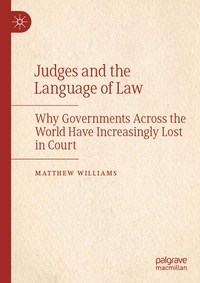
Judges and the Language of Law
Description
Reviews / Votes
"This elegantly written monograph argues persuasively that a central cause for the decades-long expansion of judicial power lies not so much in the ambition of judges as in changes of the law itself: As the specificity of laws has declined, so the power of the courts has expanded. Matthew Williams' masterful analysis, which straddles history, law and political science, causes us to rethink key theories of the judicialization of politics. His work is a tour de force that will be appreciated not only for its combination of computational text analysis with nuanced process tracing histories of judicial power, but also for its expansive ambition, covering seven decades and five jurisdictions." (Petra Schleiter, Professor of Comparative Politics, University of Oxford, United Kingdom)"We live in an age of data and data analytics. Analysing huge swathes of legislative text across time and jurisdictions, Matthew Williams has revealed a series of fascinating changes in language use. He clearly demonstrates that indeterminacy in the language of legislation affords considerable scope for judges and those exercising judicial determinations to exercise wide powers of interpretation. This clearly written book with its compelling narrative is an important contribution to our understanding of law and policy in the 21st century." (Sir Nigel Shadbolt, Professor of Computer Science, University of Oxford, United Kingdom).
More details
Other editions
Additional editions
Person
Matthew Williams is Tutor and Fellow of Jesus College, University of Oxford, UK. He lectures on British and comparative politics. His research analyses the language of politics, how the language of legislation has changed over the past century, and the effects of these changes on litigation strategies and public administration.
Content
Part 1. Language in Contemporary Politics.- Chapter 1. Introduction and State of the Art.- Chapter 2. Modern Political Language.- Part 2. Quantitative History.- Chapter 3. The "New Constitutionalism" in 187 Countries.- Chapter 4. Regulating the Extent of the State in Five Democracies.- Part 3. Qualitative History.- Chapter 5. Rule of Law without a Constitution in the UK.- Chapter 6. Federalism and Party Polarisation in the US.- Chapter 7. Mixed Legal Systems with Human Rights Reform in Canada.- Chapter 8. Executive Dominance with Decentralisation in France.- Chapter 9. The Burden of History, with the Promise of Philosophy in Germany.- Chapter 10. Conclusions.