

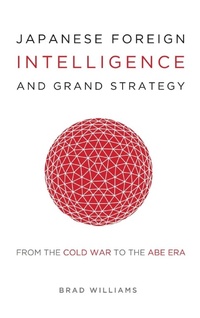
Japanese Foreign Intelligence and Grand Strategy
From the Cold War to the Abe Era
Published on 1. March 2021
Book
Hardback
280 pages
978-1-64712-063-4 (ISBN)
Description
Incisive insights into the distinctive nature of Japanese foreign intelligence and grand strategy, its underlying norms, and how they have changed over time
Japanese foreign intelligence is an outlier in many ways. Unlike many states, Japan does not possess a centralized foreign intelligence agency that dispatches agents abroad to engage in espionage. Japan is also notable for civilian control over key capabilities in human and signals intelligence. Japanese Foreign Intelligence and Grand Strategy probes the unique makeup of Japan's foreign intelligence institutions, practices, and capabilities across the economic, political, and military domains and shows how they have changed over time.
Brad Williams begins by exploring how Japan's experiences of the Second World War and its new role as a major US ally influenced its adoption of bilateralism, developmentalism, technonationalism, and antimilitarism as key norms. As a result, Japanese intelligence-gathering resources centered primarily around improving its position in the global economy throughout the Cold War. Williams then brings his analysis up to the Abe Era, examining how shifts in the international, regional, and domestic policy environments in the twenty-first century have caused a gradual reassessment of national security strategy under former prime minister Shinzo Abe. As Japan reevaluates its old norms in light of regional security challenges, the book concludes by detailing how the country is beginning to rethink the size, shape, and purpose of its intelligence community.
Anyone interested in Japanese intelligence, security, or international relations will welcome this important contribution to our understanding of the country's intelligence capabilities and strategy.
Japanese foreign intelligence is an outlier in many ways. Unlike many states, Japan does not possess a centralized foreign intelligence agency that dispatches agents abroad to engage in espionage. Japan is also notable for civilian control over key capabilities in human and signals intelligence. Japanese Foreign Intelligence and Grand Strategy probes the unique makeup of Japan's foreign intelligence institutions, practices, and capabilities across the economic, political, and military domains and shows how they have changed over time.
Brad Williams begins by exploring how Japan's experiences of the Second World War and its new role as a major US ally influenced its adoption of bilateralism, developmentalism, technonationalism, and antimilitarism as key norms. As a result, Japanese intelligence-gathering resources centered primarily around improving its position in the global economy throughout the Cold War. Williams then brings his analysis up to the Abe Era, examining how shifts in the international, regional, and domestic policy environments in the twenty-first century have caused a gradual reassessment of national security strategy under former prime minister Shinzo Abe. As Japan reevaluates its old norms in light of regional security challenges, the book concludes by detailing how the country is beginning to rethink the size, shape, and purpose of its intelligence community.
Anyone interested in Japanese intelligence, security, or international relations will welcome this important contribution to our understanding of the country's intelligence capabilities and strategy.
Reviews / Votes
I recommend this book as a solid work for those interested in the evolving intelligence community of the world's third economic power. * The Cipher Brief * An impressive and seminal work of meticulous research and outstanding scholarship, "Japanese Foreign Intelligence and Grand Strategy: From the Cold War to the Abe Era" will be of particular interest to students, academia, and non-specialist general readers with an interest in the subject of Japanese intelligence, security, or international relations. * Midwest Book Review * Williams provides English-language readers with one of the best books on the evolution of Japan's intelligence community. This book is, therefore, an important piece of the puzzle for explaining not just Japan's past security behavior, but also its likely future. * H-Diplo * Williams presents a novel framework that situates the development of Japan's intelligence system within the context of the nation's grand strategy, as well as the norms and practices that have shaped its national security and foreign policy. * Japan Review * [W]illiams' volume is distinguished by its explicit connection of intelligence with grand strategy, its new insights on economic factors, and incorporation of constructivist conceptual framework, which he expertly weaves into his account. * Pacific Affairs *More details
Language
English
Place of publication
Washington, DC
United States
Target group
Professional and scholarly
US School Grade: College Graduate Student and over
Illustrations
Not illustrated
Dimensions
Height: 229 mm
Width: 152 mm
Weight
608 gr
ISBN-13
978-1-64712-063-4 (9781647120634)
Copyright in bibliographic data and cover images is held by Nielsen Book Services Limited or by the publishers or by their respective licensors: all rights reserved.
Schweitzer Classification
Other editions
Additional editions
E-Book
03/2021
Georgetown University Press
€33.99
Available for download
Person
Brad Williams is an associate professor in the Department of Asian and International Studies at the City University of Hong Kong. He has studied, taught, and conducted research in Australia, Japan, Singapore, Hong Kong, Myanmar, Taiwan, and the United States. He is the author of Resolving the Russo-Japanese Territorial Dispute: Hokkaido-Sakhalin Relations and has also coedited and translated a number of volumes, including Japan in Decline: Fact or Fiction?
Content
List of Illustrations
Acknowledgments
Conventions
List of Abbreviations
Introduction: Normalizing Japan's Foreign Intelligence System
1. Japanese Grand Strategy and Embedded Norms: From the Yoshida Doctrine to an Abe Doctrine
2. US Covert Action in Japan: Nurturing a Bilateralism-Adhering Junior Ally
3. Beneath the Umbrella: Bilateralism and Japanese Cold War Foreign Intelligence
4. Technology Quest: The Foreign Economic Intelligence System of a Developmental State
5. Japan's Foreign Intelligence System: The Impacts of Antimilitarism and Sectionalism
6. Reinstitutionalizing Grand Strategy: Japan's Evolving Foreign Intelligence System
Conclusion: Eschewing Unorthodoxy in International Intelligence
Bibliography
Index
About the Author
Acknowledgments
Conventions
List of Abbreviations
Introduction: Normalizing Japan's Foreign Intelligence System
1. Japanese Grand Strategy and Embedded Norms: From the Yoshida Doctrine to an Abe Doctrine
2. US Covert Action in Japan: Nurturing a Bilateralism-Adhering Junior Ally
3. Beneath the Umbrella: Bilateralism and Japanese Cold War Foreign Intelligence
4. Technology Quest: The Foreign Economic Intelligence System of a Developmental State
5. Japan's Foreign Intelligence System: The Impacts of Antimilitarism and Sectionalism
6. Reinstitutionalizing Grand Strategy: Japan's Evolving Foreign Intelligence System
Conclusion: Eschewing Unorthodoxy in International Intelligence
Bibliography
Index
About the Author