

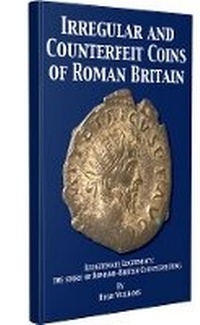
Irregular and Counterfeit Coins of Roman Britain
Illegitimate Legitimacy: The Story of Romano-British Counterfeiting
Published on 9. October 2024
Book
Paperback/Softback
108 pages
978-1-897738-81-8 (ISBN)
Description
By far the most common coins found by metal detectorists are the Romano-British copies of the third and fourth centuries. They are often described as "barbarous radiates" or even more disparagingly as "Roman grots". These little bronze offerings have a charm of their own and deserve more than to be condemned to a metal detectorist's junk box or ignored by numismatists and archaeologists as being unimportant. The purpose of this book is to highlight some of the more interesting copies from Roman Britain and to show that they too tell a story. They form miniature pieces of art made by local British artisans for use by the Romano-British population.
This book aims to illustrate the range of copies found in a way that will be of interest to numismatists, archaeologists, collectors and metal detectorists. I hope that it will foster in the reader an appreciation of an important aspect of the art of Roman Britain, and consign the description "grots" to never ending banishment.
This book aims to illustrate the range of copies found in a way that will be of interest to numismatists, archaeologists, collectors and metal detectorists. I hope that it will foster in the reader an appreciation of an important aspect of the art of Roman Britain, and consign the description "grots" to never ending banishment.
Reviews / Votes
Book Review:Hugh Williams, Irregular and Counterfeit Coins of Roman Britain (2024)
108pp; 197 Figures
Any detectorist who has found large numbers of Roman coins will be well aware that many pieces are unofficial (irregular, counterfeit, contemporary copies) - we have many thousands of such coins on the PAS Database. Irregular Roman coins were produced throughout the period of occupation in Britain and, in this excellent book, Hugh Williams covers the full spectrum, from plated Roman Republican denarii to copies of late Roman silver siliquae. This volume provides an excellent overview of the different periods of forging in Roman Britain, giving the reader a comprehensive coverage of the many types of irregular coins which they are likely to find. No such work has been produced since an article written by George Boon in 1988.
Williams writes in depth about the major periods of forging. In the earlier period, there is much copying of base metal coins in the reigns of Claudius and Nero (AD 41-68), and the production of numerous plated denarii under the Severan emperors of the early 3rd century. Possibly the most common copies are the ubiquitous 'Barbarous Radiates' of c. AD 275-85. Given Williams' deep knowledge of the coinage of Carausius and Allectus (c. AD 286-95/6), he provides a thorough coverage of copying in the reigns of these 'British' emperors.
The final major phases of copying are of various Constantinian nummi in the AD 330s and 340s, the very common irregular FEL TEMP REPARATIO 'falling horseman' pieces of c. AD 353-64 (which can be only a few millimetres in diameter) and the copies of late Roman silver siliquae.
To aid identification of irregular coins, this book is lavishly furnished with many excellent images. This provides a wonderful pictorial overview of the material which is of great help to the reader. Williams is to be congratulated on producing a clear and accessible account of irregular coins in Britain, a volume which will be of enormous help to finders and recorders of Roman coins.
Dr Sam Moorhead
Greenwich, October 2024
More details
Language
English
Place of publication
Witham
United Kingdom
Product notice
A4
Illustrations
Hundreds of colour illustrations
Dimensions
Height: 297 mm
Width: 210 mm
Thickness: 4 mm
Weight
345 gr
ISBN-13
978-1-897738-81-8 (9781897738818)
Copyright in bibliographic data and cover images is held by Nielsen Book Services Limited or by the publishers or by their respective licensors: all rights reserved.
Schweitzer Classification
Person
The Author: Hugh Williams
Hugh Williams has, for nearly fifty years, followed his passionate interest in Roman and Byzantine history specialising in the study of the numismatics of the periods. Although his first degree was in Physics, he subsequently completed research degrees in Chemical Crystallography and Roman Archaeology. He has written a book on the Roman usurper Carausius, and many articles on numismatics. Hugh regularly gives talks on the subject to numismatic and archaeological societies. He is an elected Fellow of the Royal Numismatic Society and of the Society of Antiquaries.
Hugh Williams has, for nearly fifty years, followed his passionate interest in Roman and Byzantine history specialising in the study of the numismatics of the periods. Although his first degree was in Physics, he subsequently completed research degrees in Chemical Crystallography and Roman Archaeology. He has written a book on the Roman usurper Carausius, and many articles on numismatics. Hugh regularly gives talks on the subject to numismatic and archaeological societies. He is an elected Fellow of the Royal Numismatic Society and of the Society of Antiquaries.
Content
Foreward 4
Introduction 8
Chapter One: The First Copying Epidemic 12
Chapter Two: The Inter-Epidemic Years 138-260 21
Chapter Three: The Radiate Epidemic 260-286 27
Chapter Four: The British Empire: Carausius and Allectus 51
Chapter Five: The Early Fourth Century 70
Chapter Six: The Mid-Fourth Century 84
Chapter Seven: The Aftermath 92
Chapter Eight: The Final Decades of Roman Britain 98
Conclusion 103
Bibliography 104
Introduction 8
Chapter One: The First Copying Epidemic 12
Chapter Two: The Inter-Epidemic Years 138-260 21
Chapter Three: The Radiate Epidemic 260-286 27
Chapter Four: The British Empire: Carausius and Allectus 51
Chapter Five: The Early Fourth Century 70
Chapter Six: The Mid-Fourth Century 84
Chapter Seven: The Aftermath 92
Chapter Eight: The Final Decades of Roman Britain 98
Conclusion 103
Bibliography 104